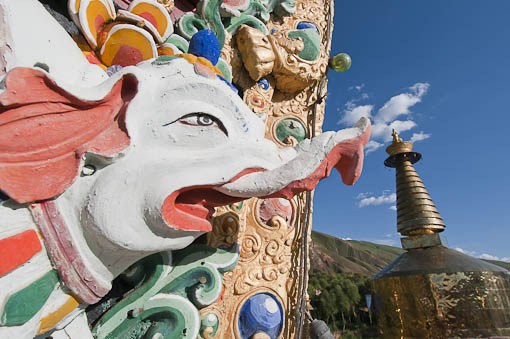
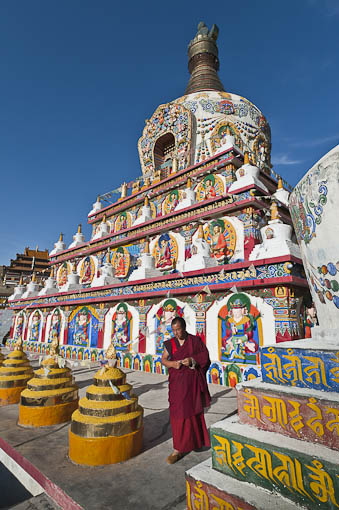
The Stupa of Kalachakra is an amazing technicolor object of veneration, at six stories tall it's a long way from the original simple mounds of mud that are thought to have housed the remains of the Buddha several millennia ago.
A monk of the Tibetan Buddhist Yellow Hat sect carried a large ring of keys yesterday evening as he opened giant red wooden doors at the stupa's base, and led us clockwise up the layer cake of ramps and steps, circumambulating to a tiny chapel housing a multi-armed and multi-headed goddess.
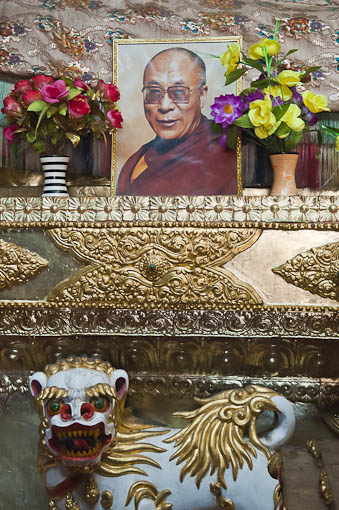
I noticed a small photograph, about 3 by 4 inches, of the Dalai Lama under the goddess, and when we visited several other temples within this large monastery complex near Tongren, I saw the Dalai Lama's portrait on every altar.
His Holiness the 14th Dalai Lama of Tibet's portrait in Temple of Tsongkapa last night.
While in China these past weeks I've noted photographs of His Holiness the 14th Dalai Lama of Tibet in every Tibetan temple, and have wondered if his difficulties (to put it mildly) with the Chinese authorities are somehow thawing in a small way. I've read that visitors should never give his portrait as a gift as possessing one is a serious offense for Chinese citizens.
I've always marveled how China provides an amazing experience around every corner, even those off the beaten track corners that don't exist in any guide book and the only reason you're there is because you turned left instead of right.
Listen to Taoist priest in this 32 second sound file pray, play a silver bell and paddle drum, a large bell rings, and birds chirp in the quiet garden.
Yesterday we decided to turn left and see if a small temple mentioned in town would turn into one of those corners. You bet it was, with chanting Taoist priest, worshipers ringing bells, fascinating art work and animal offerings.
Taoist priest leaves temple, above, while below, fierce looking sculpture of an Immortal looks down on visitors.
Below, animal scull and entrails offering mix with incense smoke in temple courtyard.
While traveling these past weeks in China's northwestern province of Qinghai, I've been meeting many Hui in addition to Tibetans, both among China's officially recognized 56 ethnic groups. Traditionally the Silk Road passed through Qinghai and Gansu, bringing Central Asian influences including the Muslim religion to China.
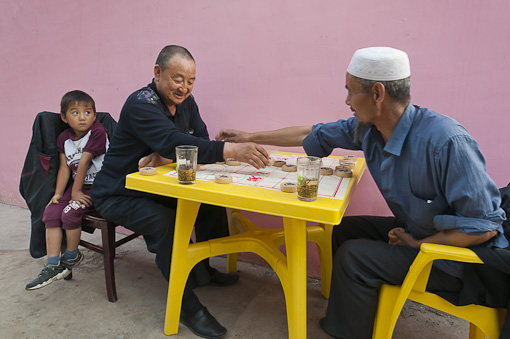
Above a grandson looks on as his grandfather and relative play a board game over tall glasses of herbal tea outside Quilian.
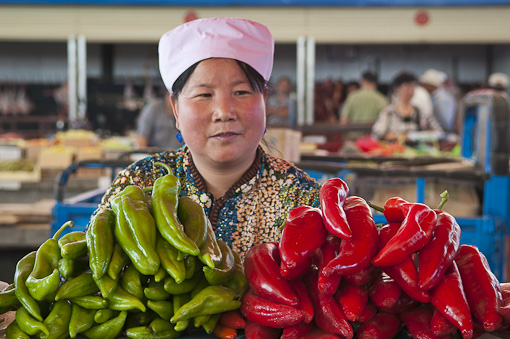
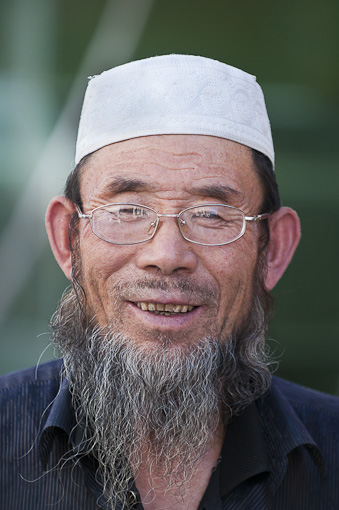
Today I met this Hui woman selling red and green peppers in Guide's market, and this Hui butcher took a break from chopping up mutton to pose for a photograph.
Unlike many other ethnic minorities here, the Hui mostly do not speak their own language and speak Chinese. The Hui are very similar culturally to the Han majority, except they practice Islam and retain their cultural identity through worship and dietary laws.
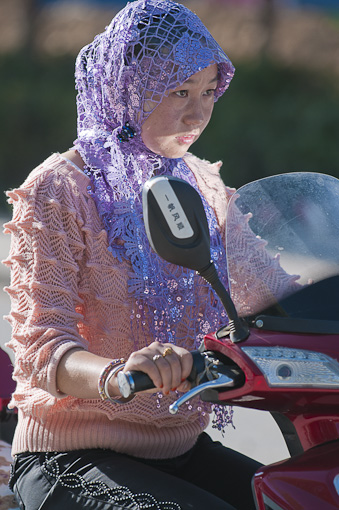
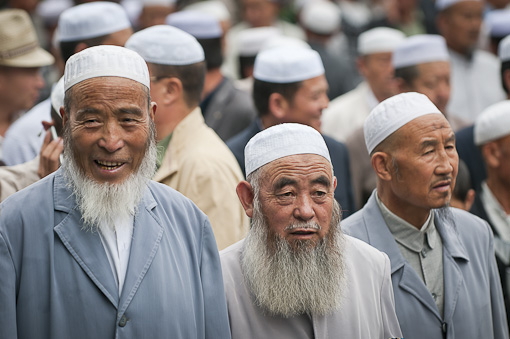
The Muslim influences I've seen are the distinctive caps for men and scarves for women, golden mosque minarets peaking above city skylines, and lots of spicy mutton at meals.
Below, a young Muslim woman rides her scooter to work while wearing a sequend head scarf, photographed yesterday in Wulan.
Today I awoke in Wulan, a small dusty town that could pass for dozens of other Chinese towns I’ve been in ... a wide modern boulevard lined with shops and restaurants, people riding bikes and scooters to work, cooking smells wafting about. No quaint architecture or chic shopping district in Wulan, it sits on the edge of Qinghai’s western desert and is off the main highway.
As often encountered in China the sidewalk I was strolling on was a construction site, no warning barriers of course, just a four foot deep trench where a sewer line was going in. Carrying the bricks and mixing the mortar for support walls were these two women laborers. Posing for me with their protective scarfs lowered, I was impressed with their easy relationship and self confidence.
Heading east, as we entered the Qinghai Nanshan Mountains, the landscape turned to rich green grasslands and we climbed to about 10,000 feet. At this altitude families of Tibetan herders were tending their yaks, sheep and goats and were camping in summer tents.
Just inside the door of one tent I met another very self confident subject, a Tibetan girl about six or seven years old who proudly showed off her festive costume.
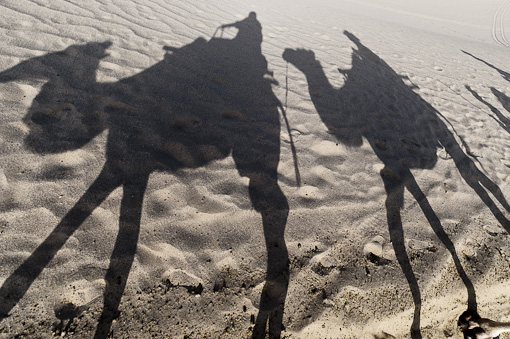
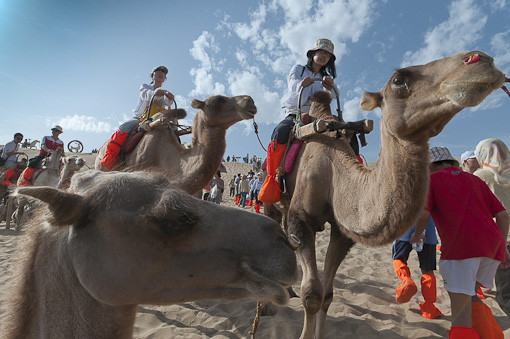
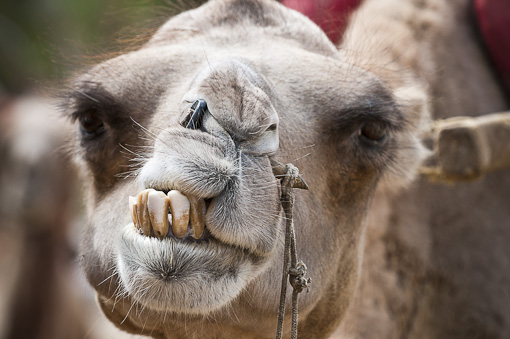
With their prosperity growing along with their world dominating economy, the Chinese are visiting the far corners of their country as tourists, and today it seemed to me that a goodly percentage of this nation of 1.3 billion had descended upon the same sand dune. What makes the scene even more fun are we were all mounted atop lumbering, grumbling camels.
Listen for tinkling camel bells, shouting camel drivers, bellowing beasts and the shouting chaos of a happy tourist crowd in this 32 second sound clip.
I’m visiting the Mingsha Shan Sand Dunes just outside of Dunhuang, a small oasis town in Gansu Province that once prospered as the last stop on the Silk Road. Here the ancient trade route split north and south to skirt the Taklaman Desert. I’ve read that Taklaman roughly translates to “you go in, you don’t go out”.
After leaving Qinghai Province yesterday, we drove west 700 km ( 350 miles ) across Gansu’s stony desert, which must be the bleakest territory I’ve ever seen. And hot, 39 degrees Centigrade, which I really don’t need to convert to Fahrenheit to know it’s crazy to be out in the noon day sun on top of a camel on top of a giant sand dune. But hey, the camels and tourists don’t seem to mind.
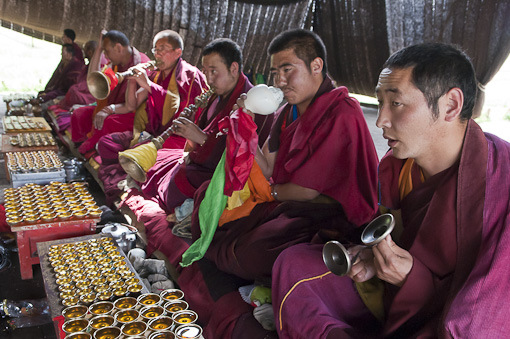
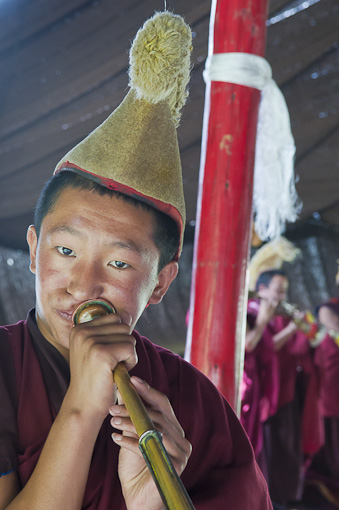
The
crisp staccato of finger cymbals cut through the musical riot emanating
from the monk’s instruments, two high pitched reed horns, a seashell
and the long low blasts from a six foot long bass horn. The chanting
weaved under, over and around the music, the two dozen monks filling
the horse hair tent temple with worshipful sound.
Listen for horns and cymbals in this 36 second audio clip, then brass teacups and chanting.
Today we stopped by a dusty little temple complex situated in the
treeless highlands in far northern Qinghai Province, in China’s
northwest corner, and way in the back the chocolate colored tent was
set up to let warm summer breezes enter through open sides.
While
chanting each monk, of the Tibetan Buddhist yellow hat sect, filled
several dozen brass teacups on a small table, then emptied them, wiped
them dry, and poured tea again.
While kneeling on the ground, one young monk rolled his bass horn
toward my microphone and blasted me, to the amusement of all. Another
pulled a point-n-shoot camera from his robes to snap my photo. I enjoy
the personal touch such small monasteries provide and feel close to a culture very different from mine.
Today I attended a Tibetan heritage festival complete with singing contests, amazing costumes and jewelry, all spread across a green grass meadow dotted with wildflowers. At the top of the hill prayer flags quietly flapped in the breeze.
Off in the distance I could see the town of Haibi, the birth place of China's atom bomb, a very strange juxtaposition indeed.
No story telling today, the long days are catching up with me, and we are off tomorrow to travel away from the capital city of Xining through Qinghai Province and into Gansu Province, all the way west to the silk road. I will post when I have internet access ... what did Marco Polo do without it ?
Today dozens of monks struggled up steep steps carrying the long rolled Thangka. Accompanied by blowing silver horns and clanging cymbals, hundreds of pilgrims struggled to touch the giant embroidery. Once unrolled and it’s yellow silk protective cover removed, a magnificent Buddha covered the entire hillside.
Once a year this beautiful embroidery Buddha is given sunshine at the Kumbum Monastery of the Tibetan Buddhism yellow hat sect, and is the centerpiece for an elaborate devotional service. With incense burning, pilgrims throw scarves, paper prayers and money onto the Thangka, which is then rolled back up hill by dozens of shouting young monks.
As the Qinghai Photography Festival winds down this weekend colleague Nancy Brown and I had the option of visiting a Tibetan cultural museum, or break away to follow up a tip we received several days ago chatting with a Chinese student practicing English on us. I’m glad we skipped the museum.
Today I visited one of the six great monasteries of the Yellow Hat sect of Tibetan Buddhism again, as did thousands upon thousands of Tibetan pilgrims, Chinese tourists, and several hundred photographers attending the Qinghai Photography Festival.
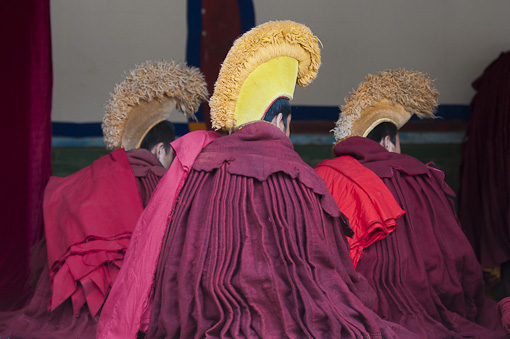
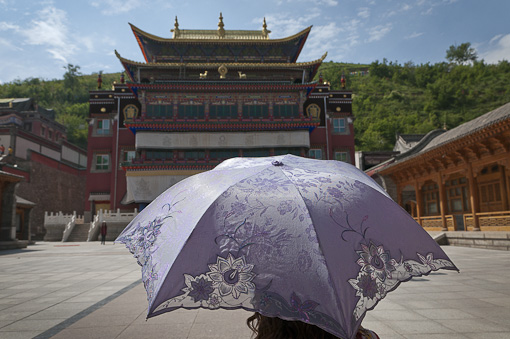
But in spite of the multitude I was struck by two things: 1) the monk’s daily routine and worship probably haven’t changed for centuries, such as these three wearing their distinctive yellow hats and pleated crimson robes, and 2) Chinese ladies are capable of wearing six inch heels to climb stone temple steps and simultaneously carry dainty lace parasols for sun protection.
Dong Guan Grand Mosque, Xining, Qinghai Province, China:
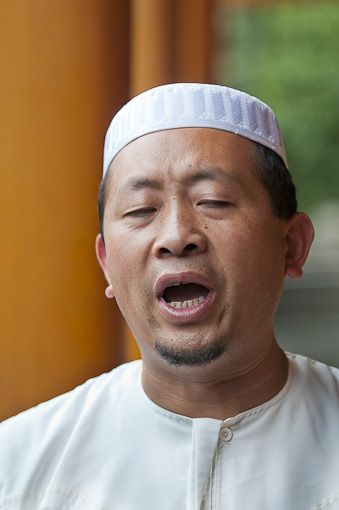
Thousands of men were streaming from the mosque onto busy Dongguan Street after Friday afternoon prayers, greeting friends with warm handshakes and stopping to chat. Most had beards and wore embroidered white caps, and ranged from young teen boys through middle age and beyond.
58 second audio clip of the Muslim call to prayer recorded today:
I was visiting the Dong Guan Grand Mosque in Xining, capital of Qinghai Province where several hundred thousand Chinese pilgrims worship during Ramadan. Qinghai has a large Muslim population as historically Central Asian influences have infused this northwestern corner of China since the ninth century.
Visitors are encouraged to enter the mosque’s surrounding grounds, and Chinese tourists in small groups were being shown around by men who were explaining the tenets of Islam. They spoke at great length with strong voices and obvious conviction, answering the occasional question. I speak no Chinese, but the word Mohammed came through loud and clear, as did their calls to prayer.
Mo Jiajie Market, Xining, Qinghai Province, China:
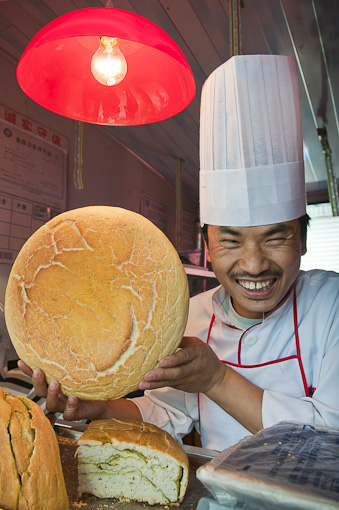
I was busying myself photographing the usual suspects, pigs feet, live fish, delicious looking fresh vegetables stacked chin high in the stalls when the young baker beckoned me over to show off his beautifully baked round bread just out of the oven. We didn’t need to speak each other’s language to see the pride in his eyes. He wanted me to take his photograph, which I did, sharing the results with him on the camera’s screen.
I was walking through the Mo Jiajie Market in the center of busy Xining, the capital of Qinghai Province, nestled up against Tibet and Sichuan and Gansu. I hope to blog a photo or two and several paragraphs every day I have internet access.
Further down the street I saw a large crowd gathered outside a music store, the laughter rolling out and into the market. It was coming from the shoppers and the television set outside on the steps playing a comedy show. Everyone was transfixed with smiles on their faces.
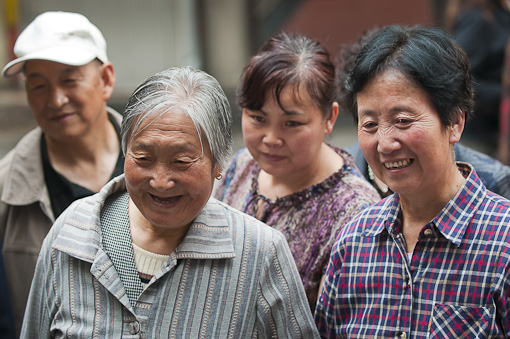
I quietly slid through the crowd and up and into the store to shoot out of sight as if in a duck blind. No need really, the crowd didn’t notice me until much later and then the two ladies pictured wanted to see their photos. They seemed pleased, they giggled and pinched my cheek before walking down the street. I wonder if they bought the pigs feet.
The young monk must of been about 12 years old, and after a half dozen prostrations on the ground, he would stand back up, wipe the sweat off his face, and look around at the hundreds of Chinese tourists thronging past the steps of the temple in the pounding rain. About a minute of rest, down to his knees, hands on two cloths, he would face downward and push off until he was lying flat on the ground in complete reverence, only to pull back to his knees a moment later and repeat.
I couldn’t help thinking about the 12-year-olds living in my Miami neighborhood, what they would be doing on this same July morning ... playing with a GameBoy if raining, riding bikes or taking tennis lessons? A long way from this Yellow Hat sect monastery of Tibetan Buddhism about a half hour outside of Xining, the capital of Qinghai. A sparsely populated province with only about 6 million of China’s 1.3 billion people. Qinghai is sandwiched between Tibet to the west, Gansu to the north, and Sichuan to the south.
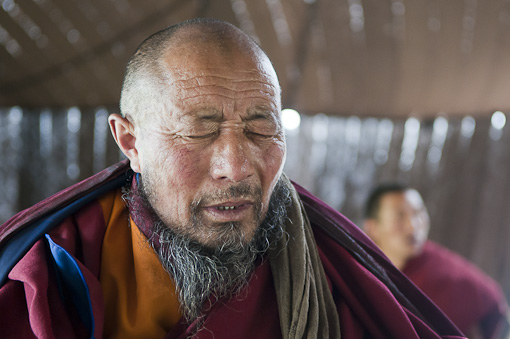
On the other end of the temple platform was a monk several generations older than the young boy, so old he could only sit on the stone step and slip into his own thoughts. I wondered how many prostration prayers he made when younger.
I’ll be spending about three weeks traveling here - attending a photography festival, judging a photo contest and exploring - and will try to post a photo or two along with a paragraph or two every day I have internet service.
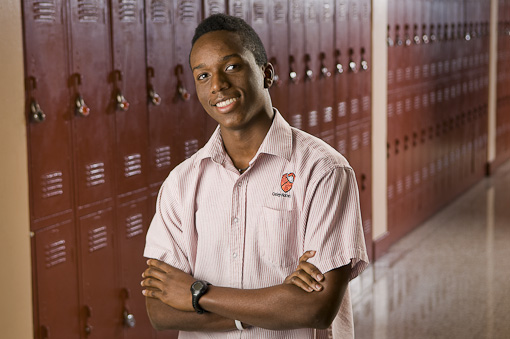
When I began my audio interview of high school senior Rhod for the fourth “There’s A School For That” multimedia show, I really had no idea what the football quarterback and standout basketball player would be saying. Would I get enough good quotes for a two minute audio slide show? Would it be all about himself? Any insights into how his school shaped him? ( iPad compatible version. )
Let see, what do you think?
- “Coach Magner is everywhere really ... if you are a new student, even if you don’t look like an athlete ... he will get you out to play a sport and he will work you as if your the greatest athlete in the world, and make you be the athlete you didn’t think you could ever be.”
- “Coach says something like this ‘you gotta get your work done across the street to be able to play over the other side of the street, you have to have the grades to play.’ ”
- “Coach Magner defines me as cool head and warm feet, because when I’m under pressure I never blink twice or look to do something else. My first decision is always the one I take because I’m the definition of cool head and warm feet.”
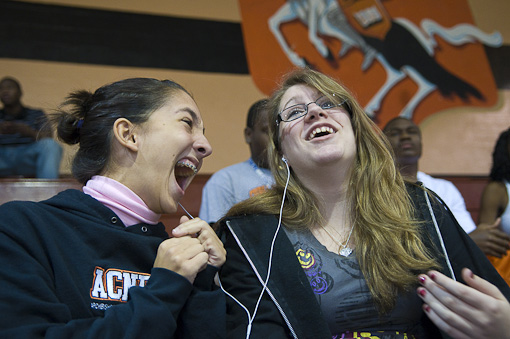
Going into each of the six student interviews at Archbishop Curley Notre Dame ( a 300-some student college prep in Miami’s Little Haiti neighborhood ) Public Relations Coordinator Katherine Doble told me in general terms each subject’s area of accomplishments - athletics, leadership, academics - but we had no predetermined script.
Rhod just started talking about athletic director and coach Greg Magner, so Coach became the show’s focus.
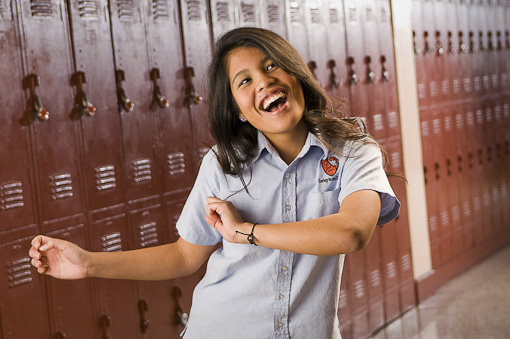
Freshman Silvia had only been in high school a few weeks and hadn’t experienced much yet. But when during her interview she came out with
- “And so far every morning when I come to this school I have a smile on my face, and everyone notices it, and I’m happy when I come”
we knew we had the theme for her show.
Who needed a script when, while I was recording ambient sound in the weight room, I picked up Coach Magner saying over the noise
- “Just show up to work just like your parents do every day, and you’re become successful. ”
I wasn’t even interviewing him, but I used the sound clip as a transitional bridge.
Of course working without a script creates a lot of extra hours in front of the computer editing sentences that sometimes make no sense, thoughts that trail off to nowhere, scrambled grammar. But hey, they're high schoolers, not college professors, and the unscripted gems are worth the effort.
You may now view this show on your iPad or iPhone with OS4, thanks to Sound Slides current beta. Due to Apple’s spat with Adobe, iPad/Phone owners are unable to view content Flash content, which all of my slide shows on this blog are. But now I’m able to post HTML5 versions that auto detect the cool Apple devices. Maybe my blog is the beginning of that print-magazine-to-electronic-reader revolution we are all hearing about ?
I knew from the start of story boarding I wanted to feature environmental
portraiture
in the recently completed six part “There’s A School For That” multimedia series. Unique
portraits around school would introduce each featured student, book ending candid photography making up story center with final portraits shot along a locker lined hallway, each student
posed in that same location.
Leading each audio slide show with students looking at camera, I hoped to immediately establish a connection with the young eighth graders who might be considering Miami’s Archbishop Curley Notre Dame. Plus the environment and activities would say “high school is interesting sweet".
Environmental portraits are a lot of fun, as I have an opportunity to create one photograph that tells
the whole story about my subject, show their personality, place them in their environment, each item
I include adds to their story. This lead portrait must grab you as the show opens, while variations changing every few seconds hold your attention.
With Michael, a junior who enjoys math, I was faced with two
challenges: 1) come up with an interesting visual concept that says
“math” and 2) find an environment that contributes to the story telling.
In his case the concept also became the environment, and a simple two light setup would pull it off.
After scratching my head for a few minutes, no really, after a week of weighing options, I decided to flat bed scan pages from Michael’s Pre-Calculus notebook, projecting the formulas complete with blue grid lines onto a classroom wall. I placed him in the beam of the LCD digital projector and added one flash head with a very tight 3 degree grid spot aimed at just his face. A short time exposure held the projection,
which became both fill and main light, with the gridded flash exposed about one and
one-third stop over that drew attention to his face and darkened the environment.
I also used environmental portraiture to wrap each show and visually tie all six together.
Each interview ends with the student emphasizing why they enjoy ACND and/or who inspired them, and concluding “There’s A School For That”, while their lockers-and-hallway portrait holds on screen.
The same slogan and hallway location form a common thread through all six shows.
At the end of Michael’s interview he says “ If you want a school where your friends push you to succeed just as much as your teachers, there’s a school for that, Archbishop Curley Notre Dame".
Credit for the slogan must go to Public Relations Coordinator Katherine Doble and Principal Brother Sean Moffett.
Hopefully the use of environmental portraiture tells the school's unique
story while holding viewers attention from beginning to end. If so,
that would be really cool sweet.
Yesterday I was preparing a collection of panoramic landscape photographs to be exhibited in July at the Qinghai Sanjiangyuan International Photo Festival in China, and while rescanning some of my favorite large format film images I compared them at pixel level to my recent panoramas stitched in software from multiple digital captures.
Rocky Mountains at Lake St. Mary, Glacier National Park, Montana, captured on 617 format film ( 2 inches tall by 7 inches wide ), large format view camera.
I had forgotten about film grain! Slow speed digital doesn't have any. Film horizons are straight lines! Rotating a digital sensor in a circle for a stitch curves the horizon and you need to hide the distortion. Light table viewing of film with 4X loupe misses seeing tiny cars parked a mile across mountain lake! Processing digital on a giant computer monitor you see all the flaws.
But I quickly stopped pixel peeping and was transported back to those outdoor locations to soak in the beauty I experienced when the shutter clicked, and realized it really didn’t matter if I was capturing my small slice of the world with a piece of film or a digital sensor.
Pretty obvious really, the story, emotion and sense of place in the photograph is what matters.
Hammock
filled with and bald cypress and air plants, Everglades National Park,
Florida, 220 degree digital assembly.
I can’t say which panorama making technique I like the best. With film, I have to slow down, think and be deliberate, as it requires setting up a heavy tripod, assembling the view camera rails and bellows, then attaching a lens. This makes me choose my subject carefully.
Under a dark cloth, I view the image upside down, so the scene becomes abstract, helping me balance my composition. I then remove the cloth, insert a preloaded magazine, and have four shots on one roll of film. Oh, exposing color transparency film is tricky. And nerve wracking, each frame costs the equivalent of a small cheese burger.
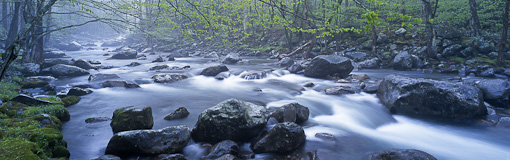
Spring mist
rising on Roaring Fork, Great Smoky Mountain National Park, Tennessee,
617 format film.
With digital, I quickly set my Nikon vertically in a special rig that allows me to swing around the lens nodal point, and I can zoom to compose precisely. My “35mm” lenses allow me to get into tighter spaces and see higher and wider. Long time exposures are linear as opposed to film, so no reciprocity failure to calculate in, and the camera processes out the noise. And with digital capture being “free” ( not counting the massive investment in upgrading cameras, computers and software ), I save a lot of cheeseburgers. Yum.
Maybe creating panoramas with digital cameras is quicker and easier. Yet film is more contemplative and precise. So I’ll just pick the tool that works best for my subject and creative ends.
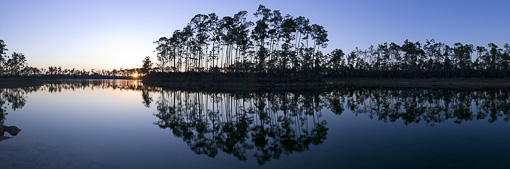
Sun setting in endangered pine woods, Everglades National Park, Florida, 170 degree digital assembly.
I'm looking forward to visiting Qinghai, one of China’s least populated provinces with not quite six million people ( out of 1.2 billion ), and it’s nestled up against Tibet to the West. I’ll be traveling with colleagues Nancy Brown of Boca Raton and Tania D’Avigon of Boston, both have also been to China multiple times, and we will drink a toast or two with our Chinese friends from previous trips.
The photo festival has invited many “foreign photographer friends” to attend and exhibit, including our American Society of Media Photographers South Florida chapter, which has sent their Light of Florida photography collection.
If you are interested in seeing the panoramic cameras used for these photos, I’ve posted a little more information on my Miami panoramic photography portfolio site.
Do you ever hear an old song on the radio that immediately takes you back to your past? Maybe that wonderful summer after graduating high school, driving the back country roads of rural Idaho with your arm around Gloria, the girlfriend soon to be left behind on the way to college in the fall ?
I’m not a psychologist and can’t explain why music imprints into our brains, but I do know that sounds tap a deep emotional response in me. Just like that summer song triggering an old story, when I hear croaking frogs, I feel a rain forest in my head. When I hear wailing sirens, I’m surrounded by oppressive big city traffic. The Tibetan monk’s cymbal reverberating in my headphones, I smell yak butter tea.
Recording ambient sound is one of my favorite parts of multimedia, and for the second audio slide show I produced for Archbishop Curley Notre Dame High School’s “There’s A School For That” campaign, I had a lot of fun with sound.
What better way to trigger those high school emotions than recording the clanging class change bell and hallway voices. I lead the show with about seven seconds of only ambient hallway sound, then duck under her interview, leaving levels high enough to still hear the banging lockers and squeaking sneakers.
Here the ambient sound first catches your attention and draws you into the story, and before Silvia’s interview begins, hopefully you’re hooked. Then the sound bed drives the narrative along. Between Silvia’s thoughts, ambient sound levels rise, taking over the story telling, like at the basketball game where you hear the coach and players huddle, and the referee’s whistle.
Just like real life, our brains don’t concentrate on that sound bed, but we feel the sound, we see the the sweaty players, we know we’re in the high school gym.
As the show winds up, the sound of frying french fries comes in strong before Silvia beings her story of her older sister asking if Curley still serves the fries she loved. The bubbling of the cafeteria deep fryer catches and holds your attention, and as the sound bed ducks under, I can taste those same fries that she is talking about. ( Good fries, BTW, I tried and liked them, though maybe the accompanying cheese burger clouded my judgment ...)
I love the complex layers of interview voice blending and threading around and over and behind the background sounds of life in a vibrant high school. I decided to run a sound bed under the entire length of each of the “There’s A School For That” multimedia shows because, well, I love ambient sound. It tells me stories, triggers my emotions and just like that old song on the radio, makes my life a whole lot richer.