Showing posts with label Tibet. Show all posts

Tuesday, October 23, 2012

Sounds Overheard: Chants At Rebuilt Monastery


Incense wafts on late afternoon sunlight at Reting Monastery North of Lhasa, Tibet. 

The Reting Monastery’s 11th century walls were freshly painted bright white, deep orange and dusty red. Gilded deities kept an eye on me from their perches atop cracked timbers supporting the roof. I felt I could reach up to touch the brilliant blue sky, as I was standing extra close at over 13, 000 feet. It was completely quiet. No breeze rustled the fall leaves, no birds chirped, no footsteps distracted me.


Listen to 1:22 recording of two Tibetan Buddhist monks chanting and playing drum and cymbals. Try headphones to hear stereo effect. iPhone & iPad link.

Suddenly two young monks rushed across the temple courtyard and disappeared through a narrow stone doorway, their red robes a quick flash of color. Soon a loud drum shattered the silence, boom, boom, boom. Then brass cymbals crashed. I followed the rhythm through the doorway and into a narrow room, a sliver of stony space with candle soot blackened walls rising two stories to an open window high above. 

The two monks began chanting in Tibetan, rapid fire fast, their voices drawn up and out the window and over the hillside temple complex, calling their brother Buddhist monks to evening prayers.

During China’s chaotic Cultural Revolution, this magnificent monastery North of Tibet’s capital Lhasa was nearly destroyed, stones and timbers torn down and salvaged for building projects, it’s monks harassed and disbanded. Since Reform and Opening of the late 1970’s, China has slowly become an economic power house tolerant of religion and money making, as long as the Communist Party is not threatened. Government and private funds are rebuilding many cultural sites, and Reting’s former splendor is slowly rising from the large piles of rubble awaiting rebirth.

During my assignments and travels I've been recording the sounds I overhear, and many don't have supporting photographs or stories. This occasional series will be my excuse to share my audio orphans, these Sounds Overheard. Please also visit my Miami commercial photography portfolio.

Thursday, August 9, 2012

Sounds Overheard: Seeing Tibet With Closed Eyes

Pilgrims worship at the Jokhang Temple, Tibetan Buddhism's holiest site.

Exploring Lhasa on my first day in Tibet was so overwhelming that I was having trouble seeing photographs. Crowds of Buddhist pilgrims dressed in regional costumes streamed down every street, Han Chinese merchants in Barkhor Square sold everything from prayer wheels to yak butter and the occupying Chinese army marched with assault rifles at the ready.

I was gasping in the thin air at 12,000 feet altitude. My stomach was deciding if it liked my yak stew lunch. Colors were way to saturated, the blue sky, the monk’s saffron robes and the rooftop golden lambs.

So I closed my eyes and started listening for pictures.


Close your eyes, listen to the sounds around the Jokhang Temple in Lhasa, and tell me what you see. iPhone & iPad link to 1:48 long MP3.

The first sound I heard was a far off rhythmic slapping and chanting.  I discovered over a dozen workers, men and women, building a traditional aga earthen roof atop the Jokhang Temple. They were on their hands and knees with hand held wooden paddles compacting the mix of gravel, dirt and water infused with willow tree bark.

I recorded the sound of wooden and leather hand protectors scraping on the cobble stone temple square as the pilgrims prostrated them selves in repetitive prayer. They stood with their hands together above their heads, then down on their knees, then on their stomachs with arms out stretched.

My ears discovered a man singing prayers from a well worn book of Tibetan script, his voice competing with the thousands of pilgrims circumambulating the mile-long circuit around the temple.

Slowly the sounds awakened the visual corners of my brain, I opened my eyes  and began making photographs.

Editors note: If you visit the "aga earthen roof" link above, poke around the site a little and see how the Chinese government views the Tibetan people.

During my assignments and travels I've been recording the sounds I overhear, and many don't have supporting photographs or stories. This occasional series will be my excuse to share my audio orphans, these Sounds Overheard. Please also visit my Miami editorial photographer portfolio.

Friday, May 18, 2012

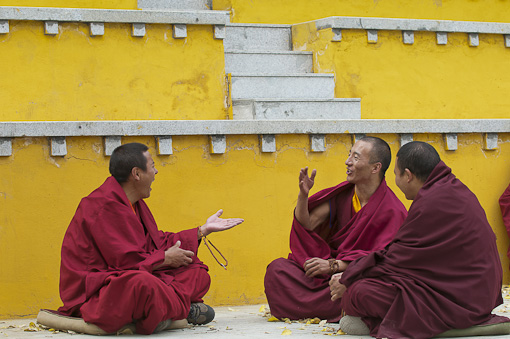
Sounds Overheard: Tibetan Monks' Spirited Debate

Spirited debate between Tibetan Buddhist monks at the Drigung Thel Monastery, Lhasa.

While traveling in Tibet last October, Tibetan Buddhist monasteries were not only locations to create some great photographs, but were also sources of terrific natural sound.

Today's post is short and sweet, three photos of debating monks from three monasteries, and a short recording of natural sound from one of them.

Listen to this 1:13 field-recorded natural sound of Tibetan Buddhist monks debating at the Sera Monastery.  iPhone & iPad friendly version.


Monk debates at the Sera Monastery, Lhasa.

From an earlier post on this blog, a little background on the debates:
Debate is an important part of a Tibetan monk's training, and is said to help expand the mind, increase mental sharpness, develop analytical skills and help gain mental clarity. The debates follow a strict form, with the standing questioner challenging the thesis of the humbly sitting defender. As the questioner raises doubts, the exchange becomes increasingly animated, with exaggerated body language, lunging, hand slapping and loud shouting. The defender mostly sits quietly and looks away, occasionally making a counter point by waving his arm.
As one monk, left, encourages the defender, right, the challenger, center, claps and lunges to make his point at the Reting Monastery.

During my assignments and travels I've been recording the sounds I overhear, and many don't have supporting photographs or stories. This occasional series will be my excuse to share my audio orphans, these Sounds Overheard. Please also visit my Miami commercial photography portfolio.

Wednesday, January 18, 2012

Sounds Overheard: Yaks & Pilgrims Ring Bells

Moving shaft of sunlight warms young Buddhist Tibetan Monk studying at temple entrance, Thasilhunpo Monastery, Shigatse, Tibet.

Traveling requires all of your senses to fully experience your surroundings, whether they are in exotic Tibet or some place closer to home, like the dusty strip of sprawling gas stations, fast food joints and mini marts you've stumbled upon after getting off the interstate highway.


Listen to one minute recording as birds chirp and large brass temple bell rings, then to nomad yak herders in outdoor market shopping for bells to hang around their livestock. 


Stand still for a moment in front of that mini mart and listen ... traffic and horns assault you, sure. Wait a moment, between traffic lights, those little chirping birds, probably sparrows, hopping around the trash filled hedge. Gee, they are pretty sounding. Hear the salsa music wafting out of that bodega over there, that sound adds some more color. A nice gentle breeze rustles the tree leaves above your head, a bossy black crow barks down from atop the power pole.

Listening to the details, sometimes loud, sometimes subtle, makes this place, this very moment in time, much richer to you. OK, I know, the light has changed and this spot is getting just plain loud, so lets relocate to Tibet. Poof!

Now we're standing under a foot tall brass bell, green with age, hanging from colorful braided cords from the hand hewn rafters of one of the Tibetan Buddhist temples in the Thasilhunpo Monastery. Founded in 1447 in Shigatse, Tibet's second largest city, the monastery is both very quiet and very full of sound. Pilgrims jump with outreached finger tips to ring the bell hanging just out of reach, rich tones reverberating and fading into background sound of happy birds chirping in the sunny courtyard.

An hour later we're visiting the outdoor market in busy downtown Shigatse, and are eavesdropping on two men dressed with red cloth braided into their long hair, silver jewelry around their necks and on their fingers, staying warm in sheep skin jackets.They are test ringing inexpensive bells to hang around the necks of their livestock, some as big as their fists for yaks, some walnut sized for sheep.

Listening carefully can enrich our travel experiences no matter where we are. Now let me decide, do I stay in Tibet, or Poof, I teleport back and dig into a lime green Double Big Gulp at the mini mart?

During my assignments and travels I've been recording the sounds I overhear, and many don't have supporting photographs or stories. This occasional series will be my excuse to share my audio orphans, these Sounds Overheard.  

More stories from Tibet are elsewhere on this blog, and more examples of field-recorded natural sound are at my Miami multimedia production portfolio site.

Friday, December 16, 2011

Sounds Overheard: Incantations Of Tibeten Nuns

Buddhist nuns wear elaborate head dresses while chanting last October in Lhasa, Tibet.

While visiting the Anezamkang nunnery in Lhasa I was reminded of the nugget of video production wisdom that goes "seventy five percent of what you see is what you hear".
 
Do you "see" more when you play 1' 15" natural sound recording of nuns chanting?

I must admit I was in a heck of an visually exotic spot, inside a tiny Tibetan Buddhist temple draped ceiling to floor with colorful banners, filled with three dozen nuns wearing elaborately embroidered robes and hammered silver-paneled hats topped with tall turbans. The nunnery was hidden down a tiny stone alley in Lhasa's ancient Tibetan quarter, out of sight of the Chinese army troops patroling with automatic weapons a few blocks away. I was gasping in the thin air at 12, 000 feet, and contentedly digesting a meal of yak noodle soup.

But listen to the above field-recording audio file of the nuns singing and chanting, ringing brass bells and swinging small paddle drums, and tell me how exotic the scene feels to you now ... seventy five percent better? I would say the experience is immeasurably more intense and real.

During my assignments and travels I've been recording the sounds I overhear, and many don't have supporting photographs or stories. This occasional series will be my excuse to share my audio orphans, these Sounds Overheard.  

More stories from Tibet are elsewhere on this blog, and more examples of field-recorded natural sound are at my Miami multimedia production portfolio site.

Wednesday, November 16, 2011

Sounds Overheard: Tibetan Lute Melody And Song

Musical detail from Buddhist temple wall painting, Reting Monastery, Tibet.

The singer's soulful voice cut through the noisy traffic, his fingers racing over the strings of his lute-like instrument while pilgrims flowed through the gates of the Dreprung Monastery on the outskirts of Lhasa.

His voice was rather raspy, yet melodic, and blended well with the tune he produced from his worn dramyin, a traditional Himalayan folk music lute common in Tibet.  Sitting cross legged on the ground, he was accepting offerings of small Chinese currency, many Fen, worth a couple of pennies each, with a few one and five Yuan notes in his collection box, valued at a couple of dimes.


Listen to natural sound recording of street performer singing folk song and playing a seven stringed dramyin. 1 minute 23 seconds. 


Last month while traveling in Tibet I encountered several such minstrels, who carry on the Tibetan tradition of oral story telling through song, with dramyins often accompanying their narratives. While in the field I simply enjoyed the music and ambiance of the the ancient temple setting, but upon my return Wikipedia's technical description of the Tibetan lute helped explain what I was hearing.

The dramyin is a long-necked, double-waisted and fretless lute. It is usually hollowed out of a single piece of wood and can vary in size from 60 cm to 120 cm in length (2 to 4 feet). Unlike a contemporary guitar, the dramyin does not have a round sound hole in the wooden sounding board but rather a rosette-shaped ones like a lute. Of its seven strings, only six continue to the pegbox. The seven strings occur in two double courses, and one triple course.

The triple course of the dramyin typically contains the half string on the left, which is usually tuned an octave above the middle unison strings. One of the other two courses are typically tuned an octave apart. The courses are normally plucked in unison during playing. Typically a single note is played at a time, making for melodic music and not harmony. 
During my assignments and travels I've been recording the sounds I overhear, and many don't have supporting photographs or stories. This occasional series will be my excuse to share my audio orphans, these Sounds Overheard.  More examples of journalistic photography from China can be viewed at my Miami corporate photography site.

Thursday, October 27, 2011

Pilgrims Inch Along Ground 300 Miles To Lhasa

Tibet, People's Republic of China:

We were traveling along a rutted dirt road down the Riteng Zang valley, framed on both sides by distant blue mountains, with a silver river reflecting the sun about a mile off. The October dry season had parched the hills a deep brown, the grass even browner, as dust rose from the pilgrim's full-body prostrations as they inched along the ground toward Lhasa.
 
Pilgrim inches his way 300 miles to Lhasa making full-body prostrations.

The six pilgrims would take two steps, about one body length,  drop to their knees, then both hands, protected by wooden and metal paddles, would touch the dirt as they slid down fully onto their stomachs. Forehead tapping the ground, their hands would swing an arch in front of them in the dirt. Stand up, take two steps, down on the ground as they maneuvered through the rocky terrain.

For these six pilgrims,  young men and women mostly in their teens and early twenty's, they had been traveling this way toward Lhasa for the past four months, covering about 150 miles so far. Four more months will be required to complete the final 150 miles, where they will eventually circumambulate the Jokhor, Tibet's holiest temple and monastery.


Pilgrim protects hands with wooden paddles, and wears thick canvas apron with padding that hangs down to his ankles.

Throughout Tibet you see such pilgrims along side the roads and highways, and where terrain does not allow it, they are on the paved roadway where trucks and cars quiz by at high speed. Depending upon terrain, weather and their stamina, they can cover around six miles a day. This group of pilgrims had an advance truck festooned with giant prayer flags carrying their  food and camping gear. Other groups pull a small two wheel cart along with their earthly processions.

Leaving their  home lands in the far reaches of Tibet, pilgrim groups often pass through two mountain passes on the way to Lhasa, the Sera Gola and the Kana, both about 15, 000 feet in altitude. Winter weather drops temperatures to double digits below zero.

Pilgrims are drawn to countless sacred locations in Tibet,  special lakes, mountains, caves and temples, and groups traveling together toward Lhasa will visit as many destinations as possible along the way. They perform a kora or circumambulation of the devotional location, leave offerings of yak butter and paper currency, chant mantras and ask for blessings from the monks.

In Tibet a pilgrimage is not as simple as walking toward your sacred destination. It is considered a great privilege to complete a pilgrimage through full-body prostrations, which focuses your concentration to every step taken, every mantra repeated.

To view more examples of journalistic photography from China, please visit my Miami commercial photography portfolio site.

Monday, October 24, 2011

Tibetan Hospitality In Nun's Cave & Monk's Cell

Tibet, People’s Republic of China

Tibetan Buddhist nun Lousan Drlma has lived in a cave for twenty years just outside the main gate of the Drepung Monastery on the outskirts of Lhasa, and seems to be very content with her way of life. After walking up the dusty road this week, I entered her modest domain through a wooden gate set in a short stone wall. Outside the tiny wooden door into her cave, we sat on low couches covered with Tibetan rugs, where I was offered tea and a round dry bread.


Buddhist nun Lousan Drlma at entrance to cave where she has lived for 20 years.

Our conversation was limited, as my only Tibetan consists of “hello” and “thank you”, so pretty quickly she gave me a tour of her cave. It was about 20 feet wide and 12 deep, lit by one tiny light bulb, which revealed a ceiling long ago blackened by yak butter candle smoke. The walls were decorated with photographs of prominent monks, prayer shawls hung everywhere and low tables supported small shrines. The cave front was closed off with a cement wall.

The next day I met Tibetan Buddhist monk Sherab Juine, who at age 18 was born after Lousan Drlma began living in her cave. We had traveled north of Lhasa to turquoise blue Namtso Lake, which lies at 14,000 feet in the bleak Tibetan plateau. The small Sangr Gompa Monastery sits above the lake, and it’s tiny temple is built into a tall cave in the rock bluff . The two dozen or so monks are easily accommodated on two long benches under the smoky black rock ceiling.


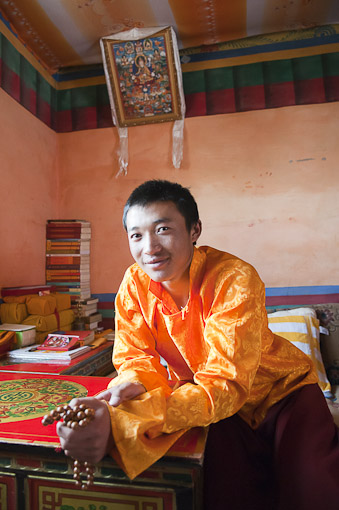
Buddhist monk Sherab Juine, 18, in his private monastery room.

Sherab Juine was in the temple where he seemed to be giving his friend on solo chanting and drumming duty a little boyish teasing. With a big smile he invited us into his private room, brightly painted with the most amazingly bright yellows and oranges. Once again tea was offered,  and we warmed ourselves by his stove as he fed the fire with dried yack dung.

After showing us his prized collection of books stacked in the corner, he wanted to take some photos with one of our cameras. The latest digital SLR was putty in his hands, as he knew how to focus, shoot and review images like a pro. After making  his portrait, he insisted on posing with each of us, sitting together on his bunk.

I have looked forward to such unplanned encounters as I travel in Tibet these past weeks, and appreciate the warm interactions that make traveling so special. And a steaming hot yak dung stove is a lovely bonus on a cold day.

To view more examples of journalistic photography from China, please visit my Miami commercial photography portfolio site. 

Friday, October 21, 2011

Yak Chow Mein & Tibetan Speed Traps

Lhasa, Tibet, People's Republic of China:

You can't travel anywhere in Tibet without encountering a yak, either standing in the middle of the road thinking it belongs there, or on your plate for dinner in some combination you never considered trying before.

Yaks cross the shallow Yangva Chu river north of Lhasa earlier this week.

Today's highway cruising yaks are domesticated from wild yaks, once numbering more than a million and populating the high Tibetan plateau., and now very rare. The domestic ones crazing in the river valleys and high up mountain sides  could also be dzo, a cross between a yak and a cow. I frankly can't tell a dzo from a yak, although I'm pretty sure I know a Tibetan cow when I see one. 

White yaks are rare, and considered very good luck, while seeing a herd all of one color is a bad omen. I couldn't tell if our Toyota Land Cruiser driver considered the lumbering beasts lucky or bad omens as they blocked our progress this week from Lhasa north to Namsto Lake. The way the long haired beasts stood their ground as the Toyota barreled down on them, I was starting to consider them bad omens. 

No worry,  every time the yaks moved, finally, seeming to wave their horns defiantly. 
The wooly little calves love to scamper at full tilt right past the bumper, and are awfully cute.

Cute or not, yak makes it way into a lot of Tibetan cooking. 

Yak-butter tea is a staple of the Tibetan diet, mixing yak butter with salt, milk, soda and tea leaves. One guide book describes the drink as "unlikely to be a highlight of your trip". One member of our party concurs with that assessment of the  thick yellowish liquid . But I've eaten strips of yak added to thugpa, a piping hot vegetable noodle soup, and ground with spices and stuffed into momos, a steamed or fried dumpling, both wonderful. We've also enjoyed a savory and thick yak steak (a bit chewy), and very spicy yak curry (excellent). All in all, very beefy tasting.

The Lhasa Kitchen caters to Tibetans and foreigners, and offers yak burgers, yak stroganoff, yak pizza, and of course, yak chow mien. Wouldn't any self respecting citizen of the USA look forward to flying over 10,000 miles from Minneapolis to Tibet just to dig into a hot steaming plate of yak chow mien. Hey, wasn't chow mien invented by the American food and the advertising industry, and is not native to the Orient?

And You Thought You Hated Traffic Intersection Cameras 

Life size fiberglass policemen in full uniform have been standing alongside the highways we've been traveling outside of Lhasa, holding speed limit paddles in their white gloved hands. Often mischievous individuals have drawn mustaches and cat whiskers upon their stern faces. The always-on-duty cops warn drivers to slow down at dangerous curves, slow down on the straightaway, slow down when you are passing over a double yellow line going uphill around a blind curve going over a 15,000 foot mountain pass.

Life size fiberglass policeman  keeps it's eyes peeled for speeders on the La Gen La Pass north of Lhasa this week.

Apparently the vigilant fiberglass fuzz have not been effective enough, as the Chinese government has instituted throughout Tibet their special twist on getting motorists to drive safely and within legal speed limits.

Regular police check points require private drivers, chauffeurs and truckers to pull over, park, walk up to a booth, show their national identification card and license, and receive a time stamped permit to proceed. You must not reach the next checkpoint before your stamped time, or you will be forced to pay 100 Yuan (US$16.00) fine per minute. Cash, on the barrel. 

Check point locations are fairly common knowledge, so a kilometer or two ahead drivers pull over, have a smoke, chat, listen to their car radios, killing time. And they are not all crazy speeders. Our highly skilled and conservative driver proceeds between check points at a very moderate pace, yet still must tread water to avid the expensive fines.

During the check in and check outs, we passengers entertain ourselves studying the graphic traffic accident photos posted at arms length from our windows, full color carnage complete with bodies lying in the road and crumpled vehicles. Maybe they need more of those plastic policemen.

To view more examples of journalistic photography from China, please visit my Miami commercial photography portfolio site.


Monday, October 17, 2011

Pilgrims Walk Around Roof Of The World

Lhasa, Tibet:

One of the first things you notice upon arriving in Lhasa are the number of Tibetan Buddhist pilgrims walking everywhere, every one fingering strings of 108 beads, and many are reciting  mantras out loud in a quiet voice. Jostling your way through the crowded Barkhor area in the center of town you walk alongside pilgrims swinging prayer wheels, some on yard long poles, always in a clockwise direction. 

Just as the sun rises this morning, a Tibetan Buddhist pilgrim makes the miles long circuit of the Portala.

As you enter Barkor Square and approach the Jokhang, a temple and monastery that is the most revered building in Tibet, these random pilgrims join the hundreds and thousands circling the building to form a human river of devotion. Little old ladies, families with tiny babies strapped to mother's back, Buddhist monks and nuns in yellow and purple robes. Traditional Tibetan dress is interspersed with members of  Chinese and Tibetan middle class in slacks and sport shirts.

Every beed fingered is a prayer, as is every every circuit of a sacred site. The prayer wheels are filled with dozens of tiny paper prayers hand printed by nuns, so every swing of the drum multiplies the  prayers.

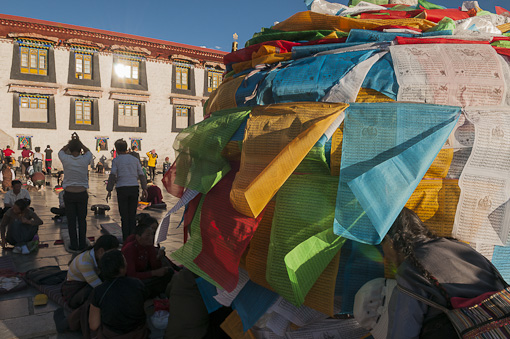
At the setting sun reflects from the  Jokhang yesterday, a woman caresses prayer flags draped many feet thick around a stupa at the edge of Bokhar Square.

Sadly the Jokhang, built in the seventh century century, no longer houses monks nor services since 2008 when the Chinese authorities shut them down after the bloody rioting in Lhasa. It is now an important government "cultural relic". 

Now you see army troops on every surrounding roof top, security cameras, eight man squads carrying automatic rifles and riot helmets marching around the square at regular intervals, and you encounter random patrols through out the central city. The up side is I never worried about being mugged.

 
A devoted pilgrim in a sea of thousands circling the Jokhang last evening. 

Visiting the towering Portala, featured on every picture postcard from the Hermit Kingdom,  is not nearly as vibrant a human experience. As if your low land lungs weren't having enough trouble at nearly 12, 000 feet, you must climb, one ancient stone step at a time another 150 yards. Your prize at the top is to be one of 3,000 daily visitors that are allowed to shuffle from one amazing room to another, all within the government mandated one hour limit.  

Yet the Portala is a truly amazing site. I was impressed by how small the former Dali Lama's private prayer quarters were, about the size of a small hotel room, rather modest for the political and religious leader of Tibet who is also a living God.

These are a few quick impressions of  my first three days in Tibet. Hopefully I'll have time and internet connections to post more in the coming weeks.

To view more examples of journalistic photography from China, please visit my Miami commercial photography portfolio site.