Showing posts with label Multimedia. Show all posts

Tuesday, July 29, 2014

Explaining "Flipping The Classroom On Its Head"

Principal Doug Romanik was very excited about his school’s new educational philosophy and how they were “flipping the classroom on its head” at his 300 student Catholic high school in Miami’s Little Haiti neighborhood. The teachers were not lecturing any more, the students were empowered to learn on their own, iPads were every where, he told me on the phone. 


Multimedia story explaining the One To One Learning Program was delivered in June 2014. Email,  iPhone & iPad link.

Beginning with the Fall 2013 term Archbishop Curley Notre Dame Prep had become the first, and only, school in the United States to fully implement this new program. Teachers and students were adapting pretty well, but all the changes were causing some confusion amongst the parents, school supporters and incoming students.

He wanted me to come in to discuss how a web site video could explain ACND’s pioneering program. Of course I would!
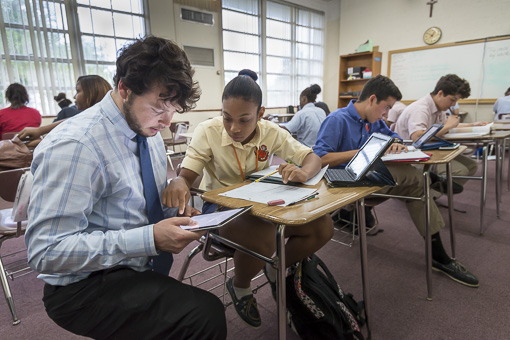

 Math teacher James Harnage gives one on one time to Jennifer Lamy.

Fonton Relational Education was created in 1957 by two Spanish psychologists and had been incubated at several schools in Colombia. (Great video by IBM here.) FRE had helped adapt and implement their framework and software platforms at ACND, so I began my research on their site. I quickly bogged down trying to understand sentences such as
Fontan Relational Education is a pedagogical model that customizes learning paths for different learners at an individual unique learning rhythm based on each students’ abilities and interests.
Not having a PhD in educational theory, I was as confused as the parents, and quickly realized that my challenge was to transform the complex and abstract into a concise and emotional multimedia story about the One To One Learning Program. 
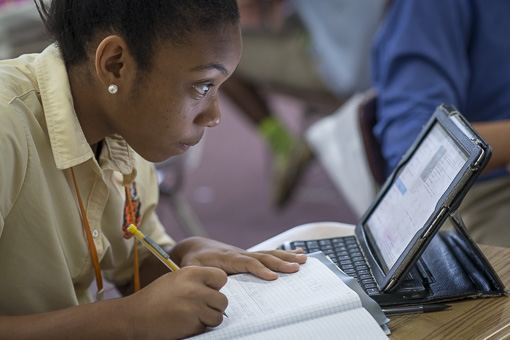

 Junior Jennifer Lamy combines pencil, paper and iPad on calculus homework.

My challenge was threefold:
  1. With interviews allow students in their own words describe their apprehension and eventual mastering of the changes. After conversations with ACND staff I drew up questions designed to elicit answers to hit target points, and to discover emotional surprises the kids might share.  
  2. With still photographs, and sit down interview video filmed by colleague Pascal Depuhl, I would put a human face on the program, show new classroom layouts and technology in use.
  3.  I would convert what I call all the Blah Blah Blah by writing a concise description of the One To One Learning Program to scroll at the end of the video. I realized there was no way the kids could hit all these points without sounding scripted. 

One To One Learning Program multimedia currently featured on ACND home page.

The non-visual aspects of One To One are explained by video end scroll:
At Archbishop Curley-Notre Dame High School, the One To One Learning Program is flipping the classroom on its head as teachers no longer lecture and students are responsible for mastering class material through guided independent study.
Teachers become coaches, first by laying out academic goals, then helping each student write their own Individual Learning Plan to achieve those goals, and  finally guiding the plan’s implementation throughout the term.
Working hand in hand with the school, students take control of their own learning while gaining time management skills, strong study habits and confidence.

Rather than sitting back during lectures, students discover the information on their own, and have instant one-on-one time with their teacher. As they move from teacher dependent to student autonomous, teachers are freed to tap into student’s individual learning styles, and students are encouraged to incorporate areas of personal interest.

During regularly scheduled classes students complete most of their homework, study in groups, and give presentations.  Grades are still earned, essays written and tests taken as students prepare for college.

Each student is issued an Apple iPad for 24/7 access to electronic books internet resources, and access to Qino, cloud storage for their learning plan and grades. The portal Showbie allows paperless submission of documents and homework.

Currently the ACND home page posts the version with end scroll, and is in standard definition. Version at top has no scroll and is in high definition.

Do you now understand what is meant my "flipping the classroom on its head"? Let me know if we were successful in explaining the One To One Learning Program in a concise and emotional manner ... there is room below for your comments.

Thank you Doug Romanik, ANCD Public Relations Specialist Lisa Morales, Pre Calculus teacher James Harnage, AP English teacher Beth Love, Daniel Briz, and Jennifer Lamy.
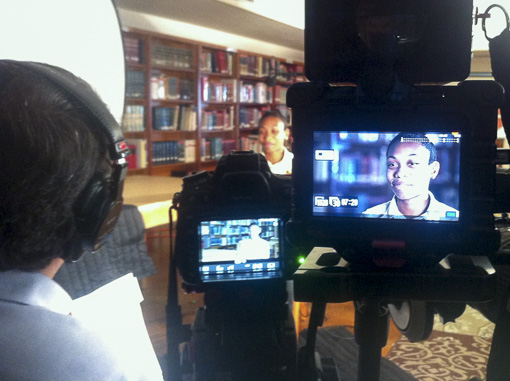

 Production photographs by Pascal Depuhl.

Technical Notes:

Pascal Depuhl lit and shot the video interviews, a 70 - 200 and Canon 5D Mark II for camera 1, and Nikon D610 and 85mm for camera 2 and on a slider for video portraits. I recorded the interviews with both Tram 50 lavs and a boomed Sennheiser MKH8050 hyper cardioid, the latter I much preferred due to it’s fuller sound, and used that track only. Wild sound was recorded with concealed TR50s tucked between Jennifer and Daniel shirt buttons, with Sennheiser G3 wireless packs. Stills were shot on Nikon 610 full frame cameras, with 16 - 35 f4, 28 mm f1.8 and 85 mm f1.8 primes. Sound was synced with Plural Eyes 3.0, video edited in Premier Pro CS 6 and sound sweetened with Audition, all on a Mac, of course.


Sunday, June 22, 2014

History Detectives: Students' Civil Rights Legacy

I believe few Americans still hold out hope that we are living in a post racial society, now that we are well into the second term of President Barack Obama and we are finding our civic discourse just as fractured and angry as ever. For a while after we as a nation elected our first African American president in 2008, I read in magazine essays and overhead in coffee shops that "maybe race doesn't matter anymore?" 


Hopefully this 5 minute multimedia story about high school students discovering how the civil rights era of the 1960s shaped their lives is just as insightful as when completed in 2011. Please read my original blog post .

In spite of opinion polls indicating most people (mostly whites?) see no racism in their lives, I feel race still matters in almost everything we as a nation and as individuals do every day. There are under currents that race matters popping up all the time. Some could observe:

- The President is being disrespected by his political opponents because of his race. 

- A billionaire basket ball team owner is a total monster because of his comments on race.

- Miami-Dade police shoot and kill in the streets an inordinate number of young black men.

-  OJ is still suspected/ still guilty/ still acquitted because of his race.

These thoughts were going through my mind this week as I was re-editing my History Detectives multimedia piece I was commissioned to create three years ago. Archbishop Curley Notre Dame Prep in Miami's Little Haiti neighborhood asked me to explain the importance of their being the first high school in the then segregated state of Florida to integrate 50 years before.

Taylor Altidor,  then a 16-year-old Junior, told me "...we just couldn't believe that Florida used to be racially segregated, that blacks and whites didn't eat in the same restaurants...". I followed her advanced placement history class as they researched segregation and interviewed students from the early 1960s and prepared for a Black History assembly. Former students and now adults well into their 60s, Paul Wyche told me he was called the N-word at a high school basket ball game, and Constance Moor Thornton recalled "colored" water fountains.

The researching students understood such overt racism that thrived in the Jim Crow era was thankfully no longer and was not part of their teen lives. But was racism completely gone? The student detectives questioned, discussed and completed class projects that brought the topic into the open.

Addressing the assembled student body in a clear and optimistic voice, one civil rights era student said "We come from different circumstances, but color doesn't matter, it is what is in your heart." 

I hope so, and I hope some day we will be living in a truly post racial society.


Technical Notes:

This month I was in the process of updating my Miami multimedia photography portfolio and had begun transferring the original History Detectives from a Flash based player made in Sound Slides to a more universally accepted and iOS friendly H 265 video format, when ACND called looking a new high resolution file. Good timing.

I reprocessed all 123 original still photographs in the newest Adobe Light Room 5, squeezing additional color quality and dynamic range from the newest RAW processor. I always export as Tiffs with medium sharpening, believing compressed Jpegs, and over sharpening, could potentially cause video jitter. I cropped the original 4:3 aspect ratio to the video standard 16:9. This cut a little close to some image content, as I was not thinking 16:9 originally and had composed my images differently.

I added the stills to a Adobe Premier Pro CS6 timeline, imported my original sound track made with Apple Logic, and switched in a couple of new images but pretty much left the timing alone. I no longer liked the Ken Burns movement on some photos in the original, and removed it. I added a new title and credit page with a typewriter effect in Adobe After Effects CS6 ... a lot easier than this amateur video editor thought. On your P Pro time line >  right click the title > open as a After Effects composition > in AE Effects & Presets search "typewriter" > drop that puppy onto the composition and bingo, you have the type type type effect all done for you.

I digress. And I used the American Typewriter font in PP to make new lower thirds. I couldn't figure out how to animate them too, so decided would be less busy without. I exported through Adobe Media Encoder with the Vimeo 720 p presets, and uploaded to Vimeo. Easy peasy.

Wednesday, April 30, 2014

Talking Picture Postcard - Suwannee River


Green lightening bug last week streaks across still frame from moonless sky time lapse, Nikon D 610, Nikkor 16 - 35 mm at widest end, 30 seconds at f 4.0, ASA 3200, no noise reduction.

It's 3:30 AM as I crawl out of my tent pitched along the Suwannee River at the Florida state park of the same name, and I'm groggily peering up through the trees searching for the bright stars that dotted the sky when I had entered my sleeping bag five hours earlier. But I don't see a thing in the dark.  Double checking that my glasses are on my face, I switch on my head lamp only to see hazy water droplets suspended in foggy air.


View 1:29 video on you iPhone or iPad.

As I stumble down the trail toward my camera I worry if my time lapse was completely obscured by the cold morning fog creeping amid the slash pine and live oaks. I soon hear the camera still clicking and am reassured by the green glowing lamp as images are written to the memory card.

With two 30-second time exposures taken every minute for the past five hours,  I held the review button down to quickly spin the individual still photographs across the screen, magically moving the stars along their orbits in the heavens. Wow, condensing hours into a few seconds, that's cool!

I turned the camera and head lamp off to toss my head way back and look up. I knew there was six feet of dangling Spanish Moss above me as I could feel it tickle my nose. But I couldn't see the moss, nor the trees nor beyond. I could only feel the wet fog on my face, and hear a thousand thousand croaking frogs way off along the flooded banks of the Suwannee . Wow, being out doors in the middle of the night is really cool too!

My plan was to kayak and explore the historic river and had driven the 435 miles from Miami due North to within a half hour of the Georgia state line and the Okefenokee Swamp, from which the Suwannee originates. Only problem was I didn't call ahead, I guess the dry season in South Florida is not necessarily the dry season up here. An unseasonably rainy winter had forced the river up to 15 feet above flood stage, to dangerous to paddle. 

No problem, though, I found lots of scenic country to photograph, natural sounds to record and the nearby Santa Fe river fed by springs, one of my best paddles ever. A great trip with enough to fill an entire post card, a Talking Picture Postcard for sure.

Tuesday, February 11, 2014

Talking Picture Postcard - Everglades Web

Sunday while loading up my kayak and paddle, I threw in my new Nikon D610 DSLR camera and small audio recorder, along with a sandwich and one bottle of beer. I had no set plans other than spending a day in Everglades National Park about an hour south of Miami. I could paddle inland through tunnels covered with mangroves, or across open Florida Bay skipping from island to island.

If while out in nature I heard a cool sound, I could record it. If I saw great light, I could shoot a picture. Or if something intriguing moved, I could capture video. What ever happened would be just fine with me.


 This 30 second Talking Picture Postcard was shot Sunday, with sound captured nearby. Listen first for a red-winged blackbird, and then a red- shouldered hawk. Direct link for iOS devices.

Right after entering the park at sunrise, I noticed  the subtle movement of dew covered spider webs blowing in the breeze on a vast saw grass prairie. I was just beginning to become familiar with the video controls of my camera, and other than shooting video of my cat Shadow, who at age 14 and weighting 19 pounds does not move much, the webs were my first "action" subjects.

After a long paddle, the sandwich, beer and a nap, the setting sun was back lighting gently flowing Spanish moss hanging from live oak trees. Seeing this "action" as a bookend to the morning's spider webs, I realized I could edit a short video from the day.

It's been three years since I contributed to my occasional Talking Picture Postcard series on this blog, so Everglades Web is a revival of sorts. Back in 2010 I described my interest in postcards:
I’m trying to think of each [ short video ] as a couple of lines on the back of a picture postcard, like those I’ve discovered while rummaging through dusty boxes in antique stores over the years.
After gleaning what I can from the photos, I turn the cards over to read the hand written lines, often family news, weather reports and plans about the future. I wonder how the parties to the correspondence lived their lives and what happened to them. Those few lines can be the best part, ease dropping on people who’ve long since passed away.
 Sorry I won't mail this postcard to you, you're have to read it here, as I'm saving the .49 cent stamp.

Monday, November 18, 2013

12,000 Kung Fu Children

The 12,000 young boys and girls kicked and thrust, their shouted responses echoed from the tall dormitories and off the concrete drill field as their instructor’s Chinese commands squawked from loud speakers. Kung Fu movements in unison as far as I could see, the children and teens were in endless formations radiating in all directions like corn blowing in the wind.


iPhone & iPad friendly version or if you've received via e-mail. Listen to 1:30 of field-recorded sound and watch still photographs from Weseng Tuan Training Center in September, associated with legendary warrior monks of China's Shaolin Temple. 

In September I was visiting the Weseng Tuan Training Center on the same day as picture day, and this being China, picture day was a BIG deal. Mr. Qin Hua was eight stores up with his Nikon to capture the assembled thousands in a grand panoramic view. I opted for a view from ground level.

The school is closely associated with the Shaolin Temple at Song Mountain in China’s central Henan Province. The temple’s legendary warrior monks date from the chaotic politics of the sixth century, when the emperor awarded favors to Buddhists with fighting skills. For centuries many martial arts traditions flourished as trade and religion between China and India flowed, with the Shaolin form of Kung Fu becoming the most prominent.


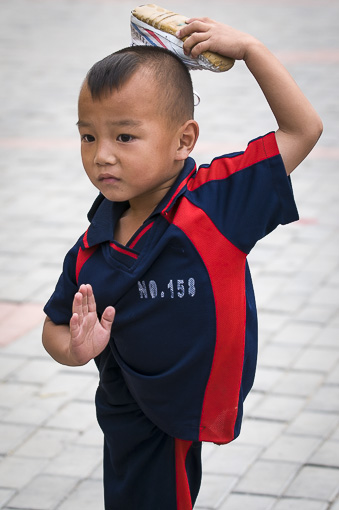
After just three months at boarding school, five-year-old demonstrates Kung Fu moves. 

From Wikipedia:
Kung Fu is a Chinese term referring to any study, learning, or practice that requires patience, energy and time to complete, often used in the West to refer to Chinese martial arts ... Originally to practice Kung Fu did not just mean to practice Chinese martial arts. It refers to excellence achieved through long practice in any endeavor. 
Today this blending of hand to hand fighting with Buddhist ideology continues to embrace self-defense, body-building and athletics, with Kung Fu becoming a world wide personal philosophy and sport.

Tuition, room and board at the Wuseng Tuan school is around $ 4,800 a year, a considerable sum for a Chinese family in spite of the country’s recent economic growth. Besides good basic academic education, many students hope to join the military or work as body guards. There are thousands of Kung Fu schools throughout China, all competing for a piece of a very big business. Yet the day before I saw a group of a half a dozen English speaking twenty something men and women training one on one with a saffron robed monk in the nearby Shaolin Temple.


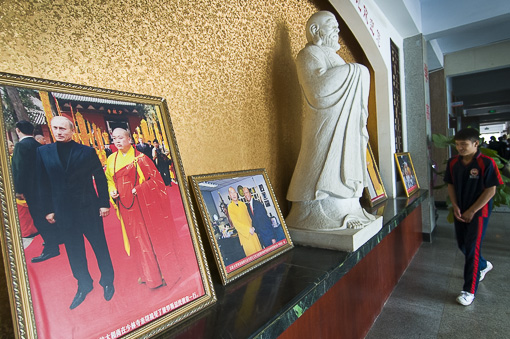
Photograph of Russian President Vladimir Putin and Shaolin Temple abbot is proudly displayed at the Wusen Tuan training center in Henan Province, China.

With the school enrolling 15,000 students, I was wondering where the other 3,000 were, as I had taken on face value their assertion of 12,000 Kung Fu children in front of me. Give or take a handful, seemed reasonable to me.

Just as I was about to ask, several accomplished five-year-olds were trotted out to perform for us. With just three months at the boarding school these cute tikes whipped through their foot kicking, hand chopping routine, climaxing with placing one foot behind their heads while standing perfectly still. Were the future generals of the People’s Liberation Army before me, standing like tall storks? With the world’s largest armed forces, China could always use one more Kung Fu practitioner.

Wednesday, July 31, 2013

Surprising Guided Conversation With Foster Child

Every interview is a guided conversation, but in spite of where I think I may be headed with my reporting, my subjects always lead me down paths unanticipated, and frequently they surprise me with their insight.


Foster teen Isaac and his adult mentor Barbara K. have developed a lifelong bond through weekly Saturday visits. iPhone & iPad link. Video by Paul Morris.

My journey down one of those paths began when I answered the phone back in March. Barbara Schechter, Executive Director of the Heart Gallery of Broward County (FL) was on the line wondering if I had any ideas on how to recruit mentors for her children living in foster care. Besides organizing a traveling photography exhibit of children waiting to be permanently adopted, the Heart Gallery provides innovative programs that enrich the county’s foster children.

I suggested we produce a multimedia piece featuring one adult mentor who has developed a successful relationship with a Heart Gallery child so we could tell the story through their eyes and in their own words. I’ve found viewers easily relate to the combination of photojournalism and audio story telling, what I call Public Radio With Pictures.

 Isaac, 13, leaps into mentor Barbara K.'s swimming pool during weekly Saturday visit. Still photographs by Tom Salyer

While Barbara set to work finding the subjects, I began researching mentoring on social service agency web sites and building a list of keywords that would help us filter our story telling decisions. What activities should we photograph, at what locations and the questions we should ask? Why are we making this film?

My keyword list included: guidance, friendship, relationship, trust, sharing, teacher, listen, adult, growth, role model, permanence, family problems, self confidence, support, patience, time, heart, consistency, commitment, approval, the future. Shortening the list to four or five, I was able to state the purpose of the film in one sentence:

Mentors provide children living in foster care with positive adult relationships that encourage trust, self-confidence and friendship.

During a brief telephone pre-interview with our adult mentor, Barbara K. described how for two years she has called 13-year-old Isaac every Friday afternoon to talk about their Saturday plans. Keyword consistency. How they went swimming and made cookies. Keyword friendship. Washing the car, doing homework and attending a baseball game would make great locations. While drawing up a list of questions I tried to anticipate the arch of our story, how to open, our subject’s journey and a final resolution.


Mentor Barbara K. lets her dog lick cookie dough as Isaac, who lives in a foster care group home, looks on.

On interview day in April colleague Paul Morris, running the video cameras, and I were joined by Barbara Schechter and new Heart Gallery Executive Director Ken Crooks. First we interviewed Barbara K., who quickly gave us unanticipated answers.

Among the reasons she wanted to be a mentor:

Selfishly, I have two grown children in their 40s, neither one is married, neither one has any children. I wanted some grand children!

Wrapping up her mentoring experience:
  
I hope that what ever happens to Isaac that he’s in my life ... forever... you’re have  friend for life, you really will.

When we asked Issac our written question about what his life was like before foster care, he firmly stated he didn’t want to talk about that. But later he offered this unanticipated journey:

I really love Miss Barbara because she is always there for me... like when I do bad stuff, and she tells me the right things to do, like when I ran away...she’s like, Isaac, you should of never (done) that, you could of gotten hurt, and...nobody could of found you, and you could of been dead...

One more guided conversation full of surprises.

This video “Miss Barbara Is Always There For Me” will be posted on the Heart Gallery’s web site, on YouTube and shown live at foster family and adoption training and fund raising events.


 Former Heart Gallery of Broward County Executive Director Barbara Schechter, left, and current Executive Director Ken Crooks supervise car washing scene during filming of "Miss Barbara Is Always There For Me."

Technical Notes:

Paul Morris recorded the video with Canon 5D Mark II and Mark III cameras and lenses. During my still photography, I recorded the ambient sound and conversations with concealed Tram TR50 lavalier microphones and Sennheiser G3 wireless units, and the interview with a boomed Sennheiser MKH 8050 hyper cardioid. I edited stills in Adobe Light Room and Photo Shop, and assembled the video in Adobe Premier Pro and Audition CS 6.

Tuesday, September 18, 2012

These Wheels Are Walking Wheels: Disabled Teen

When Laterence was just three days old, his mother realized that because of his disability she could not care for him, and straight from the hospital placed him in state custody. Now a teenager, he has been living in Florida's foster care system all his life, with families and in group homes, all the while hoping he would be permanently adopted by a loving family.


This multimedia piece incorporates video, still photos, interview and field-recorded natural sound. iPhone & iPad friendly link.

Four years running his photograph has been in the Heart Gallery of Broward County (FL), a traveling photo exhibit of foster children available for adoption. Hoping to spark frank discussions around adopting children with disabilities, the Heart Gallery commissioned this multimedia audio slide show. The show will be utilized by social service agencies charged with recruiting and training adoptive parents.

Laterence - he prefers LT - is now a very articulate 15-year-old, and in this three minute story he narrates his emotional journey and has advise for prospective adoptive parents.

Does LT ever find his "forever family"?


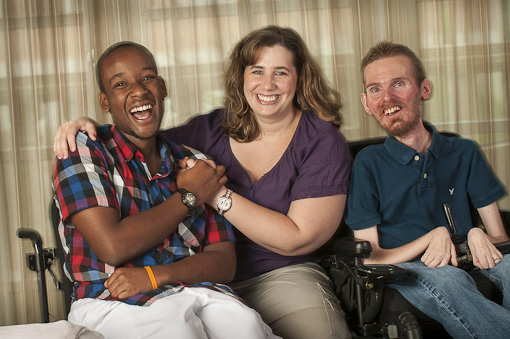
 From left, LT gets to know Jennifer and Brad during visit to South Florida in July.

This multimedia piece could not of been created without collaboration with colleagues, as there are just to many moving parts for one photographer to keep track of when video is incorporated into narrative story telling.

My hands were more than full with recording the audio while conducting the interview, so Paul Morris helped me by recording the A roll on two video cameras, then picking up B roll afterward. Heart Gallery Executive Director Barbara Schechter helped me plan the coverage, conduct the interview and shape the editing of the piece. Miami video journalist Chuck Fadely gave me invaluable feedback. And of course we would be unable to tell this story without LT, Brad and Jennifer.

Notes for still photographers beginning to work with motion capture ... it’s not rocket science nor do you need a ton of expensive gear. First, you need a great story, and then you must shape a compelling narrative arch that captivates your audience.

- Video cameras, Canon 5DMarkII & Canon 7D (no rigs, EVFs, focus assist)
- Video camera rolling wheels in mall, Canon s100 point ‘n shoot
- Still cameras, Nikon D300
- Interview Mics, Tram 50 lavalier & Sennheiser ME 64 cardioid; wild sound, Giant Squid
- Sound Devices MixPre D field mixer & Tascam DR 100 recorder
- Adobe CS 5.5 Premier Pro, Audition & touch of After Effects

 Please visit my Miami commercial photography portfolio.

Thursday, August 9, 2012

Sounds Overheard: Seeing Tibet With Closed Eyes

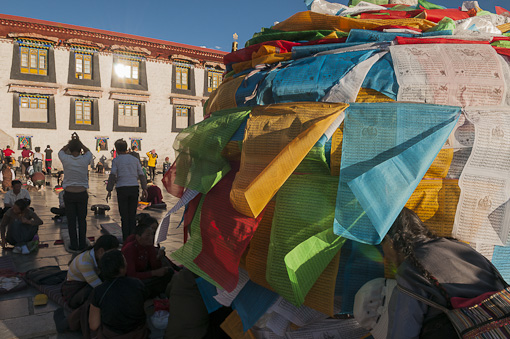
Pilgrims worship at the Jokhang Temple, Tibetan Buddhism's holiest site.

Exploring Lhasa on my first day in Tibet was so overwhelming that I was having trouble seeing photographs. Crowds of Buddhist pilgrims dressed in regional costumes streamed down every street, Han Chinese merchants in Barkhor Square sold everything from prayer wheels to yak butter and the occupying Chinese army marched with assault rifles at the ready.

I was gasping in the thin air at 12,000 feet altitude. My stomach was deciding if it liked my yak stew lunch. Colors were way to saturated, the blue sky, the monk’s saffron robes and the rooftop golden lambs.

So I closed my eyes and started listening for pictures.


Close your eyes, listen to the sounds around the Jokhang Temple in Lhasa, and tell me what you see. iPhone & iPad link to 1:48 long MP3.

The first sound I heard was a far off rhythmic slapping and chanting.  I discovered over a dozen workers, men and women, building a traditional aga earthen roof atop the Jokhang Temple. They were on their hands and knees with hand held wooden paddles compacting the mix of gravel, dirt and water infused with willow tree bark.

I recorded the sound of wooden and leather hand protectors scraping on the cobble stone temple square as the pilgrims prostrated them selves in repetitive prayer. They stood with their hands together above their heads, then down on their knees, then on their stomachs with arms out stretched.

My ears discovered a man singing prayers from a well worn book of Tibetan script, his voice competing with the thousands of pilgrims circumambulating the mile-long circuit around the temple.

Slowly the sounds awakened the visual corners of my brain, I opened my eyes  and began making photographs.

Editors note: If you visit the "aga earthen roof" link above, poke around the site a little and see how the Chinese government views the Tibetan people.

During my assignments and travels I've been recording the sounds I overhear, and many don't have supporting photographs or stories. This occasional series will be my excuse to share my audio orphans, these Sounds Overheard. Please also visit my Miami editorial photographer portfolio.

Friday, March 30, 2012

Video Stories With Vision & Collaboration

As a group still photographers are creative, independent and stubborn as we’ve relied primarily on ourselves in pulling successful photos from challenging assignments while at the same time embracing the digital information age.  But as we’re being asked to add video to our story telling tool set, we’re being forced to - gasp - learn new skills and - double gasp - collaborate with others.


Four still photographers collaborated in producing a web video promoting Nancy Brown’s photography book “Simply China”. Paul Morris with video, lighting and studio space. Tom Salyer recorded sound and edited. Jonathan Rios as production assistant. Nancy Brown, on camera talent and stills. http://vimeo.com/39290394

On my section of the long tail of photography the four-year economic crisis has reduced my assignment budgets to hiring an assistant to very rare. I’m producing my shoots, setting up my lights and processing my own files. That’s were stubbornness comes in for us, we can do it ourselves doggone it.

I’ve heard wondrous stories of colleagues working on high budget advertising shoots with a producer, hair and makeup, assistants and digital tech. And a lunch budget, oh my! 

OK, I agree, the idea of every photographer being a lone wolf working completely on their own is not completely accurate, at least in the commercial photography field. We all have colleagues we can call for advise and insight with projects, our art directors give us direction, and most still shoots are not overly complicated.

Working either on our own or with a small crew, our independence drives our ability to visualize our images in advance and make them happen. Our “eye” is our strongest asset, and can be transferred to another medium.

By comparison, with motion projects the nuts and bolts of producing technically successful video is very complex and has a steep learning curve. You thought learning about color spaces and layer masks were hard? Try mastering Final Cut Pro, motion graphics and compression codices.

Video requires many jobs: director, producer, director of photography, camera operator, lighting grip, sound recordist, and editor. On simpler shoots a person can handle multiple jobs, but there are to many moving parts for one transitioning still photographer to handle them all. The story line will be jumbled, the picture overexposed, the sound levels low.


NFL St. Louis Rams head coach Jeff Fisher is interviewed last weekend by Paul Morris, far left, and Orlando Noah, left center, at The Breakers, Palm Beach, FL. Photo by Tom Salyer.

Photographers need to collaborate with the people who already have these skills, and our unique vision is the key to success. We already approach image making with our life time of experience as visual story tellers. We already know how to compose a great image, capture a decisive moment, and creative lighting is a piece of cake.

Clients are beginning to come to still photographers asking to add on motion for web sites and social media because they trust their eye and ability to successfully complete jobs. Don't worry big video production companies, most of us aren't competing with you. Yet.

Examples:

- Minneapolis based Ryan Siemers has been expanding his architectural photography business by adding motion, interviews and animations.

- Jeffery Salter, a Miami portrait and fine art photographer, collaborated with videographers on stories for Readers Digest: Richard Patterson on former football player Keith Fitzhugh, and with Chuck Fadely on long distance swimmer Diane Nyad.

- Miami commercial photographer Paul Morris has added video to two still photography assignments in the past months: executive interviews for farm equipment trade association American Equipment Manufacturers, and National Football League head coaches for New Era head wear suppler. I was sound recordist on both, and Orlando Noah and Meine Smith of Digital Decaf provided video and digital services on the latter.

Please see example of my Miami multimedia photography portfolio.

Friday, December 16, 2011

Sounds Overheard: Incantations Of Tibeten Nuns

Buddhist nuns wear elaborate head dresses while chanting last October in Lhasa, Tibet.

While visiting the Anezamkang nunnery in Lhasa I was reminded of the nugget of video production wisdom that goes "seventy five percent of what you see is what you hear".
 
Do you "see" more when you play 1' 15" natural sound recording of nuns chanting?

I must admit I was in a heck of an visually exotic spot, inside a tiny Tibetan Buddhist temple draped ceiling to floor with colorful banners, filled with three dozen nuns wearing elaborately embroidered robes and hammered silver-paneled hats topped with tall turbans. The nunnery was hidden down a tiny stone alley in Lhasa's ancient Tibetan quarter, out of sight of the Chinese army troops patroling with automatic weapons a few blocks away. I was gasping in the thin air at 12, 000 feet, and contentedly digesting a meal of yak noodle soup.

But listen to the above field-recording audio file of the nuns singing and chanting, ringing brass bells and swinging small paddle drums, and tell me how exotic the scene feels to you now ... seventy five percent better? I would say the experience is immeasurably more intense and real.

During my assignments and travels I've been recording the sounds I overhear, and many don't have supporting photographs or stories. This occasional series will be my excuse to share my audio orphans, these Sounds Overheard.  

More stories from Tibet are elsewhere on this blog, and more examples of field-recorded natural sound are at my Miami multimedia production portfolio site.

Wednesday, November 30, 2011

Faces of China Photographic Exhibition Now Online

I’ve been hearing from some of my friends and colleagues that they’ve been unable to see my Faces of China exhibit currently hanging at the Archbishop Curley Notre Dame Gallery of Art, which opened earlier this month, and closes January 21, 2012. Their work or personal schedules have interfered, and some aren’t from the Miami area and won’t have the opportunity to visit.


Faces of China slide show runs just two minutes ... iPhone & iPad version.

So I decided to set up an on-line version of the 38 image exhibit, viewable right here in your web browser. Each image is on screen for just three seconds, so the entire show will take barely two minutes of your time, 30 seconds more if you read the shortened artist’s statement at the end.

For the show’s opening November 5, I mixed a 20 minute audio track of field-recorded natural sound from my trips to China, which played in the background, giving visitors an extra dimension of understanding to the photographs.

This on-line edition of the exhibit is accompanied by a brand new sound track of a guzheng, a multi-stringed Chinese instrument that is plucked, which I recorded at the Buddha Zen Hotel in Chengdu on my last night in China in October. A very peaceful waterfall accompanied the lovely young lady who was performing that evening.

Six images from Tibet are included, shot just two weeks before exhibit opened.

In September I wrote about the then upcoming Faces of China exhibit, and I’ll take the liberty of reprinting my artist’s statement here:
Visiting China as a photographer for the first time was very intimidating. With a population of 1.3 billion and one of the planet’s most ancient cultures, I worried that my images would not contribute anything new. How could I tell the story of the political transformation since Liberation in 1949, the legacy of the Cultural Revolution, and an economy that’s moved hundreds of millions of rural peasants to the cities and transformed the nation into world power?
I decided to meet China’s people one at a time, capture a tiny bit of that nation’s character one photograph at a time. I went into the streets and markets and temples with no particular agenda other than to see the relaxed and candid side of people from a culture very different from my own.

After seven trips to China I present here no insights into their political, economic and environmental challenges. I simply try to look into a pair of eyes just like mine, accept them for who they are at that moment, make a connection that I can digitize, take home and share. These Faces of China are fleeting glimpses of people that are like you and me, people who are trying to live their lives to the fullest, plan for the future, contribute to their community. And sometimes they sneak a peek at an unusual Western visitor with a camera.

My technique to capture these photographs is very basic: I show my subjects respect, smile, indicate an interest with body language, and treat them as I would want to be treated. I say hello in badly mispronounced Mandarin, “ni hao” throughout China, “sain baina uu” in Inner Mongolia, and in traditional Tibetan regions of Sichuan, Gansu and Qinghai, “tashi dele” brings out the smiles.

Captions accompany maps with featured Chinese province.

For more examples of field-recorded natural sound combined with photography, please visit my multimedia portfolio site. More examples of journalistic photography from China can be viewed at my Miami corporate photography site.

Monday, July 25, 2011

Shamans Appease Mountain Gods, Qinghai, China

Every July shamanistic festivals featuring ritual dances, holy skin drums, and food offerings are designed to appease the mountain gods and guarantee good harvests in villages around Tongren. After three frenzied days of communicating with ancient Mongolian army generals, reincarnations of the gods, the shamans go into deep trances.


Link to iPhone & iPad friendly version of multimedia audio slide show.

Although not officially Buddhist, the festivals take place in and around Tibetan Buddhist temples and monasteries, and attract hundreds of observers and participants. Wearing distinctive peaked hats with red tassels, young boys through middle aged men dance for hours, circling the walled courtyard. Senior men carry flags and banners. Young girls solemnly march, enduring heavy coral beads and silver medallions braided into their long hair.

Ethnic Tibetan dancer takes break during Tongren Shaman Festival, Qinghai Province, China

Villagers bring offerings, including long bolts of beautiful fabric that are tied horizontally from the temple’s decoratively carved timbers. Offerings of food arrive, small plates of tsampa, a Tibetan barley flour bread, fruit, flowers and candy. Offerings of liquor are drunk by the shamans, shared with dancers and finally poured on the ground.

I photographed this Tongren Shaman Festival by walking up a steep hill from downtown Tongren, a small dusty town two hours from Qinghai Province's capital Xining. The amazing sounds of goat skin drums, silver bells, brass cymbals and the “brrrrrrrr” of the frenetic shaman were all recorded in the field as I photographed the festivities.

View more multimedia audio slide shows from China, and Miami Multimedia Photography. Last summer I wrote almost daily from my trip to Qinghai, China.

Saturday, June 25, 2011

Cancer Survivor Only Cried For One Day

I felt really bad when my question made Lainie cry.

She was sitting on the edge of her bed, her Boston terriers Oliver and Stella curled up in her lap, and, dressed in pink and pearls, she was a very pretty 27-year-old. I certainly didn’t begin the interview with the intention of catching her with her defenses down in order to record her raw emotions on tape.


Watch this multimedia audio slide show and hear cancer survivor Lainie tell her story. iPhone & iPad version.

It was just one of the questions on my two page list:

- paint me a picture of those first days after your cancer diagnosis
- how have you decided to live your life in light of your illness?
- when you were a little girl, what did you want to grow up to be?

That last one made her cry.

As a child, she wanted to be an actress. In college, a nurse. Since cancer ... her dreams have been to live life to the fullest.

Within a few moments she bounced back to the strong and positive Lainie Schultz who has beaten adrenal carcinoma, Stage 2 breast cancer, melanoma, and thyroid cancer. When diagnosed with breast cancer at 24, she cried for “only one day”, and has since refused to let the disease prevent her from enjoying her life.


Young cancer survivor Lainie Schultz wears bracelets during her fight with cancer.

Lainie turned to Broward Health in Ft. Lauderdale to treat her cancer. Because she was so young for a breast cancer diagnosis, her doctors sought genetic testing. More shocking news, she had a rare genetic disorder called Li-Fraumeni Syndrome which predisposes for cancer only about 400 people in the country.

In spite of the many challenges facing her, Lainie decided to embrace life full throttle, and that’s why Broward Health commissioned me to photograph her for an advertising campaign and to produce a multimedia audio slide show for their web site.

Lainie has not only become a force field of positive energy for those closest to her - parents, fiance and large circle of friends - she has taken on the role of cancer survivor evangelist. She blogs intimately at My Journey with Li-Fraumeni Syndrome, and has been interviewed by print, television and online news media. On Voices of Survivors, she wrote the following:
It’s saddening to give up your innocence at 26, but when you’re stripped down to your unrefined self, bald, and have cancer, you find strengths you never knew you had. You develop relationships that are closer than you ever thought possible. You see love and support in those around you that overwhelm you at times. I have been able to meet others who inspire me and have given me a new meaning to the word, “strong.” Every morning I wake up, and thank my lucky stars I am able to call myself a survivor!
After reading her words above it’s time for me to get a little choked up ... I know, I’m the hard bitten newsman with decades of objective story telling experience, never get involved, just keep to the facts please. I held my emotions in check during a week of photography, interviewing, editing audio and composing the multimedia piece.  I’m a cancer survivor too, but have pushed aside my experience as being so very far removed from Lainie’s daily challenges.

So today I’m dropping my objectively, and will just come out and say it. I’m impressed by how Lainie is living her life, and I’m inspired by her. I’m sorry I made her cry, but not sorry she made me cry too.

Besides Lainie, I have to thank Jenny Mackie of Broward Health's Marketing Department, who served as creative director, set dresser and dog wrangler. Carolyn Jones was a master with makeup and wardrobe, and Antoine Heusse did the heavy lifting as lighting assistant.

To view more Miami multimedia photography, please visit my portfolio site.

Wednesday, May 18, 2011

Young History Detectives Discover Segregation

History was being made 50 years ago this week as the first cross country buses of  freedom riders rolled into Alabama and Mississippi, only to face withering racial hatred and violence. As two brilliant PBS television documentaries have shown, the non-violent participants played a pivotal roll in nudging the Kennedy administration to finally act, and the civil-rights movement turned the corner that leads directly to our current times.

Did we really live in an America were segregation of whites and blacks was not only legal, but thrived south of the Mason Dixon line? Where white mobs beat and murdered blacks while racist police did nothing? Where schools and hospitals were segregated, blacks sat in the back of buses and weren’t allowed into restaurants?


Multimedia audio slide show tells 1960 story of first Florida high school to integrate. iPhone & iPad version.

I know we did, as I grew up in the 1960’s. I recall flickering black and white television images of students blasted with fire hoses and reading about the freedom riders in Life magazine.

But do young people today know this history? Recently I found out that some Miami high school students were amazed to hear that segregation was a way of life in their home town.

Being white and living in Idaho and Washington state, to me the civil-rights movement was an abstraction. I had never experienced discrimination. In my family we were raised to be inclusive, my parents frequently reminding us that the color of one’s skin did not matter. Then Martin Luther King died. His assassination shook my college idealism to the core, and for a while my friends and I wondered what sort of world was awaiting us.

When I moved to Miami 30 years ago it rarely occurred to me that I was living in the deep south. I remember in 1980 our realtor remarking that just a few years before our Miami Shores neighborhood had been “red lined”, where banks would keep minorities out by applying more stringent loan requirements than to whites. Though no longer pure white, we wouldn’t have to worry about “them”, she implied.

Miami’s Jim Crow legacy hit home when a family friend told of being able to buy a senior prom dress at a downtown department store, but she was unable to try it on first as the fitting rooms were for whites only. She had to buy it and hope it fit. She went on to be the first African American woman judge in Florida.

When history teacher David Monaco, left, told his AP American History class Miami used to be segregated, Taylor Altidor, right, and her classmates couldn't believe it.

In the years since the lens through which I viewed my adopted community was that of a rich cultural stew, Cubans and Nicaraguans and Colombians, Coconut Grove Bahamians and African Americans, with Haitians rounding out the mix. An occasional remaining Gringo would be tossed in for seasoning. South Florida’s civil-rights legacy was not on my radar screen.

Last February my radar lit up. I was commissioned to produce a multimedia show about the 50th anniversary of Florida’s first high school to integrate, and while interviewing former students I learned first hand what it was like to live in a segregated Miami.

Paul Wyche, who in 1960 entered the then all white Archbishop Curley School for Boys, told me how his cross country team left a Howard Johnson’s restaurant when he was refused service because he was black. And as a student sports reporter for the Miami Herald he and the black basketball players were called the “N-word” in Homestead.

Constance Moore Thornton described to me the “colored” and “white” drinking fountains at her neighborhood Winn Dixie grocery store, which offended her, so she refused to drink from either. Yet as a rebellious teen she rode in the front of Miami’s buses and endured stares from both blacks and whites without incident. She helped integrate sister school Notre Dame Academy, and like Wyche, felt fully accepted by their Catholic school, faculty and fellow students.

Sandwiched between the Spring 1960 student-led sit ins that integrated lunch counters in Tennessee, Georgia and throughout the south, and the May 1961 freedom rides, history was being made in Miami too. The Archbishop quietly admitted black students into his Catholic high schools in September 1960, without “making a fuss” the Miami Herald reported.

Black and white students from the early 1960s returned to their high school to share their experience with integration.

The Archbishop did not have to worry about politics nor historic prejudice within his jurisdiction, plus hundred’s of Cuban students were then flooding his schools as they fled Fidel Castro’s revolution. A few black students moving up from all black parish elementary schools was, as we would say today, a no brainer.

The boy’s school had inherited a legacy of inclusiveness from it’s name sake, Fr. Michael Joseph Curley, Bishop of St. Augustine. In 1916 he led a vocal public campaign on behalf of thee Sisters of St. Joseph who were arrested in violation of state law which prohibited white women from teaching in “negro schools.”

Miami-Dade County schools did not desegregate until the early 1970s, and then only under a a federal court order, which was not lifted until 2001. Observers note, however, that the public schools had to deal with segregated neighborhoods, busing and a sprawling district encompassing hundreds of schools.

To mark the 50th anniversary of it’s integration, Archbishop Curley Notre Dame planned a day long event during Black History Month where students from that era - black, white and Latino -  would share their experiences with the students of today. Principal Brother Sean Moffett asked me to tell the story through multimedia, and my first challenge was how.

I decided to interview two former students, now in their 60s, to open the story by talking about their experiences living as teens with segregation. No explanation at first as to why, I wanted a bit of mystery to draw viewers in.

I set up a mini studio at the school the day before the celebration, shot on black seamless and converted the files to black and white to evoke a historic feel. From 50-year-old yearbook photos I cross cut to color as the story shifted to the present day.

Constance Moore Thornton remembered "colored" water fountains at her neighborhood Miami grocery store.

Not wanting to build my visual story on just the official ceremony, I photographed the Advanced Placement American History class researching integration history, including exploring micro fiche film a the public library and interviewing students from the early 1960s. This also gave me a great “History Detectives” hook.

I recorded natural sound from the library trip, machines whirling and students reading, and wired subjects with lavaliere microphones and recorders during classroom discussions.

But I was stuck on how to use audio to tell the overall story, from historic perspective to describing events. My technique of interviewing a subject and building a narrative around whatever came out of their mouths would not work. I had points important to the story and set events already photographed. I decided to write a script, and with the help of Junior Taylor Altidor, who would be narrating, and history teacher David Monaco, that’s what I did.

Taylor leads with her amazement in learning about Miami’s segregationist history, and describes how her multiethnic school of just over 300 students embraces a philosophy of inclusiveness. And she notes how those who pioneered integration 50 years ago led to her way of life today.

The result is a five minute multimedia audio slide show that I hope is an informative and emotional history lesson for today’s students. The school plans to feature the piece on the ACND web site, driving traffic from media interviews with students and administrators. They've also received requests to place the story in several university history archives.

Many thanks for the help of Brother Moffett, CFC, VP of Student Services Douglas Romanik, David Monaco, and Taylor Altidor.  And thanks to the freedom riders and all those who took risks during the civil-rights movement ... today our country's race relations are far from perfect, but they've come a long ways in 50 years.

Thursday, April 21, 2011

“I Hate Moving Around”, Teen Wants Adoptive Family

In the card game of life, the dealer has given Corey more than his fair share of tough hands to play. When his mother died two years ago while he was 14, it was after her long struggle with self destructive behavior. His father had long disappeared from his life, and the State of Florida became the orphan's only parent.

His first foster care placement found him forced to clean house and do chores while the family’s biological teens did nothing. “So I went on runaway”, Corey says, and he’s bounced from one placement to another ever since. Temptations not resisted led to spending a year at a structured camp on the edge of the Everglades.


Teenager Corey describes his life in foster care and why he wants an adoptive home.
iPad friendly version.


Corey is the subject of the second multimedia audio slide show I’ve produced on commission for the Heart Gallery of Broward County, the traveling photographic portrait exhibit of children in foster care that long for permanent adoptive homes. Only one in ten teens are adopted from foster care, and multiple agencies will deploy the shows in recruitment and training seminars and on line hoping to improve those statistics.

Last October Corey finally moved to a Broward County home where his foster mom “Miss Michelle” and foster brother “Q”, as he calls them, are providing a loving environment that he says he’s thriving in. He’s attending school, has a girlfriend, is pulling his weight at home.

It may be the momentary clarity of a 16-year-old, but he says he wants to become a chef  and attend culinary school after graduating from high school in two years. He’s done with temptations, he says, and adds “some people try to get you into doing bad things, but you just have to show them you are a leader and not be a follower.”

All Corey says he needs now is a family to adopt him, before he ages out of the foster care system at age 18. When be becomes an adult he knows the State of Florida will support him if he stays in school, but he longs for that permanent family. One that can sustain him and give him love, which he can return unconditionally.

Last month two teen girls’ shared their thoughts about why they should be adopted, and the advantages over adopting a baby. See more stories featuring Miami multimedia photography that blend public-radio-style interviews with photojournalism.

Saturday, February 5, 2011

“Adopt Me, I’m Unforgettable”, Foster Teen Dreams

Best friends Celene and Sheaundra are hanging out in the park together, seemingly typical teens giggling while swinging, gossiping about school friends and alongside a sun sparkled lake share whispered dreams for their future.

But unlike the other children playing in the park, these two girls have no families.  Both have lived in foster care over half their lives, orphans after the State of Florida severed their parent’s rights to raise them. They both long to leave their group homes and be adopted into permanent families.


Teens who’ve lived half their lives in foster care describe why they want to be adopted in this 3:10 audio slide show. iPad friendly version.

The problem is, teens in foster care have an uphill battle finding what the Heart Gallery of Broward County calls “Forever Families”, says Barbara Schechter, Executive Director of the Ft. Lauderdale based traveling exhibit of photographs featuring foster children who are available for adoption.

Of the 90 foster children currently featured in the Heart Gallery, 60 per-cent are teens, but only 10 per-cent, about six, will find permanent families, she says. With children under 12, adoption rates are much better, with 30 per-cent being adopted, and the percentages are even higher for those under eight years old.

Schechter believes some potential adoptive parents let unfounded or exaggerated perceptions about teens in foster care get in the way of their considering older children, fearing the foster care system has hardened children into uncontrollable or defiant teens.

At times, she says, teens “are set in their ways, they talk back, they don’t want to be told what to do or how to do it and they don’t like to follow rules”. Then notes, “actually, this could describe my own teenager”, and can apply to foster teens too.


Schechter suggests approaching teen adoption as a mutual decision between child and family, allowing plenty of time for both parties to get to know each other’s strengths and weaknesses. “Families who can be open about who they are and what they expect can help to make the matching process much easier for the child”. Teens are old enough to choose their family, she adds.

To help prospective adoptive parents start thinking about teens, the Heart Gallery commissioned me to produce a multimedia audio slide show featuring the voices of Celene and Sheaundra.

Teens in foster care often have some tough history, Sheaudra, 15, frankly told me in December, and that’s why they need a family.  “I think that’s why people kinda judge us. They think it’s our fault (we’re in foster care), but it’s not my fault ... because my parents made these mistakes, and I didn’t”. 

Celne, 14, thinks adopting teens is easier than adopting babies because “... teens are more mature and it’s easier for them to learn than a little kid ... (who) messes up the house, throws stuff, yells and has temper tantrums...”.

She’s a very self confident young lady when she wraps the multimedia show with “I should get adopted ‘cause I’m awesome, I’m smart, I’m mature ... I’m unforgettable!”

The Heart Gallery of Browad County is not only looking for people to adopt children, but also matches those willing to be mentors, donate time, become a child advocate or donate funds. They work hand in hand with Child Net, the private, not for profit organization that manages the child welfare system in Broward County for the State of Florida.

See more stories featuring miami multimedia photography that blend public-radio-style interviews with photojournalism.

Friday, January 28, 2011

Talking Picture Postcard - Tibetan Harvest Prayers

While Buddhist monks chanted and tossed paper prayers up to the blue sky, ranchers and farmers whooped, hollered and sprayed cheap liquor over the two dozen people gathered at the edge of Qinghai Lake. Last July an extended family of ethnic Tibetans were praying for a successful harvest and green pastures for their livestock.


View an iPad  friendly version of this 28 second audio slide show.

Monks carefully placed prayer flags to capture the breezes at this tiny holy place, a row of low stupas sprouting from the rocky and treeless soil where green grass, endless sky and brilliant blue lake merged.

We had spotted the multiple colors while speeding by on the highway, and when we followed the rutted track toward the lake, the only people around were two dirty children willing to pose for coins atop a horse. I wandered over to the fluttering flags, and within minutes the celebrants arrived, monks and civilians pouring out of 4 x 4 pickup trucks.

Located in a depression of the Tibetan Plateau 10,000 feet above sea level, saline Qinghai Lake has no outlet and is China’s largest. Qinghai means “Blue/Teal Sea” in Chinese, and also names this sparsely populated province that contains only about 6 million of China's 1.3 billion people.

Like the few lines we scribble and mail home describing our vacation travels, this Talking Picture Postcard, a brief five photographs and 28 seconds of field-recorded sound, is my way of saying “The weather is fine, having a great time, which you were here.”

And also, "have a great harvest!"

View more Miami multimedia photography at my portfolio site.

Wednesday, December 15, 2010

Finding Sounds Among The Trees

Sometimes making sense out of a complex soundscape is like photographing a chaotic scene ... at first, you just can’t see the forest through the trees.

Which are my key sounds ? Can I isolate them from the background noise ? Is that sound reconcilable? How will it help tell my story ? Will the viewer experience the real life scene in front of me ?


In the above audio slide show listen for horns, conch shells, and cymbals fading to chanting, then scooped rice and finally clanging tea cups. I Pad friendly version.

Upon entering  the Arou Ba Temple in China’s Qinghai Province, my senses were blasted by the monks blowing low notes on eight-foot-long brass horns. Squawking reed instruments competed with ringing finger cymbals. The Yellow Hat sect Tibetan Buddhist monks were chanting, slowly at times, then as rat-a-tat-tat fast as an auctioneer.

At first I listened and watched to get a handle on the action, and for the monks to become accustomed to my presence. I began to use my recorder’s shotgun microphone to select one sound at a time, choosing my story building blocks carefully. If one monk’s chanting was distinctive, I recorded it. When all the instruments played at once, I sensed the complex acoustic mix would be my intro. Three voices were playing off each other, so I placed my omnidirectional mic to capture the layers of sound.

I especially enjoyed discovering the sound of rice being scooped up and dropped over a series of decorated silver bowls and rings, a meditation performed together by two monks.

As I saw a compelling image, I’d break for photography. One by one my story elements, once hidden between the trees, showed themselves to me and were recorded or photographed. An incredibly fascinating forest emerged.

Here's a link to past posts from my three week trip to China last July.

Monday, November 29, 2010

Never Say Never - Insightful Voices Drive Multimedia


Roger’s favorite high school subject is English, taught by his favorite teacher Brother John Corcoran, who is also his cross country coach. Such relationships provide many teaching moments. But Roger’s greatest inspiration has been observing his mentor quietly overcoming adversity.


Link to iPad and iPhone friendly version.

During our taped interview earlier this year discussing why he liked attending Archbishop Curley Notre Dame,  Roger described Brother Cocoran as an interesting and approachable teacher, as well as a challenging and goal-setting coach.

Over the past school year Roger and his teammates have watched their coach recover from an accident, return to walking and then to full duties at school. Roger has learned “to never say never,” an unofficial lesson.


Such insights, straight from the student mouths, have been the driving force behind the six-part multimedia series ACND commissioned to focus their “There’s A School For That” campaign.  By using journalistic still photography and public-radio-style audio interviews, the small Catholic prep school on the edge of Miami’s Little Haiti neighborhood is growing enrollment and strengthening ties with its support community.

Anecdotal reports suggest these audio slide shows are succeeding in small ways:
- A mother reported her son insisted on enrolling at ACND after being impressed by their web site, where the shows are featured
-  Another new student said he chose Curley “to find my athletic potential," directly borrowing a line from one show.

This is my sixth and last post about this project. Thanks again for the help of Principal Brother Patrick Sean Moffett, CFC, his assistant Daphne Dominique, Dean of Students Douglas Romanik, and former Public Relations director Catherine Doble.

Here are all six multimedia audio slide shows from Miami high school Archbishop Curley Notre Dame.

Monday, November 15, 2010

Sounds Overheard: NYC Subway


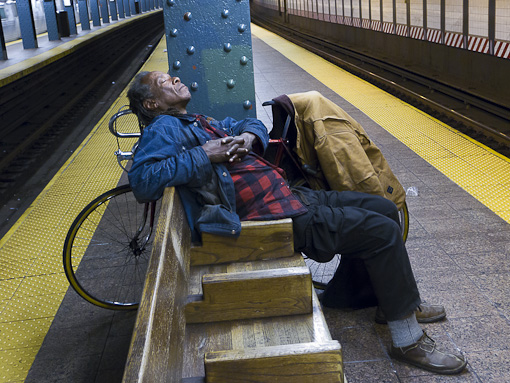
The $ 2.25 to ride the New York City subway is probably the best entertainment admission price in town, especially if you travel through the underground with your ears wide open.


Earlier this month I recorded the sounds of a classical Spanish guitarist, then a Manhattan bound train arriving, doors closing, being whisked to another station, where I’m finally left alone on an abandoned platform. Direct link to two minute clip here.

Sure you need your eyes to read the stories on your fellow traveler’s faces, spot the rat running down the rails, be amused by the zombie Halloween costumes. But listening to the sounds surrounding you will make the trip much richer.


Conversations in Polish, Spanish, Chinese and where in the world are they from ? Music from violins, flutes, drummed upon plastic buckets. Humming air conditioning, whooshing air brakes, ear shattering screeching. Foot steps, the train fading down the tunnel, now it’s quiet.

During my assignments and travels I've been recording the sounds I overhear, and many don't have supporting photographs or stories. This occasional series will be my excuse to share my audio orphans, these Sounds Overheard.