Showing posts with label China. Show all posts

Wednesday, September 17, 2014

Travel Photo Tips: Moments Between The Notes


Kung Fu performers from world famous Songshan Shaolin Temple in Henan Province face off in decisive moment.

Yesterday I was complimented by a caller that the photographs on my web site were “so nice and ... so clear.” For a moment I wondered if praising my ability to get things in focus was really a compliment, as I had been at this game for a few decades, but then I remembered that often people find it difficult to articulate exactly why a photo works for them. “So clear” usually means “I get it!”.

Very orderly and quiet lunch room for young Kung Fu students at Wuseng Tuan Training Center, Shaolin Temple, Henan. Between the notes sips and sticks important.

For me the technical craft of focus, f-stops, composition, color and light intuitively blend into the moment when I trip the shutter and capture a unique story. The viewer doesn’t need to recognize my hidden steps to understand the photograph.

 
Vendor offers just spun cotton candy for waiting night time visitors in Pingyao, Shanxi.
 
In photographing people one of my favorite hidden steps is timing,  just the right moment so we, the viewers, connect human being to human being. The peak action of Kung Fu performers facing off, fists out and eye to eye is the interesting icing on the photo cake. We really feel the drama playing out on a far off Chinese mountain.

 
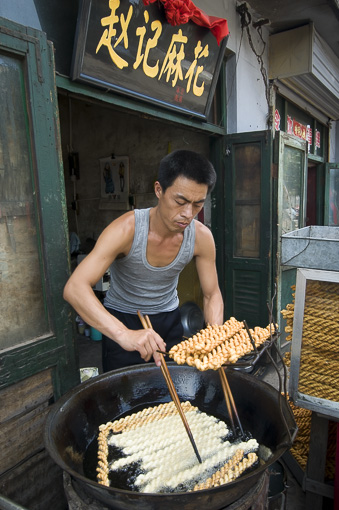
Frying rope bread called Mahua at shop spilling onto sidewalk, Pingyao, Shanxi. 

But sometimes the decisive moment is more subtle and more difficult to capture because I have to watch between the moments for just the right tilt of the chop stick or turn of the body.  I liken it to editing a good interview where the reflective pause is as important as the words on either side. The small moments between the major notes can tip the viewer over into “I get it!” and make the photograph “so clear”.


Quiet moment captures shoe repairman and customer sharing shady sidewalk with 
bicycle shop, Pingyao, Shanxi.
 
A year ago this month (first five blog posts here) I was traveling in China with friends where we were invited to exhibit at a municipal cultural center and we attended an international photography festival, with extensive travel in between. Yes China is exotic, the people fascinating and the politics meaningful. But by golly this trip was the toughest photographically of all my trips there. The weather was hot, the skies were pollution brown and we practically never had delicious light. And now I know why some regions we visited are not in the guide books ... nobody in their right mind should go there. But we had a great time meeting Chinese from all walks of life and made photos in spite of the challenges. 

Next week:  Travel Photo Tips: People Don’t Bite (Usually).


Tourists pause on Jinshanling section of the Great Wall, Beijing. Composition and light set stage for freezing people in moment.


Tuesday, December 31, 2013

Chinese Family, Friends & Selfies

As the end of the year catches up with me, I thought I'd wrap up with some miscellaneous candid street photographs from this Fall's trip to China. This selection captures a handful of the 1.3 billion Chinese ... urban, middle class citizens enjoying their children, parents, grand children, best buddies and close friends.


Mother and teen daughter walk arm in arm down busy Lianyungang shopping street in
Jiansu Province.


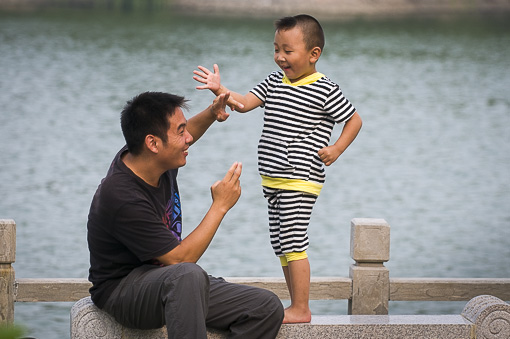
Son play attacks his father lakeside at the Emperor 's Palace Theme Park in Kaifeng, Henan Province.


 Baby and his grand mother discover high flying balloons at a city park in Kaifeng, Henan Province.


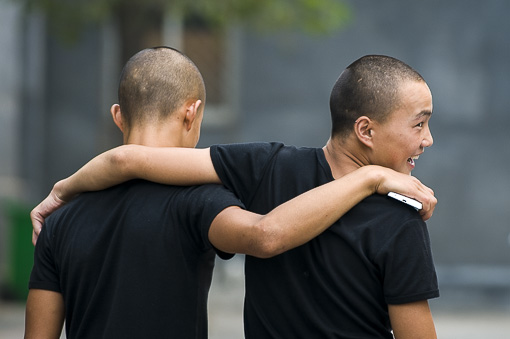
 Best buddies walk to lunch after morning of Kung Fu drills at the Weseng Tuan Training Center in Henan Province.


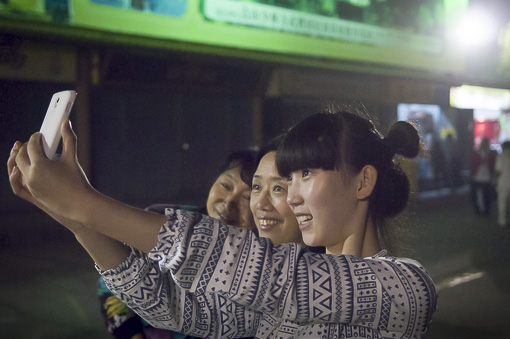
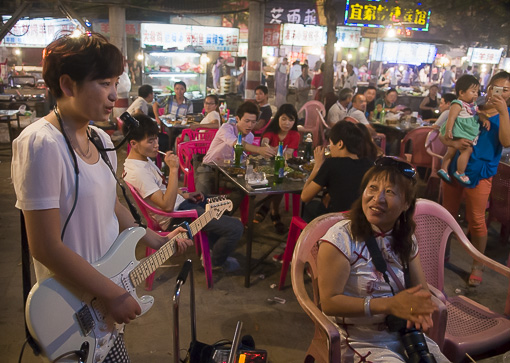
 A selfie records friends attending an evening outdoor music performance in Denfeng City, Henan Province.

Thursday, December 19, 2013

Sounds Overheard: Smog, Muzak & Crickets


The 13 story tall Iron Pagoda of the Buddhist Youguo Temple dating from 1049 pierces the smoggy sky last September in Keifeng, Henan Province, China. 

 
Ambient sounds recorded in Iron Pagoda Park range from tranquil to chaotic: 0:00 gabbing tourists, 0:14 background music on loud speakers, 0:31 parakeets for sale,  0:46 children's train ride, 1:23 cooing while feeding pigeons, 1:40 grand children & grannies, 1:48 crickets compete with music in quiet corner. Direct link for iPhones & iPads or if receiving post via email.

One of the surprises of traveling off the beaten tourist track in China is finding authentic photographs and sounds in not so glamorous places, so as dawn broke over Keifeng in China’s Henan Province, I was excited to get going.

This being my eighth trip to China, I knew from experience that Sunday morning last September that I could stumble onto interesting people doing interesting things in colorful ways.

Once in Yunnan I left a history museum tour and discovered a bride and groom in full wedding regalia strolling through the park. A random turn off the highway led to Buddhist monks in Qinghai inviting me into their yak hair tent to listen to eight-foot-long horns. In Inner Mongolia I sipped warm horse milk inside a yurt and met Westernized tweens texting in bunny slippers. All these chance encounters made terrific memories.


Early morning exercises follow well worn track around trees in park surrounding the Iron Pagoda in Kaifeng, city of five million on the banks of the Yellow River.


This morning as the sun rose it feebly punched through the thick gray smog. Buildings across a four lane street were obscured, and it was hot and humid too. Ugh, I thought as I optimistically entered the park surrounding a temple. There had to be a picture here in spite of the horrible light. There had to be sounds of everyday life here somewhere.


Yes and yes, within minutes I found both,  photographs and ambient sounds depicting off the beaten path China. Maybe not as colorful or glamorous as my other Chinese experiences, but authentic enough for another terrific memory.

During my assignments and travels I've been recording the sounds I overhear, and many don't have supporting photographs or stories. This occasional series will be my excuse to share my audio orphans, these Sounds Overheard.

Monday, November 18, 2013

12,000 Kung Fu Children

The 12,000 young boys and girls kicked and thrust, their shouted responses echoed from the tall dormitories and off the concrete drill field as their instructor’s Chinese commands squawked from loud speakers. Kung Fu movements in unison as far as I could see, the children and teens were in endless formations radiating in all directions like corn blowing in the wind.


iPhone & iPad friendly version or if you've received via e-mail. Listen to 1:30 of field-recorded sound and watch still photographs from Weseng Tuan Training Center in September, associated with legendary warrior monks of China's Shaolin Temple. 

In September I was visiting the Weseng Tuan Training Center on the same day as picture day, and this being China, picture day was a BIG deal. Mr. Qin Hua was eight stores up with his Nikon to capture the assembled thousands in a grand panoramic view. I opted for a view from ground level.

The school is closely associated with the Shaolin Temple at Song Mountain in China’s central Henan Province. The temple’s legendary warrior monks date from the chaotic politics of the sixth century, when the emperor awarded favors to Buddhists with fighting skills. For centuries many martial arts traditions flourished as trade and religion between China and India flowed, with the Shaolin form of Kung Fu becoming the most prominent.


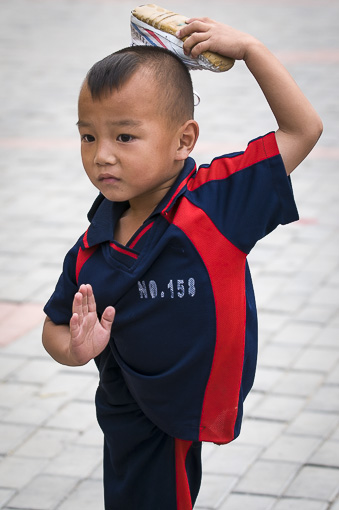
After just three months at boarding school, five-year-old demonstrates Kung Fu moves. 

From Wikipedia:
Kung Fu is a Chinese term referring to any study, learning, or practice that requires patience, energy and time to complete, often used in the West to refer to Chinese martial arts ... Originally to practice Kung Fu did not just mean to practice Chinese martial arts. It refers to excellence achieved through long practice in any endeavor. 
Today this blending of hand to hand fighting with Buddhist ideology continues to embrace self-defense, body-building and athletics, with Kung Fu becoming a world wide personal philosophy and sport.

Tuition, room and board at the Wuseng Tuan school is around $ 4,800 a year, a considerable sum for a Chinese family in spite of the country’s recent economic growth. Besides good basic academic education, many students hope to join the military or work as body guards. There are thousands of Kung Fu schools throughout China, all competing for a piece of a very big business. Yet the day before I saw a group of a half a dozen English speaking twenty something men and women training one on one with a saffron robed monk in the nearby Shaolin Temple.


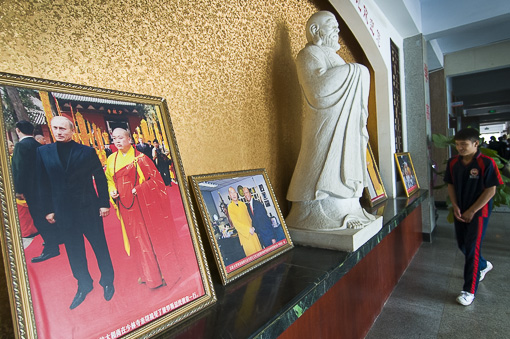
Photograph of Russian President Vladimir Putin and Shaolin Temple abbot is proudly displayed at the Wusen Tuan training center in Henan Province, China.

With the school enrolling 15,000 students, I was wondering where the other 3,000 were, as I had taken on face value their assertion of 12,000 Kung Fu children in front of me. Give or take a handful, seemed reasonable to me.

Just as I was about to ask, several accomplished five-year-olds were trotted out to perform for us. With just three months at the boarding school these cute tikes whipped through their foot kicking, hand chopping routine, climaxing with placing one foot behind their heads while standing perfectly still. Were the future generals of the People’s Liberation Army before me, standing like tall storks? With the world’s largest armed forces, China could always use one more Kung Fu practitioner.

Thursday, October 31, 2013

Sounds Overheard: Pingyao's Chaotic Streets


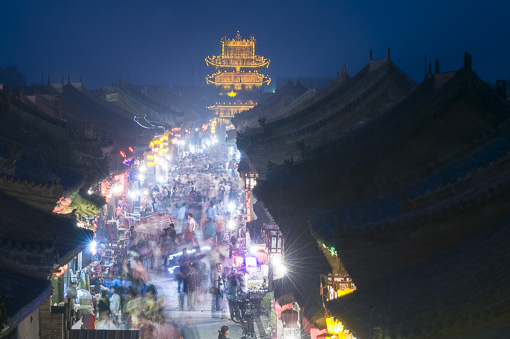
At dusk the 14th century Market Tower rises from cobblestone streets teeming with people in the Ancient City of Ping Yao in China's Shanxi Province in September.


 0:00 traditional instruments, 0:14 bamboo flute, 0:32 swarms of people, 0:40 fire crackers, 0:49 street vendor, 1:01 toy rubber chicken seller, 1:15 outdoor wok, 1:30 police cart, 1:43 live bar music

iPhone & iPad friendly link, or if you've received an email without audio player.


Considering only pedestrians and pedal powered bicycles are allowed into the central core of the ancient walled city of Pingyao, an amazing tapestry of sound is generated in this city of 50,000. Not ear shattering New York City jack hammer and subway loud. But just as enveloping ... shouting vendors, crackling fireworks, banging gongs, sizzling woks, bicycle bells, conversations soft and shouted. Here sounds are every where, sharpening your senses, your eyes noticing more detail, your nose discovering new flavors wafting on the air.


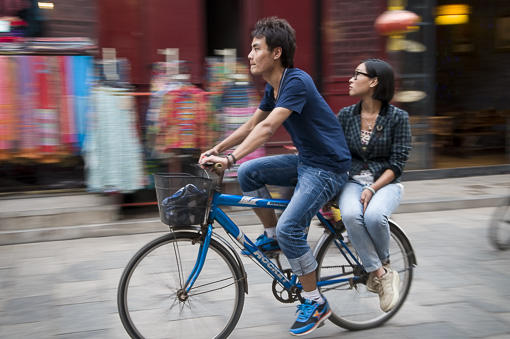
As shop lights twinkle on, a young couple thread Pingyao's narrow streets last month. 

 When the magic hour arrives at dusk, the sky goes from deep blue to black and the red cloth lanterns twinkle on in the restaurants and shops, there is no quiet spot within these stone walls built over 500 years ago.

 It's due to the hordes of Chinese and foreign tourists and businesses catering to them. So many visitors flock to what are considered among the best preserved city walls in the world - Pingyao is a UNESCO World Heritage Site - that rampart tourism and development are considered a major threat.


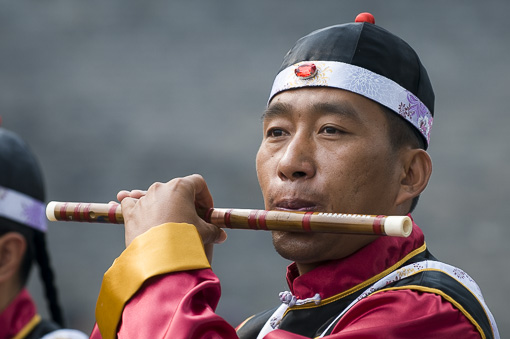
Costumed musician plays bamboo flute below the South Gate in the 6,000 meter stone wall that encircles Pingyao, which is about 450 miles West and a little South of Beijing.

Don't let the crowds discourage your visit, there's lots of room. What fun being a fly on the wall among the throng, people watching, recording sound and taking photographs. If those pursuits aren't enough entertainment, then a $5.00 foot massage lasts almost an hour. At a street side table a large bottle of warm beer is 75 cents and great dinner of stir fried pork and eggplant a few dollars more. The pandemonium becomes background music

I never experienced a quiet and calm Pingyao. I suspect there's an hour when the nightly hubbub dims as the shops and bars close and visitors stroll off to bed. Probably when the sky brightness early in the morning the streets are momentarily quiet as the city regains it's strength, soon to murmur back to life.


Preparing Mahua, a friend dough twist cooked in peanut oil, on the sidewalk of the Zhauji family shop.

During my assignments and travels I've been recording the sounds I overhear, and many don't have supporting photographs or stories. Well, today there's a short story and a few pictures. This occasional series will be my excuse to share my audio orphans, these Sounds Overheard

Wednesday, October 23, 2013

Billions Of Chinese Phones Love Big Nose

On my September trip to China it seemed to me a large percentage of the country's 1.2 billion people were talking on their mobile phones, sending texts or surfing the internet. I saw the phones in the hands of parents commuting through traffic with children hanging off their electric scooters. In the country side I noted farmers chatting. While zooming at 200 Km per hour on a high speed train, fingers flew playing internet games. 


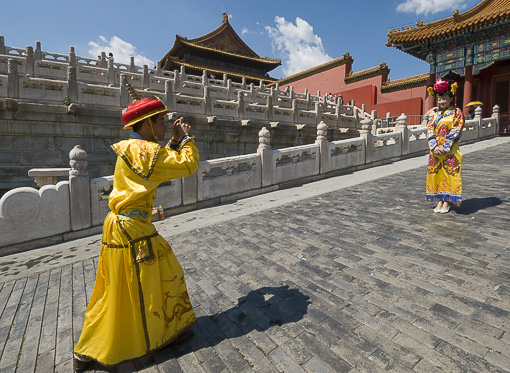
While wearing rented 17th century costumes boyfriend snaps mobile phone photos of girlfriend in Beijing's Forbidden City last month.

And the Chinese were snapping photos with their phones of everybody and everything. In the park with grandma and grandpa, tourists dressed in Qin dynasty costumes, pictures of photographs hanging at photography festivals. Even pictures of photographers standing in front of their photographs at photography festivals.

A recent report claimed that among the 1,200,000 citizens of China, there were 1,104,000 mobile phone users. Gee that seems high, even noting that maybe people have multiple handsets or SIM cards. But come to think about it, though, as a Westerner I must of had a cel phone camera pointed at me nearly a billion times.


While baby sleeps mother stays connected with smart phone while visiting the Longman Caves in Luoyang, Henan Province, China.

Every day, often multiple times an hour, while walking down the street I would catch several faces smiling at me, with one of their party trotting up to me for a photo. Smile, "ha ha ha ha" and thank you in English and Chinese. Then the shooter and the subject would change places, others would see the activity, waiting their turn to be photographed with the "Dabizi".

I learned to pronounce it "Dah - be - zerrr", "big nose" or "long nose", the Chinese description for foreigners. I figured that described me pretty well, so I embraced the term.


In September street performer sings for tips at night market while baby-toting mom (right) photographs the Big Nose, Kaifang, Henan Province, China.

 One afternoon I was completely pooped from walking in an amusement park for hours in the heat and humidity, so I bought a cold bottle of juice and was leaning on a tree while the multitude surged around me. I felt a gentle nudge on my back, and turning, discovered a teen age girl sneaking close to have her picture taken with the visiting Big Nose. She was to shy to talk to me, so I turned around and gave her camera phone toting boyfriend a big grin.


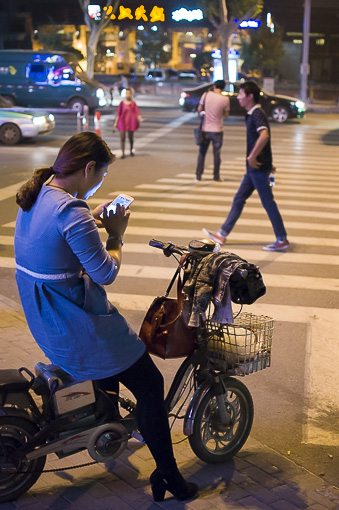
Last month young woman commuting home on electric scooter pauses to text, Anyan, Henan Province, China.

OK the headline at top is a bit of hyperbole, a billion Chinese weren't really shooting my picture, nor a million, and I doubt if no more than a bunch of dozen zoomed in on me. But I had fun meeting so many Chinese who were friendly and genuinely curious about a Big Nose.

Tuesday, October 23, 2012

Sounds Overheard: Chants At Rebuilt Monastery


Incense wafts on late afternoon sunlight at Reting Monastery North of Lhasa, Tibet. 

The Reting Monastery’s 11th century walls were freshly painted bright white, deep orange and dusty red. Gilded deities kept an eye on me from their perches atop cracked timbers supporting the roof. I felt I could reach up to touch the brilliant blue sky, as I was standing extra close at over 13, 000 feet. It was completely quiet. No breeze rustled the fall leaves, no birds chirped, no footsteps distracted me.


Listen to 1:22 recording of two Tibetan Buddhist monks chanting and playing drum and cymbals. Try headphones to hear stereo effect. iPhone & iPad link.

Suddenly two young monks rushed across the temple courtyard and disappeared through a narrow stone doorway, their red robes a quick flash of color. Soon a loud drum shattered the silence, boom, boom, boom. Then brass cymbals crashed. I followed the rhythm through the doorway and into a narrow room, a sliver of stony space with candle soot blackened walls rising two stories to an open window high above. 

The two monks began chanting in Tibetan, rapid fire fast, their voices drawn up and out the window and over the hillside temple complex, calling their brother Buddhist monks to evening prayers.

During China’s chaotic Cultural Revolution, this magnificent monastery North of Tibet’s capital Lhasa was nearly destroyed, stones and timbers torn down and salvaged for building projects, it’s monks harassed and disbanded. Since Reform and Opening of the late 1970’s, China has slowly become an economic power house tolerant of religion and money making, as long as the Communist Party is not threatened. Government and private funds are rebuilding many cultural sites, and Reting’s former splendor is slowly rising from the large piles of rubble awaiting rebirth.

During my assignments and travels I've been recording the sounds I overhear, and many don't have supporting photographs or stories. This occasional series will be my excuse to share my audio orphans, these Sounds Overheard. Please also visit my Miami commercial photography portfolio.

Monday, August 27, 2012

Roaring Chinese Children Sweep Photo Cobwebs

I had just flown and sat around in airports for nearly 30 hours to reach Chengdu from Miami, and by my first morning I needed to stretch my legs, get some fresh air and make some photographs. As I entered Wenhua Park, just a few steps from my hotel, I could feel the cobwebs tugging at the corners of my tired brain.

I love wandering Chinese urban parks, especially early in the morning while millions head off to work through honking traffic and yellow smog. I find open spaces, greenery, even chirping birds. And parks provide lots of people enjoying themselves outdoors, easy to approach and photograph.


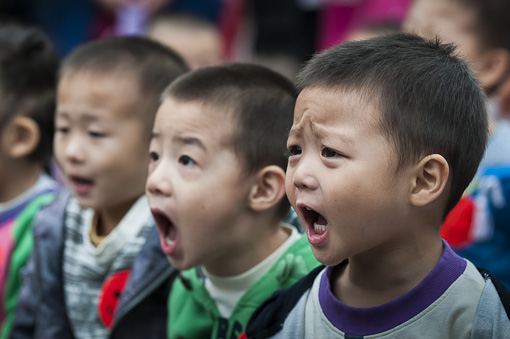
Kindergarten-age children roar like lions during school outing in Wenhua Park, Chengdu.

I’ve been invited to China several times to attend photographic festivals, and once to lecture at a trade school, and my eager hosts booked my days with activities they thought a photographer would enjoy. Visiting the ethnic village and puppet factory made photos. The trip to the electrical cord factory and municipal museum, not really. But by getting up early and skipping breakfast, I could fast walk to the closest park and find people I would shoot on my own terms.

And skipping a breakfast of cold noodles with super spicy meat sauce, watery oatmeal or pickled shredded vegetables would keep my mind on the pancake house back home give me time to shoot.

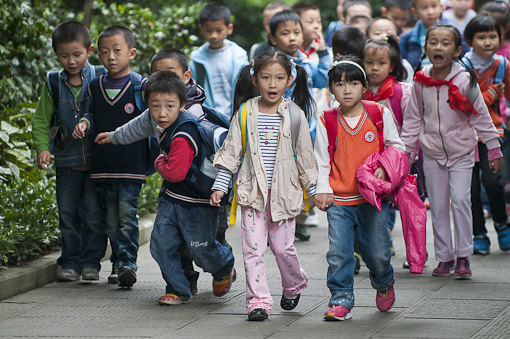
 Children race to picnic area in Wenhua Park last October.

On this weekday in Wenhua Park I found children flowing past the usual seniors tango dancing and performing tai chi with swords. The young, brightly dressed elementary aged students were on school sponsored outings with teachers and parent volunteers.

As about three dozen kids sat in tiny plastic chairs, their teacher read them an adventure story while encouraging them to vocalize the animal’s roars and growls.

As I plopped down nearby on the pavement and began making photos, the children cheered, laughed and howled at the top of their lungs. I shot wide, then closer, then super tight, picture after picture, the children’s expressions were terrific. Before I knew it, their roaring and blown away my cobwebs and I was ready for the coming three weeks traveling in China.


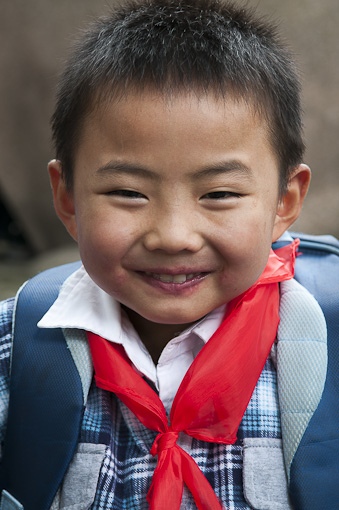
Wearing the red scarf uniform, a member of the Young Pioneers is curious about my 
cameras in Wenhua Park, Chengdu, China.

To see more photography from China, please visit my Miami editorial photography portfolio site.

Thursday, August 9, 2012

Sounds Overheard: Seeing Tibet With Closed Eyes

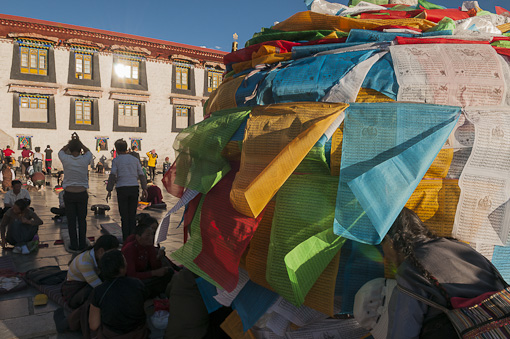
Pilgrims worship at the Jokhang Temple, Tibetan Buddhism's holiest site.

Exploring Lhasa on my first day in Tibet was so overwhelming that I was having trouble seeing photographs. Crowds of Buddhist pilgrims dressed in regional costumes streamed down every street, Han Chinese merchants in Barkhor Square sold everything from prayer wheels to yak butter and the occupying Chinese army marched with assault rifles at the ready.

I was gasping in the thin air at 12,000 feet altitude. My stomach was deciding if it liked my yak stew lunch. Colors were way to saturated, the blue sky, the monk’s saffron robes and the rooftop golden lambs.

So I closed my eyes and started listening for pictures.


Close your eyes, listen to the sounds around the Jokhang Temple in Lhasa, and tell me what you see. iPhone & iPad link to 1:48 long MP3.

The first sound I heard was a far off rhythmic slapping and chanting.  I discovered over a dozen workers, men and women, building a traditional aga earthen roof atop the Jokhang Temple. They were on their hands and knees with hand held wooden paddles compacting the mix of gravel, dirt and water infused with willow tree bark.

I recorded the sound of wooden and leather hand protectors scraping on the cobble stone temple square as the pilgrims prostrated them selves in repetitive prayer. They stood with their hands together above their heads, then down on their knees, then on their stomachs with arms out stretched.

My ears discovered a man singing prayers from a well worn book of Tibetan script, his voice competing with the thousands of pilgrims circumambulating the mile-long circuit around the temple.

Slowly the sounds awakened the visual corners of my brain, I opened my eyes  and began making photographs.

Editors note: If you visit the "aga earthen roof" link above, poke around the site a little and see how the Chinese government views the Tibetan people.

During my assignments and travels I've been recording the sounds I overhear, and many don't have supporting photographs or stories. This occasional series will be my excuse to share my audio orphans, these Sounds Overheard. Please also visit my Miami editorial photographer portfolio.

Friday, May 18, 2012

Sounds Overheard: Tibetan Monks' Spirited Debate

Spirited debate between Tibetan Buddhist monks at the Drigung Thel Monastery, Lhasa.

While traveling in Tibet last October, Tibetan Buddhist monasteries were not only locations to create some great photographs, but were also sources of terrific natural sound.

Today's post is short and sweet, three photos of debating monks from three monasteries, and a short recording of natural sound from one of them.

Listen to this 1:13 field-recorded natural sound of Tibetan Buddhist monks debating at the Sera Monastery.  iPhone & iPad friendly version.


Monk debates at the Sera Monastery, Lhasa.

From an earlier post on this blog, a little background on the debates:
Debate is an important part of a Tibetan monk's training, and is said to help expand the mind, increase mental sharpness, develop analytical skills and help gain mental clarity. The debates follow a strict form, with the standing questioner challenging the thesis of the humbly sitting defender. As the questioner raises doubts, the exchange becomes increasingly animated, with exaggerated body language, lunging, hand slapping and loud shouting. The defender mostly sits quietly and looks away, occasionally making a counter point by waving his arm.
As one monk, left, encourages the defender, right, the challenger, center, claps and lunges to make his point at the Reting Monastery.

During my assignments and travels I've been recording the sounds I overhear, and many don't have supporting photographs or stories. This occasional series will be my excuse to share my audio orphans, these Sounds Overheard. Please also visit my Miami commercial photography portfolio.

Friday, March 30, 2012

Video Stories With Vision & Collaboration

As a group still photographers are creative, independent and stubborn as we’ve relied primarily on ourselves in pulling successful photos from challenging assignments while at the same time embracing the digital information age.  But as we’re being asked to add video to our story telling tool set, we’re being forced to - gasp - learn new skills and - double gasp - collaborate with others.


Four still photographers collaborated in producing a web video promoting Nancy Brown’s photography book “Simply China”. Paul Morris with video, lighting and studio space. Tom Salyer recorded sound and edited. Jonathan Rios as production assistant. Nancy Brown, on camera talent and stills. http://vimeo.com/39290394

On my section of the long tail of photography the four-year economic crisis has reduced my assignment budgets to hiring an assistant to very rare. I’m producing my shoots, setting up my lights and processing my own files. That’s were stubbornness comes in for us, we can do it ourselves doggone it.

I’ve heard wondrous stories of colleagues working on high budget advertising shoots with a producer, hair and makeup, assistants and digital tech. And a lunch budget, oh my! 

OK, I agree, the idea of every photographer being a lone wolf working completely on their own is not completely accurate, at least in the commercial photography field. We all have colleagues we can call for advise and insight with projects, our art directors give us direction, and most still shoots are not overly complicated.

Working either on our own or with a small crew, our independence drives our ability to visualize our images in advance and make them happen. Our “eye” is our strongest asset, and can be transferred to another medium.

By comparison, with motion projects the nuts and bolts of producing technically successful video is very complex and has a steep learning curve. You thought learning about color spaces and layer masks were hard? Try mastering Final Cut Pro, motion graphics and compression codices.

Video requires many jobs: director, producer, director of photography, camera operator, lighting grip, sound recordist, and editor. On simpler shoots a person can handle multiple jobs, but there are to many moving parts for one transitioning still photographer to handle them all. The story line will be jumbled, the picture overexposed, the sound levels low.


NFL St. Louis Rams head coach Jeff Fisher is interviewed last weekend by Paul Morris, far left, and Orlando Noah, left center, at The Breakers, Palm Beach, FL. Photo by Tom Salyer.

Photographers need to collaborate with the people who already have these skills, and our unique vision is the key to success. We already approach image making with our life time of experience as visual story tellers. We already know how to compose a great image, capture a decisive moment, and creative lighting is a piece of cake.

Clients are beginning to come to still photographers asking to add on motion for web sites and social media because they trust their eye and ability to successfully complete jobs. Don't worry big video production companies, most of us aren't competing with you. Yet.

Examples:

- Minneapolis based Ryan Siemers has been expanding his architectural photography business by adding motion, interviews and animations.

- Jeffery Salter, a Miami portrait and fine art photographer, collaborated with videographers on stories for Readers Digest: Richard Patterson on former football player Keith Fitzhugh, and with Chuck Fadely on long distance swimmer Diane Nyad.

- Miami commercial photographer Paul Morris has added video to two still photography assignments in the past months: executive interviews for farm equipment trade association American Equipment Manufacturers, and National Football League head coaches for New Era head wear suppler. I was sound recordist on both, and Orlando Noah and Meine Smith of Digital Decaf provided video and digital services on the latter.

Please see example of my Miami multimedia photography portfolio.

Tuesday, January 31, 2012

Not So Picturesque Chinese Village Yields Photos

When “Mike” promised to take me to a quaint little village - “many good pictures you like for sure” - situated on the outskirts of the crowded, polluted and generally not quaint provincial capital of Sichuan Province, Chengdu, I said yes.

I met Mike while I was soaking in the peace and quiet of the Wenshu Monastery, an oasis within a metropolitan area of 14 million Chinese. He was there trolling for a days work as a tour guide. After nearly three weeks of travel in China and Tibet, I was pretty worn out with photography, but was game for one more day.

Last October, baby boy rides in his Grandfather's basket through Saturday Market.

Like many Chinese, Mike has adopted an “English name” for the sake of us visitors who are unable to get our Western tongues around Chinese names. He was 40 ish, wore thick glasses and scuffed shoes, and presented a hand written then Xeroxed business card listing about a dozen talents. But he was charming and full of stories of all the photographers he had escorted into hidden Chengdu. Back stage at the Sichuan opera, he suggested. Sorry, I’ve done that. Visit a religious person in their private quarters, thanks, I’ve had tea with a monk and cookies with a nun. Visit a picturesque farming village untouched by urban sprawl?

Ok, why not? I really didn’t expect a People’s Paradise, but I’ve made interesting photographs all over China in pretty drab surroundings. Safety, going off with a stranger? No problem, I was traveling with three women friends, they would protect me.

As the next day dawned with a drizzle washing the pollution from sky to street, a tiny rattle trap van wheezed up to the hotel, our private car with driver for the day. Mike was riding shotgun. No seat belts, but they would of just transmitted more discomfort from the vehicle’s frame, which had no springs nor shocks.

Seniors in old style Mao jackets smoke and play cards in tea house outside Chengdu.

We drove over an hour, past the modern skyscraper skyline, down the eight lane highway, then way out two lane roads through farm fields being bulldozed for housing. A dirt track led to an old stone bridge spanning a muddy brown river. As we pulled into the village, a woman pitched a bucket of kitchen scraps into the waterway from a house overlooking green fields.

We were in luck, it had rained all night, so the village wasn’t the least bit dusty, only muddy, and it was Saturday morning, market day! We plunged into the crowd and worked our way along the single street running above the river. Everything was for sale, onions, nuts, pet fish, clothing, live ducks and cheap electronics. Between vendors, customers and strollers, the entire town had turned out this morning. Coffee shops were full of mahjong players, smokers in blue Mao jackets puffed on hand rolled cigarettes stuck in long pipes, and mothers carried their “one child policy” children dressed in their cutest outfits.

Mike knew everyone, or at least he let on that he did. We were introduced to the smokers, the barber, the old lady crocheting in her kitchen goods stall, Mike was best friends with them all. It was fun watching him act important, and it helped to have someone breaking the ice with each group of new faces around the next corner.

Market day brings man in for head shave, while his warm cap awaits his departure.

And around those corners the drab little village yielded photographs, slowly, one by one. I kept an open mind, smiled and interacted, caught those passing moments that told a story of this village on this market day under this gray sky.

Lunch at the open-onto-the street kitchen was Mike’s triumph. With great flourish, insight and experience he ordered dish after dish for our group. Spicy noodles, tangy chicken, steamed vegetables, cold beer bottle after bottle, all witnessed by the market visitors with sufficient money to dine at neighboring tables. The rest of the market streamed by to check us out. (Editors note, the driver only had one beer, Mike saw to that.)

As the dishes arrived, one by one he educated us on their ingredients and flavors, and eloquently complimented the restaurant’s owner and her chefs. So much food, we worried! No worry, Mike and the driver set to work, clicking chopsticks and slurping soups, they kept going long after we were full. Obviously this was a banquet for the two of them, a tour guide perk, even though it only cost the four of us about $ 6 each.

Mike peppered us with questions about current events in the United States, and was obviously well informed. What did we think about the log jam in Congress? European debt crisis? President Obama’s relationship with President Hu? Between flying noodle and rice, “what you think about” ... sports, popular music, social media. Whew!

It was quite a day, our “picturesque” little village and our new best friend, “Mike”.

The last I saw Mike, he had just peeled off several large Yuan notes for the driver, and was walking off through Chengdu’s pedestrian crowd counting his money with a big smile on his face.

To see multimedia audio slide shows about travel in China, please visit my Miami multimedia photography portfolio site and click through to "Chinese Stories". Please also visit my Miami commercial photography portfolio.

Wednesday, January 18, 2012

Sounds Overheard: Yaks & Pilgrims Ring Bells

Moving shaft of sunlight warms young Buddhist Tibetan Monk studying at temple entrance, Thasilhunpo Monastery, Shigatse, Tibet.

Traveling requires all of your senses to fully experience your surroundings, whether they are in exotic Tibet or some place closer to home, like the dusty strip of sprawling gas stations, fast food joints and mini marts you've stumbled upon after getting off the interstate highway.


Listen to one minute recording as birds chirp and large brass temple bell rings, then to nomad yak herders in outdoor market shopping for bells to hang around their livestock. 


Stand still for a moment in front of that mini mart and listen ... traffic and horns assault you, sure. Wait a moment, between traffic lights, those little chirping birds, probably sparrows, hopping around the trash filled hedge. Gee, they are pretty sounding. Hear the salsa music wafting out of that bodega over there, that sound adds some more color. A nice gentle breeze rustles the tree leaves above your head, a bossy black crow barks down from atop the power pole.

Listening to the details, sometimes loud, sometimes subtle, makes this place, this very moment in time, much richer to you. OK, I know, the light has changed and this spot is getting just plain loud, so lets relocate to Tibet. Poof!

Now we're standing under a foot tall brass bell, green with age, hanging from colorful braided cords from the hand hewn rafters of one of the Tibetan Buddhist temples in the Thasilhunpo Monastery. Founded in 1447 in Shigatse, Tibet's second largest city, the monastery is both very quiet and very full of sound. Pilgrims jump with outreached finger tips to ring the bell hanging just out of reach, rich tones reverberating and fading into background sound of happy birds chirping in the sunny courtyard.

An hour later we're visiting the outdoor market in busy downtown Shigatse, and are eavesdropping on two men dressed with red cloth braided into their long hair, silver jewelry around their necks and on their fingers, staying warm in sheep skin jackets.They are test ringing inexpensive bells to hang around the necks of their livestock, some as big as their fists for yaks, some walnut sized for sheep.

Listening carefully can enrich our travel experiences no matter where we are. Now let me decide, do I stay in Tibet, or Poof, I teleport back and dig into a lime green Double Big Gulp at the mini mart?

During my assignments and travels I've been recording the sounds I overhear, and many don't have supporting photographs or stories. This occasional series will be my excuse to share my audio orphans, these Sounds Overheard.  

More stories from Tibet are elsewhere on this blog, and more examples of field-recorded natural sound are at my Miami multimedia production portfolio site.

Friday, December 16, 2011

Sounds Overheard: Incantations Of Tibeten Nuns

Buddhist nuns wear elaborate head dresses while chanting last October in Lhasa, Tibet.

While visiting the Anezamkang nunnery in Lhasa I was reminded of the nugget of video production wisdom that goes "seventy five percent of what you see is what you hear".
 
Do you "see" more when you play 1' 15" natural sound recording of nuns chanting?

I must admit I was in a heck of an visually exotic spot, inside a tiny Tibetan Buddhist temple draped ceiling to floor with colorful banners, filled with three dozen nuns wearing elaborately embroidered robes and hammered silver-paneled hats topped with tall turbans. The nunnery was hidden down a tiny stone alley in Lhasa's ancient Tibetan quarter, out of sight of the Chinese army troops patroling with automatic weapons a few blocks away. I was gasping in the thin air at 12, 000 feet, and contentedly digesting a meal of yak noodle soup.

But listen to the above field-recording audio file of the nuns singing and chanting, ringing brass bells and swinging small paddle drums, and tell me how exotic the scene feels to you now ... seventy five percent better? I would say the experience is immeasurably more intense and real.

During my assignments and travels I've been recording the sounds I overhear, and many don't have supporting photographs or stories. This occasional series will be my excuse to share my audio orphans, these Sounds Overheard.  

More stories from Tibet are elsewhere on this blog, and more examples of field-recorded natural sound are at my Miami multimedia production portfolio site.

Wednesday, November 30, 2011

Faces of China Photographic Exhibition Now Online

I’ve been hearing from some of my friends and colleagues that they’ve been unable to see my Faces of China exhibit currently hanging at the Archbishop Curley Notre Dame Gallery of Art, which opened earlier this month, and closes January 21, 2012. Their work or personal schedules have interfered, and some aren’t from the Miami area and won’t have the opportunity to visit.


Faces of China slide show runs just two minutes ... iPhone & iPad version.

So I decided to set up an on-line version of the 38 image exhibit, viewable right here in your web browser. Each image is on screen for just three seconds, so the entire show will take barely two minutes of your time, 30 seconds more if you read the shortened artist’s statement at the end.

For the show’s opening November 5, I mixed a 20 minute audio track of field-recorded natural sound from my trips to China, which played in the background, giving visitors an extra dimension of understanding to the photographs.

This on-line edition of the exhibit is accompanied by a brand new sound track of a guzheng, a multi-stringed Chinese instrument that is plucked, which I recorded at the Buddha Zen Hotel in Chengdu on my last night in China in October. A very peaceful waterfall accompanied the lovely young lady who was performing that evening.

Six images from Tibet are included, shot just two weeks before exhibit opened.

In September I wrote about the then upcoming Faces of China exhibit, and I’ll take the liberty of reprinting my artist’s statement here:
Visiting China as a photographer for the first time was very intimidating. With a population of 1.3 billion and one of the planet’s most ancient cultures, I worried that my images would not contribute anything new. How could I tell the story of the political transformation since Liberation in 1949, the legacy of the Cultural Revolution, and an economy that’s moved hundreds of millions of rural peasants to the cities and transformed the nation into world power?
I decided to meet China’s people one at a time, capture a tiny bit of that nation’s character one photograph at a time. I went into the streets and markets and temples with no particular agenda other than to see the relaxed and candid side of people from a culture very different from my own.

After seven trips to China I present here no insights into their political, economic and environmental challenges. I simply try to look into a pair of eyes just like mine, accept them for who they are at that moment, make a connection that I can digitize, take home and share. These Faces of China are fleeting glimpses of people that are like you and me, people who are trying to live their lives to the fullest, plan for the future, contribute to their community. And sometimes they sneak a peek at an unusual Western visitor with a camera.

My technique to capture these photographs is very basic: I show my subjects respect, smile, indicate an interest with body language, and treat them as I would want to be treated. I say hello in badly mispronounced Mandarin, “ni hao” throughout China, “sain baina uu” in Inner Mongolia, and in traditional Tibetan regions of Sichuan, Gansu and Qinghai, “tashi dele” brings out the smiles.

Captions accompany maps with featured Chinese province.

For more examples of field-recorded natural sound combined with photography, please visit my multimedia portfolio site. More examples of journalistic photography from China can be viewed at my Miami corporate photography site.

Wednesday, November 16, 2011

Sounds Overheard: Tibetan Lute Melody And Song

Musical detail from Buddhist temple wall painting, Reting Monastery, Tibet.

The singer's soulful voice cut through the noisy traffic, his fingers racing over the strings of his lute-like instrument while pilgrims flowed through the gates of the Dreprung Monastery on the outskirts of Lhasa.

His voice was rather raspy, yet melodic, and blended well with the tune he produced from his worn dramyin, a traditional Himalayan folk music lute common in Tibet.  Sitting cross legged on the ground, he was accepting offerings of small Chinese currency, many Fen, worth a couple of pennies each, with a few one and five Yuan notes in his collection box, valued at a couple of dimes.


Listen to natural sound recording of street performer singing folk song and playing a seven stringed dramyin. 1 minute 23 seconds. 


Last month while traveling in Tibet I encountered several such minstrels, who carry on the Tibetan tradition of oral story telling through song, with dramyins often accompanying their narratives. While in the field I simply enjoyed the music and ambiance of the the ancient temple setting, but upon my return Wikipedia's technical description of the Tibetan lute helped explain what I was hearing.

The dramyin is a long-necked, double-waisted and fretless lute. It is usually hollowed out of a single piece of wood and can vary in size from 60 cm to 120 cm in length (2 to 4 feet). Unlike a contemporary guitar, the dramyin does not have a round sound hole in the wooden sounding board but rather a rosette-shaped ones like a lute. Of its seven strings, only six continue to the pegbox. The seven strings occur in two double courses, and one triple course.

The triple course of the dramyin typically contains the half string on the left, which is usually tuned an octave above the middle unison strings. One of the other two courses are typically tuned an octave apart. The courses are normally plucked in unison during playing. Typically a single note is played at a time, making for melodic music and not harmony. 
During my assignments and travels I've been recording the sounds I overhear, and many don't have supporting photographs or stories. This occasional series will be my excuse to share my audio orphans, these Sounds Overheard.  More examples of journalistic photography from China can be viewed at my Miami corporate photography site.

Thursday, October 27, 2011

Pilgrims Inch Along Ground 300 Miles To Lhasa

Tibet, People's Republic of China:

We were traveling along a rutted dirt road down the Riteng Zang valley, framed on both sides by distant blue mountains, with a silver river reflecting the sun about a mile off. The October dry season had parched the hills a deep brown, the grass even browner, as dust rose from the pilgrim's full-body prostrations as they inched along the ground toward Lhasa.
 
Pilgrim inches his way 300 miles to Lhasa making full-body prostrations.

The six pilgrims would take two steps, about one body length,  drop to their knees, then both hands, protected by wooden and metal paddles, would touch the dirt as they slid down fully onto their stomachs. Forehead tapping the ground, their hands would swing an arch in front of them in the dirt. Stand up, take two steps, down on the ground as they maneuvered through the rocky terrain.

For these six pilgrims,  young men and women mostly in their teens and early twenty's, they had been traveling this way toward Lhasa for the past four months, covering about 150 miles so far. Four more months will be required to complete the final 150 miles, where they will eventually circumambulate the Jokhor, Tibet's holiest temple and monastery.


Pilgrim protects hands with wooden paddles, and wears thick canvas apron with padding that hangs down to his ankles.

Throughout Tibet you see such pilgrims along side the roads and highways, and where terrain does not allow it, they are on the paved roadway where trucks and cars quiz by at high speed. Depending upon terrain, weather and their stamina, they can cover around six miles a day. This group of pilgrims had an advance truck festooned with giant prayer flags carrying their  food and camping gear. Other groups pull a small two wheel cart along with their earthly processions.

Leaving their  home lands in the far reaches of Tibet, pilgrim groups often pass through two mountain passes on the way to Lhasa, the Sera Gola and the Kana, both about 15, 000 feet in altitude. Winter weather drops temperatures to double digits below zero.

Pilgrims are drawn to countless sacred locations in Tibet,  special lakes, mountains, caves and temples, and groups traveling together toward Lhasa will visit as many destinations as possible along the way. They perform a kora or circumambulation of the devotional location, leave offerings of yak butter and paper currency, chant mantras and ask for blessings from the monks.

In Tibet a pilgrimage is not as simple as walking toward your sacred destination. It is considered a great privilege to complete a pilgrimage through full-body prostrations, which focuses your concentration to every step taken, every mantra repeated.

To view more examples of journalistic photography from China, please visit my Miami commercial photography portfolio site.

Monday, October 24, 2011

Tibetan Hospitality In Nun's Cave & Monk's Cell

Tibet, People’s Republic of China

Tibetan Buddhist nun Lousan Drlma has lived in a cave for twenty years just outside the main gate of the Drepung Monastery on the outskirts of Lhasa, and seems to be very content with her way of life. After walking up the dusty road this week, I entered her modest domain through a wooden gate set in a short stone wall. Outside the tiny wooden door into her cave, we sat on low couches covered with Tibetan rugs, where I was offered tea and a round dry bread.


Buddhist nun Lousan Drlma at entrance to cave where she has lived for 20 years.

Our conversation was limited, as my only Tibetan consists of “hello” and “thank you”, so pretty quickly she gave me a tour of her cave. It was about 20 feet wide and 12 deep, lit by one tiny light bulb, which revealed a ceiling long ago blackened by yak butter candle smoke. The walls were decorated with photographs of prominent monks, prayer shawls hung everywhere and low tables supported small shrines. The cave front was closed off with a cement wall.

The next day I met Tibetan Buddhist monk Sherab Juine, who at age 18 was born after Lousan Drlma began living in her cave. We had traveled north of Lhasa to turquoise blue Namtso Lake, which lies at 14,000 feet in the bleak Tibetan plateau. The small Sangr Gompa Monastery sits above the lake, and it’s tiny temple is built into a tall cave in the rock bluff . The two dozen or so monks are easily accommodated on two long benches under the smoky black rock ceiling.


Buddhist monk Sherab Juine, 18, in his private monastery room.

Sherab Juine was in the temple where he seemed to be giving his friend on solo chanting and drumming duty a little boyish teasing. With a big smile he invited us into his private room, brightly painted with the most amazingly bright yellows and oranges. Once again tea was offered,  and we warmed ourselves by his stove as he fed the fire with dried yack dung.

After showing us his prized collection of books stacked in the corner, he wanted to take some photos with one of our cameras. The latest digital SLR was putty in his hands, as he knew how to focus, shoot and review images like a pro. After making  his portrait, he insisted on posing with each of us, sitting together on his bunk.

I have looked forward to such unplanned encounters as I travel in Tibet these past weeks, and appreciate the warm interactions that make traveling so special. And a steaming hot yak dung stove is a lovely bonus on a cold day.

To view more examples of journalistic photography from China, please visit my Miami commercial photography portfolio site. 

Friday, October 21, 2011

Yak Chow Mein & Tibetan Speed Traps

Lhasa, Tibet, People's Republic of China:

You can't travel anywhere in Tibet without encountering a yak, either standing in the middle of the road thinking it belongs there, or on your plate for dinner in some combination you never considered trying before.

Yaks cross the shallow Yangva Chu river north of Lhasa earlier this week.

Today's highway cruising yaks are domesticated from wild yaks, once numbering more than a million and populating the high Tibetan plateau., and now very rare. The domestic ones crazing in the river valleys and high up mountain sides  could also be dzo, a cross between a yak and a cow. I frankly can't tell a dzo from a yak, although I'm pretty sure I know a Tibetan cow when I see one. 

White yaks are rare, and considered very good luck, while seeing a herd all of one color is a bad omen. I couldn't tell if our Toyota Land Cruiser driver considered the lumbering beasts lucky or bad omens as they blocked our progress this week from Lhasa north to Namsto Lake. The way the long haired beasts stood their ground as the Toyota barreled down on them, I was starting to consider them bad omens. 

No worry,  every time the yaks moved, finally, seeming to wave their horns defiantly. 
The wooly little calves love to scamper at full tilt right past the bumper, and are awfully cute.

Cute or not, yak makes it way into a lot of Tibetan cooking. 

Yak-butter tea is a staple of the Tibetan diet, mixing yak butter with salt, milk, soda and tea leaves. One guide book describes the drink as "unlikely to be a highlight of your trip". One member of our party concurs with that assessment of the  thick yellowish liquid . But I've eaten strips of yak added to thugpa, a piping hot vegetable noodle soup, and ground with spices and stuffed into momos, a steamed or fried dumpling, both wonderful. We've also enjoyed a savory and thick yak steak (a bit chewy), and very spicy yak curry (excellent). All in all, very beefy tasting.

The Lhasa Kitchen caters to Tibetans and foreigners, and offers yak burgers, yak stroganoff, yak pizza, and of course, yak chow mien. Wouldn't any self respecting citizen of the USA look forward to flying over 10,000 miles from Minneapolis to Tibet just to dig into a hot steaming plate of yak chow mien. Hey, wasn't chow mien invented by the American food and the advertising industry, and is not native to the Orient?

And You Thought You Hated Traffic Intersection Cameras 

Life size fiberglass policemen in full uniform have been standing alongside the highways we've been traveling outside of Lhasa, holding speed limit paddles in their white gloved hands. Often mischievous individuals have drawn mustaches and cat whiskers upon their stern faces. The always-on-duty cops warn drivers to slow down at dangerous curves, slow down on the straightaway, slow down when you are passing over a double yellow line going uphill around a blind curve going over a 15,000 foot mountain pass.

Life size fiberglass policeman  keeps it's eyes peeled for speeders on the La Gen La Pass north of Lhasa this week.

Apparently the vigilant fiberglass fuzz have not been effective enough, as the Chinese government has instituted throughout Tibet their special twist on getting motorists to drive safely and within legal speed limits.

Regular police check points require private drivers, chauffeurs and truckers to pull over, park, walk up to a booth, show their national identification card and license, and receive a time stamped permit to proceed. You must not reach the next checkpoint before your stamped time, or you will be forced to pay 100 Yuan (US$16.00) fine per minute. Cash, on the barrel. 

Check point locations are fairly common knowledge, so a kilometer or two ahead drivers pull over, have a smoke, chat, listen to their car radios, killing time. And they are not all crazy speeders. Our highly skilled and conservative driver proceeds between check points at a very moderate pace, yet still must tread water to avid the expensive fines.

During the check in and check outs, we passengers entertain ourselves studying the graphic traffic accident photos posted at arms length from our windows, full color carnage complete with bodies lying in the road and crumpled vehicles. Maybe they need more of those plastic policemen.

To view more examples of journalistic photography from China, please visit my Miami commercial photography portfolio site.