Showing posts with label Florida Everglades. Show all posts

Tuesday, February 11, 2014

Talking Picture Postcard - Everglades Web

Sunday while loading up my kayak and paddle, I threw in my new Nikon D610 DSLR camera and small audio recorder, along with a sandwich and one bottle of beer. I had no set plans other than spending a day in Everglades National Park about an hour south of Miami. I could paddle inland through tunnels covered with mangroves, or across open Florida Bay skipping from island to island.

If while out in nature I heard a cool sound, I could record it. If I saw great light, I could shoot a picture. Or if something intriguing moved, I could capture video. What ever happened would be just fine with me.


 This 30 second Talking Picture Postcard was shot Sunday, with sound captured nearby. Listen first for a red-winged blackbird, and then a red- shouldered hawk. Direct link for iOS devices.

Right after entering the park at sunrise, I noticed  the subtle movement of dew covered spider webs blowing in the breeze on a vast saw grass prairie. I was just beginning to become familiar with the video controls of my camera, and other than shooting video of my cat Shadow, who at age 14 and weighting 19 pounds does not move much, the webs were my first "action" subjects.

After a long paddle, the sandwich, beer and a nap, the setting sun was back lighting gently flowing Spanish moss hanging from live oak trees. Seeing this "action" as a bookend to the morning's spider webs, I realized I could edit a short video from the day.

It's been three years since I contributed to my occasional Talking Picture Postcard series on this blog, so Everglades Web is a revival of sorts. Back in 2010 I described my interest in postcards:
I’m trying to think of each [ short video ] as a couple of lines on the back of a picture postcard, like those I’ve discovered while rummaging through dusty boxes in antique stores over the years.
After gleaning what I can from the photos, I turn the cards over to read the hand written lines, often family news, weather reports and plans about the future. I wonder how the parties to the correspondence lived their lives and what happened to them. Those few lines can be the best part, ease dropping on people who’ve long since passed away.
 Sorry I won't mail this postcard to you, you're have to read it here, as I'm saving the .49 cent stamp.

Friday, May 31, 2013

Sounds Overheard: Florida Bay Deserted Island

 One of the tiny Oyster Keys floats in Florida Bay earlier this month a short paddle from Everglades National Park's Flamingo Visitor Center. 


I was paddling my kayak on the mirror smooth waters of Florida Bay when two tiny dots off on the horizon caught my eye. Out there where the blue sky meets the even bluer water I had no idea how many miles into the distance I could see. But it was far enough for my mind to imagine the curving of the earth causing some distant islands to slip below the waterline just far enough for me to barely detect the tippy tops of the three-story tall mangrove trees.

I knew I was just an hour of paddling from the mainland, about four miles out, but with my back to the shore and my face into the sun facing South West, I pretended I was lost in a vast wilderness and needed to reach those distant fuzzy dots in order to survive. 

At low tide the the mangroves revealed a tiny opening on the lee side just big enough for me to beach my kayak on dry land, climb out and begin soaking in the amazing sounds emanating from this island about the size of a city home lot. A chatty king fisher scolded me and great blue heron squawked, seemingly to complain about my presence. But a cricket hidden under a rotten log didn't seem to mind, nor the thousands of bees seeking nectar from the mangrove flowers high up in the forest canopy. I popped on my headphones and set up my recorder and began to preserving the sound of my wilderness island.

iPhone & iPad friendly link to audio recording.

During my assignments and travels I've been recording the sounds I overhear, and many don't have supporting photographs or stories. This occasional series will be my excuse to share my audio orphans, these Sounds Overheard

Tuesday, April 30, 2013

Best (Kayak) Camera Is The One That's With You


Fish Eating Creek overflows live oak and palm tree forest last October near Lake Okeechobee. Shot with Canon PowerShot S100 point 'n shoot digicam.

Today I'm attempting to connect the dots between a weekend conversation, a trending style of internet photography and, lastly, staying creative while paddling a kayak. Let me know If I've succeeded ...

Sunday I had my photojournalist hat on while on assignment at the Miami’s Marlins Stadium, shooting two foster children and their adult mentor for an upcoming multimedia program. I had my two Nikon D300 DSLRs with three zoom lenses while I worked in and around the fans seated near my subjects, when a young woman asked what I was doing. I explained the story, and she said “wow those are pretty nice cameras, you must be getting great photos”.

Most professional photographers have heard such remarks many times, and I admit, even my 2008 era digital cameras, now a generation out of date, do allow me to make images in difficult situations. In the stadium, I needed wide angle to telephoto focal lengths, a fast motor drive and good low light capabilities.


Rainbow at sunset this January while paddling in Atlantic Ocean off Bahia Honda Key. Shot with Canon S100.

But it’s not the camera that makes the photograph, I thought to myself, it’s your story telling eye, your vision of the world and your people skills that capture the images.

In a rush, I not very eloquently told her that such cameras "help, but you still need a brain!”

Just because I go out and buy a set of law books doesn’t make me a lawyer, nor having the cash to buy a Ferrari won’t make me a race car driver. Heck, even buying the latest and most expensive Nikon won’t make me a better photographer. (Note to Santa, a Nikon D4 and a D800 would be sweet!)


While paddling the back country in Everglades National Park's 10,000 Islands area, I photographed wave details with Nikon P6000.

Several years ago photographer Chase Jarvis’ The Best Camera Is The One That’s With You became a sensation,  in which he urged everybody to just use that camera phone in you pocket. Shoot what you see and experience every day. It’s your creativity that matters, not fancy equipment nor exotic locals. Keep it simple, and practice practice practice.

Sorry this post is not another iPhoneography convert having fun with cool camera apps. I’ve used my iPhone camera a little, but somehow that internet phenomenon of post processing camera phone photos with colors, effects and borders hasn’t clicked for me. I’ll leave that to others, including friend Steven Boxall’s I Shoot You Long Time blog.


Clouds are icing atop Miami city skyline during paddle around Elliot Key in Biscayne Bay. Nikon P6000.

But my creativity and insatiable curiosity about nature and the outdoors gets going the moment I sit in my kayak, launch onto open water, and I pull out my digital point ’n shoot camera to document what I experience and discover. I used to paddle with my DSLRs and long lenses, but once I began to  record audio from my kayak, I was carrying to much gear to have any fun. My current Canon PowerShot S100 is about the same heft and volume as my iPhone yet packs a lot of capability. 

It goes without saying that only having my point 'n shoot with me in my kayak makes that camera the best at hand. And as long as I “... still need a brain”, I'll make out just fine.


Dry season on Nine Mile Pond in Everglades National Park forces me to share shallow water with several alligators. Note, as your review mirror warns, wide angle lens makes six-foot gator seem further away than reality. Nikon P6000.

Thursday, August 25, 2011

Sounds Overheard: Swamp Creatures Create Jobs

Visitors can hear an entirely different Everglades National Park after the sun sets. 

I really don’t recommend visiting Everglades National Park during Florida’s summer rainy season, unless you enjoy being part of the food chain by donating blood to the clouds of incessantly buzzing hungry mosquitos.

Recently I witnessed two pale tourists wearing t-shirts and shorts driving a rental car, apparently straight from Miami International Airport as their luggage was sticking from the convertible’s rear seat. They seemed to be enjoying the drive, wind in their hair.  

Listen to this natural sound field-recorded this summer as the sun set and then under a sliver of moon: 1) tree bound insects  2) multiple frog species sing  3) an alligator splashes 4) mosquitoes buzz.

They gave me a very curious look as I wadded out of the flooded sawgrass prairie, dressed head to toe in insect protective gear, carrying a shotgun microphone atop a seven-foot long pole. When I drove past the next pullout, they were dancing and swatting and flailing their arms as clouds of bugs descended upon their bare skin. Maybe I should of passed along a warning that insect repellent only makes the bugs madder?

Most important summertime equipment to record nature sounds in Everglades National Park are mosquito jacket, veil, gloves and very thick pants. Bare feet in sandals would prove to be quite foolish!

Actually, being part of the food chain helps fulfill God’s big plan in the swamp: female mosquitos need blood to brood their young, their fry feed inch long mosquito fish, which feed wading birds and larger fish, which end up attracting tourists and kayakers and sportsmen to visit the national park.

Wow, quick, tell Congress that donating blood to mosquitos is really a Jobs Plan for park rangers, scientists and tour guides.The Democrats and Republicans must quit fighting in Washington about the deficit, they should come down here this summer and walk around the swamp in their underwear, baring all to the mosquitos.

All seriousness aside, for the sound clip above my recording gear included: 1) Sennheiser ME 67 long gun mic plus K6 powering capsule 2) Sound Devices MixPre D preamp field mixer 3) Tascam DR-100 dual channel recorder 4) K-tek KE-79 boom pole and K-mount shock mount 5) Windtech MM302 Mic Muff 6) Petro Deca Mixer Bag 7) Sony MDR-7506 head phones 8) Benadryl spray

During my assignments and travels I've been recording the sounds I overhear, and many don't have supporting photographs or stories. This occasional series will be my excuse to share my audio orphans, these Sounds Overheard

View more multimedia featuring field-recorded natural sound at my Miami Multimedia Photography portfolio site.

Sunday, May 29, 2011

Sounds Overheard: Alligator Primeval Love Songs

An alligator at sunrise in Everglades National Park.

Listening to big old bull alligators bellow is a primeval experience. After 200 million years on earth, these guys have perfected a low, deep, rumbling sound that raises the hair on the back of your neck. Creepy, and thrilling.

  •  0:00 two male alligators bellow
  •  0:25 alligators thrash
  •  0:38 bees in tree canopy
  •  0:55 Northern Cardinal sings
  •  1:01 Barred Owl in background
  •  1:27 Red-winged Blackbirds
  •  1:52 White Ibis fly overhead
I was deep inside a hardwood hammock in Everglades National Park, and two love struck males were bellowing back and forth as they competed for the affections of a lone female. The three occupied a living room sized water hole, a small refuge during this month’s height of the dry season. I imagined the female being enthralled by their macho display. I kept my distance.

While they arched their backs and raised their massive heads out of the water, I recorded the low rumbles emanating from their vibrating diaphragms. The water along side them pulsated, with tiny water droplets shooting upward from the surface. After their squabble echoed off the surrounding trees, I was left alone with the quiet sounds of a frog or two, a lone cricket, and the low buzz of bees high above in the flowering tree canopy.

At the edge of the hammock I captured song birds, including the Northern Cardinal while a Barred Owl hooted way off in the distance. Upon emerging onto the sawgrass prairie, a rambunctious group of Red-winged blackbirds were chattering away. Then complete silence, broken only when the beating wings of six White Ibis flew right over my head, the leader squawking directions to the group.

For those interested in learning more about listening to cardinals and how to attract them to your yard here is an excellent resource https://www.worldbirds.org/attracting-cardinals/

During my assignments and travels I've been recording the sounds I overhear, and many don't have supporting photographs or stories. This occasional series will be my excuse to share my audio orphans, these Sounds Overheard.

Friday, February 25, 2011

Sounds Overheard: Pig Frogs & Grumpy Birds


Bottle nose dolphin fishing for lunch alongside my kayak last Sunday at Coon Key where Ten Thousand Islands National Wildlife Refuge meets the Gulf of Mexico.

The Ten Thousand Islands National Wildlife Refuge is a hidden natural gem that most motorists miss while racing across busy Tamiami Trail from Miami to cosmopolitan Naples on Florida's south west coast. The refuge  protects a unique subtropical estuarine ecosystem, ranging from marsh wetlands to mangrove lined islands along the Gulf of Mexico.


Listen to 1:50 recording of wading birds at dusk followed by chorus of frogs.

About an hour before sundown I pulled off Tamiami Trail and parked in the newly constructed Marsh Trail parking lot. With no other visitors at the tall observation tower, and only the low rumble of an occasional highway truck to distract me, I quickly slowed down and began to hear the amazing sounds of the saw grass marsh settle down for the evening.

Hundreds of wading birds, great blue herrons, snowy egrets, coots and white ibis were settling into the trees of a water surrounded rookery, squakwing and honking and grumbling amongst themselves. As the sun reached the horizon, they calmed down a little, with the ibis flapping their wings in unison.

In the fading light a chorus of frogs croaked back and forth, a high pitched chirp chirp chirp of reptilian love calls soon overpowering the sounds from the rookery. Finally, in the pitch dark, pig frogs got to work sounding like, well, croaking pigs. I imagined tourists thinking wild hogs were crouched hiding in the tall grass, waiting for an opportune moment to pounce and devour the uninitiated traveler.

The only creatures attacking me were the voracious mosquitoes, which were sucking blood from the microphone holding hand I extended from under my bug jacket's protective netting. Hidden natural gem or not, it was time to retreat to the safety of my car.

During my assignments and travels I've been recording the sounds I overhear, and many don't have supporting photographs or stories. This occasional series will be my excuse to share my audio orphans, these Sounds Overheard

More audio recording and Miami multimedia photography can be viewed here.

Sunday, October 31, 2010

Close Encounters Of The Alligator Kind

I received a stock photo request this week from National Wildlife magazine expressing an interest in using an alligator photograph of mine to illustrate an article about their favorite places to see wildlife.

While I was digging the image out of my digital archive I got to thinking about the fun times I’ve had with Alligator mississippiensis.

Alligator finds dwindling pond at height of dry season, Everglades NP

Don’t worry, I’m not a mountain man with wild beasts stories, or a species discovering biologist nor an accomplished wildlife photographer. I’m just a guy looking to enjoy the outdoors, and photography and kayaking are great excuses to do so. In Florida, alligators come with the territory.

Nine Mile Pond is my favorite place to paddle in Everglades National Park as it features a five mile loop threading between mangrove islands and over the sawgrass prairie, all with water not much deeper than a paddle blade. Fluffy clouds and blue sky mirror themselves on the water. Wading birds and fish eating Osprey fly above. If you are going to experience just one Everglades paddle, this is it.

Rising sun warms alligator's back, Everglades NP

But by the middle of May two years ago it was the heart of the dry season, and I paddled off the pond and down a mangrove covered trail. The water was as wide as my paddle, about 18 inches deep, and muddy brown. After a hundred yards, I could see about a dozen ‘gators up ahead enjoying the only other body of water left, a house sized pool.

Female gator gently touches male to say she's ready for love, Everglades NP

I stopped paddling and drifted forward, and suddenly felt a solid bump transmitted through the kayak’s hull and directly to my back side an inch above. I listened to a scraping sound run down the length of my boat and imagined rocks protruding from the murky bottom. As my stern cleared, I looked over my shoulder only to see a six foot long alligator rise up to the surface. I had run over a gator, and was drifting toward a dozen more.

American Alligator makes daily stroll from Flamingo Bay to Eco Pond, Everglades NP

Now if you are an experienced swamper please tell me if I’m wrong, but I’ve always reasoned that my 12-foot-long orange craft looks like a big old predator in an alligator’s eye. Why would they attack me? No worries, I thought, I might as well make a few photos, and that’s when I shot the seven footer in the top photo as it drifted by my wide angle lens .

Friday, May 28, 2010

Film Or Digital, Panoramic Landscapes China Bound

Yesterday I was preparing a collection of panoramic landscape photographs to be exhibited in July at the Qinghai Sanjiangyuan International Photo Festival in China, and while rescanning some of my favorite large format film images I compared them at pixel level to my recent panoramas stitched in software from multiple digital captures.

Rocky Mountains at Lake St. Mary, Glacier National Park, Montana, captured on 617 format film ( 2 inches tall by 7 inches wide ), large format view camera.

I had forgotten about film grain! Slow speed digital doesn't have any. Film horizons are straight lines! Rotating a digital sensor in a circle for a stitch curves the horizon and you need to hide the distortion. Light table viewing of film with 4X loupe misses seeing tiny cars parked a mile across mountain lake! Processing digital on a giant computer monitor you see all the flaws.

But I quickly stopped pixel peeping and was transported back to those outdoor locations to soak in the beauty I experienced when the shutter clicked, and realized it really didn’t matter if I was capturing my small slice of the world with a piece of film or a digital sensor.

Pretty obvious really, the story, emotion and sense of place in the photograph is what matters.

 Hammock filled with and bald cypress and air plants, Everglades National Park, Florida, 220 degree digital assembly.

I can’t say which panorama making technique I like the best. With film, I have to slow down, think and be deliberate, as it requires setting up a heavy tripod, assembling the view camera rails and bellows, then attaching a lens. This makes me choose my subject carefully.

Under a dark cloth, I view the image upside down, so the scene becomes abstract, helping me balance my composition. I then remove the cloth, insert a preloaded magazine, and have four shots on one roll of film. Oh, exposing color transparency film is tricky. And nerve wracking, each frame costs the equivalent of a small cheese burger.

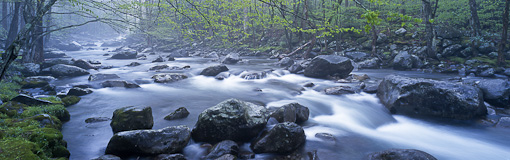
Spring mist rising on Roaring Fork, Great Smoky Mountain National Park, Tennessee, 617 format film.

With digital, I quickly set my Nikon vertically in a special rig that allows me to swing around the lens nodal point, and I can zoom to compose precisely. My “35mm” lenses allow me to get into tighter spaces and see higher and wider. Long time exposures are linear as opposed to film, so no reciprocity failure to calculate in, and the camera processes out the noise. And with digital capture being “free” ( not counting the massive investment in upgrading cameras, computers and software ), I save a lot of cheeseburgers. Yum.

Maybe creating panoramas with digital cameras is quicker and easier. Yet film is more contemplative and precise. So I’ll just pick the tool that works best for my subject and creative ends.

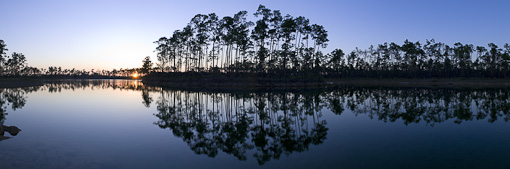
Sun setting in endangered pine woods, Everglades National Park, Florida, 170 degree digital assembly.

I'm looking forward to visiting Qinghai, one of China’s least populated provinces with not quite six million people ( out of 1.2 billion ), and it’s nestled up against Tibet to the West. I’ll be traveling with colleagues Nancy Brown of Boca Raton and Tania D’Avigon of Boston, both have also been to China multiple times, and we will drink a toast or two with our Chinese friends from previous trips.

The photo festival has invited many “foreign photographer friends” to attend and exhibit, including our American Society of Media Photographers South Florida chapter, which has sent their Light of Florida photography collection.

If you are interested in seeing the panoramic cameras used for these photos, I’ve posted a little more information on my Miami panoramic photography portfolio site.

Wednesday, April 28, 2010

Talking Picture Postcard - Mangrove Creek Songs


My favorite kayaking destination here in South Florida is any waterway that takes me though a tunnel formed by mangrove trees, a path that almost blocks out the sky above and forces me to inch along a glassy smooth tidal creek deep in the back country.

Earlier this month I spent four days paddling the 10,000 Islands area off Florida’s South West coast, putting in either at Everglades National Park’s Chokoloskee Bay ranger station in Everglades City, or off  the Tamiami Trail in the Big Cypress National Preserve.


On a Monday I quickly paddled past the off shore mangrove islands dotting the bay and entered Half Way Creek with a rising tide, utilizing the powerful tidal flows to my advantage. In about an hour I was wrapped in a mangrove canopy completely encompassing the narrow creek, all sound reduced to my splashing paddles.

Then I heard them, two different song birds, one hidden just out of sight in the thick red mangroves, it sounded like it was right on top of me, and the second, I guessed a different species, off at a distance. They seemed to be playing a duet, one trilling upward, and a moment later the closest one singing a six note refrain.

Water dripping from my paddle was the only sound between the songs. Using my recorder's built in stereo microphones I could hear in my headphones the notes echo back and forth through the mangrove tunnel and off the water. (If you’re a real sound geek, try ‘phones to hear the separation, water drip and mosquito buzz.) Then the birds flew off, leaving me in complete silence.

Halfway Creek flowed into the Left-Hand Turner River, and finally the mangrove cover opened up to small shallow ponds where sunlight rippled through tannin colored water, and when I entered Turner Lake, I paddled blue back country waters.

Turning South onto the Turner River I rode the outgoing tide back into Chokoloskee Bay, already missing my intimate mangrove tunnels and their hidden singers

Here's a link to more multimedia photography Talking Picture Postcards.

Sunday, February 28, 2010

Talking Picture Postcards Personal Challenge


Today I’m launching what I hope will become a challenging personal project, telling short stories from my experiences and travels by assembling just a handful of photographs and a few sound clips to tell short stories.

I’m calling them Talking Picture Postcards, and hope to write them fairly often and mail the multimedia shows on this blog.


“ Dear Mom, went camping in Everglades NP, found great Osprey nest with two chicks ... kayaking on Florida Bay at sunset another family squawked at me. Otherwise very quiet and peaceful weekend. Promise to find real job soon. Tom”

I’m trying to think of each as a couple of lines on the back of a picture postcard, like those I’ve discovered while rummaging through dusty boxes in antique stores over the years. I love those hand colored black and white photos of some some obscure vacation spot from the 1930s or 40s, or even the sepia toned ones from the early teens.

After gleaning what I can from the photos, I turn the cards over to read the hand written lines, often family news, weather reports and plans about the future. I wonder how the parties to the correspondence lived their lives and what happened to them. Those few lines can be the best part, ease dropping on people who’ve long since passed away.

But here I am 50 or 100 years later, reading about how they enjoyed their visit last weekend or how they are sending money to their sister.

With a postcard you only have room for the briefest of reports, so my challenge will be to use 20 to 30 seconds to scribble my couple of lines on the back of these digital postcards.

If you're reading this 50 years from now after discovering a dust covered box of antique blogs, I hope it was a bargain.

Here's a link to more Miami multimedia photography Talking Picture Postcards.

Friday, November 6, 2009

Listening For Photographs and Looking For Sounds

I’ve just returned from more than two weeks traveling in the ethnic Tibetan regions of
Western Sichuan province, the mountainous areas abutting the Tibetan Autonomous Region, as the People’s Republic of China describes what we call the country of Tibet.

This fifth trip to China was my first where I started listening for photographs, and looking for sounds.

When we first drove up a steep hill to the Huiyuan Temple in Bamei, looking down onto a temple carved from the earth, dozens of  spinning prayer wheels and hundreds of Tibetan Buddhist pilgrims marching clockwise, I was overwhelmed and unable to pick up a camera. Just too many sensations to absorb at once. Heck, there were even dozens of young monks swarming all over painting the decorative roof.


I put on my headphones, turned on my tape recorder, attached a microphone and started listening. I heard the shuffling feet, and spin of the wheels. I followed a tinkling bell to the far side, recorded the low chants, creak of the prayer wheel. I noticed the steady thump of walking sticks. I started to see photographs and got to work.

Play the 30 second clip under the photo and experience how the ambient sounds inform the photograph, and how the photo amplifies on the recordings.

After dedicating my entire photographic career to photojournalism and commercial photography by capturing a single image distilling an entire story into a single frame, Henri Cartier-Breasson’s famous “Decisive Moment”, I’ve begun working in multimedia production. I’ve become fascinated with the expanded dimensions of story telling that capturing on scene ambient sounds and interviews with photo subjects add to my still photographs.

Ultimately I will combine the sounds and still photos from Sichuan into a multimedia slide show that will tell a story over time, linear story telling, but that will be a topic of a future post.

At a Tibetan cultural dance festival in Danba I loved photographing these men wearing hats made from wild cat skins ( and hoping they were not endangered species ), yet when I recorded their call and answer singing with their female partners, and their skin boots stomping, the entire experience came alive.

Back in Chengdu, a very laid back and friendly city of 10 million, I was walking through the quiet gardens attached to the Wenshu Temple, one of the largest Buddhist temples in China. It was overcast, air yellow with pollution. Bad light, my photographer side said. While listening to the monks chanting during their mid-day meal, I heard a bird at a distance, and followed the sound. Then more birds, playing off each other, rising and flowing through the trees. I did not recognize them as wild, they were so melodic.


Under the low hanging bamboo trees were six song birds in cages, enjoying the “fresh air”, with their six elderly male owners sitting on stools and animatedly discussing the affairs of the day and the relative skills of their birds. Another combination of photographs with sound.

It all started last summer. For years I’ve  spent a lot of time capturing landscapes and photographing the wildlife in Everglades National Park, using the subtleties of sunrise light or catching the glint in an alligator’s eye to tell my stories. Of course I was aware of the sounds around me, buzz of the insects and calls of the birds. But they were just part of the enjoyment of being out doors, not being in an office cubicle to make a living. But this summer when I ventured into the same familiar wetlands with a tape recorder and shotgun mic, suddenly my visual world really came alive with the sounds that surrounded me. A thunder storm, rain drops and running water said “Everglades” in a way none of my photos ever had.

Be warned, it's three minutes long.


I was unable to post to this blog while in China, as the government has blocked practically all access to social media from within the country, including Blogger, Face Book and Twitter. An internet search from within China yielded complicated articles on how to use proxy servers to read and post to overseas blogs, but I decided that was way too complicated while I was working up to 14 hour days and sleeping poorly at 10, 000 feet.

Heck, the PRC has even blocked access to the iTunes store, making it impossible to catch up on the National Public Radio shows such as “Car Talk” that I missed!

Here's a link to more editorial photography from Sichuan China.