Showing posts with label High School Stories. Show all posts

Tuesday, July 29, 2014

Explaining "Flipping The Classroom On Its Head"

Principal Doug Romanik was very excited about his school’s new educational philosophy and how they were “flipping the classroom on its head” at his 300 student Catholic high school in Miami’s Little Haiti neighborhood. The teachers were not lecturing any more, the students were empowered to learn on their own, iPads were every where, he told me on the phone. 


Multimedia story explaining the One To One Learning Program was delivered in June 2014. Email,  iPhone & iPad link.

Beginning with the Fall 2013 term Archbishop Curley Notre Dame Prep had become the first, and only, school in the United States to fully implement this new program. Teachers and students were adapting pretty well, but all the changes were causing some confusion amongst the parents, school supporters and incoming students.

He wanted me to come in to discuss how a web site video could explain ACND’s pioneering program. Of course I would!
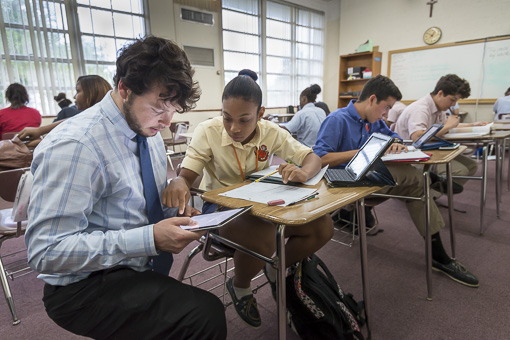

 Math teacher James Harnage gives one on one time to Jennifer Lamy.

Fonton Relational Education was created in 1957 by two Spanish psychologists and had been incubated at several schools in Colombia. (Great video by IBM here.) FRE had helped adapt and implement their framework and software platforms at ACND, so I began my research on their site. I quickly bogged down trying to understand sentences such as
Fontan Relational Education is a pedagogical model that customizes learning paths for different learners at an individual unique learning rhythm based on each students’ abilities and interests.
Not having a PhD in educational theory, I was as confused as the parents, and quickly realized that my challenge was to transform the complex and abstract into a concise and emotional multimedia story about the One To One Learning Program. 
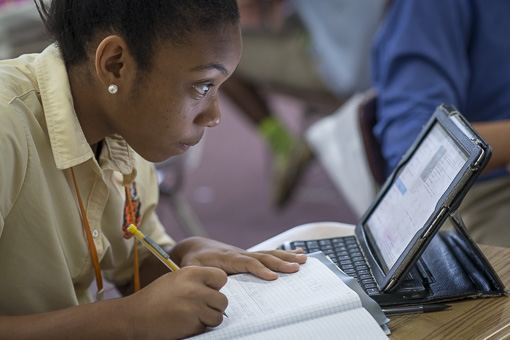

 Junior Jennifer Lamy combines pencil, paper and iPad on calculus homework.

My challenge was threefold:
  1. With interviews allow students in their own words describe their apprehension and eventual mastering of the changes. After conversations with ACND staff I drew up questions designed to elicit answers to hit target points, and to discover emotional surprises the kids might share.  
  2. With still photographs, and sit down interview video filmed by colleague Pascal Depuhl, I would put a human face on the program, show new classroom layouts and technology in use.
  3.  I would convert what I call all the Blah Blah Blah by writing a concise description of the One To One Learning Program to scroll at the end of the video. I realized there was no way the kids could hit all these points without sounding scripted. 

One To One Learning Program multimedia currently featured on ACND home page.

The non-visual aspects of One To One are explained by video end scroll:
At Archbishop Curley-Notre Dame High School, the One To One Learning Program is flipping the classroom on its head as teachers no longer lecture and students are responsible for mastering class material through guided independent study.
Teachers become coaches, first by laying out academic goals, then helping each student write their own Individual Learning Plan to achieve those goals, and  finally guiding the plan’s implementation throughout the term.
Working hand in hand with the school, students take control of their own learning while gaining time management skills, strong study habits and confidence.

Rather than sitting back during lectures, students discover the information on their own, and have instant one-on-one time with their teacher. As they move from teacher dependent to student autonomous, teachers are freed to tap into student’s individual learning styles, and students are encouraged to incorporate areas of personal interest.

During regularly scheduled classes students complete most of their homework, study in groups, and give presentations.  Grades are still earned, essays written and tests taken as students prepare for college.

Each student is issued an Apple iPad for 24/7 access to electronic books internet resources, and access to Qino, cloud storage for their learning plan and grades. The portal Showbie allows paperless submission of documents and homework.

Currently the ACND home page posts the version with end scroll, and is in standard definition. Version at top has no scroll and is in high definition.

Do you now understand what is meant my "flipping the classroom on its head"? Let me know if we were successful in explaining the One To One Learning Program in a concise and emotional manner ... there is room below for your comments.

Thank you Doug Romanik, ANCD Public Relations Specialist Lisa Morales, Pre Calculus teacher James Harnage, AP English teacher Beth Love, Daniel Briz, and Jennifer Lamy.
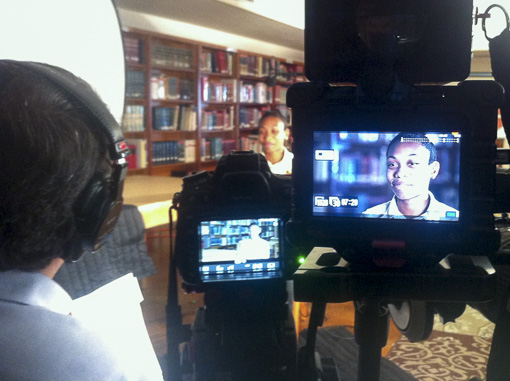

 Production photographs by Pascal Depuhl.

Technical Notes:

Pascal Depuhl lit and shot the video interviews, a 70 - 200 and Canon 5D Mark II for camera 1, and Nikon D610 and 85mm for camera 2 and on a slider for video portraits. I recorded the interviews with both Tram 50 lavs and a boomed Sennheiser MKH8050 hyper cardioid, the latter I much preferred due to it’s fuller sound, and used that track only. Wild sound was recorded with concealed TR50s tucked between Jennifer and Daniel shirt buttons, with Sennheiser G3 wireless packs. Stills were shot on Nikon 610 full frame cameras, with 16 - 35 f4, 28 mm f1.8 and 85 mm f1.8 primes. Sound was synced with Plural Eyes 3.0, video edited in Premier Pro CS 6 and sound sweetened with Audition, all on a Mac, of course.


Sunday, June 22, 2014

History Detectives: Students' Civil Rights Legacy

I believe few Americans still hold out hope that we are living in a post racial society, now that we are well into the second term of President Barack Obama and we are finding our civic discourse just as fractured and angry as ever. For a while after we as a nation elected our first African American president in 2008, I read in magazine essays and overhead in coffee shops that "maybe race doesn't matter anymore?" 


Hopefully this 5 minute multimedia story about high school students discovering how the civil rights era of the 1960s shaped their lives is just as insightful as when completed in 2011. Please read my original blog post .

In spite of opinion polls indicating most people (mostly whites?) see no racism in their lives, I feel race still matters in almost everything we as a nation and as individuals do every day. There are under currents that race matters popping up all the time. Some could observe:

- The President is being disrespected by his political opponents because of his race. 

- A billionaire basket ball team owner is a total monster because of his comments on race.

- Miami-Dade police shoot and kill in the streets an inordinate number of young black men.

-  OJ is still suspected/ still guilty/ still acquitted because of his race.

These thoughts were going through my mind this week as I was re-editing my History Detectives multimedia piece I was commissioned to create three years ago. Archbishop Curley Notre Dame Prep in Miami's Little Haiti neighborhood asked me to explain the importance of their being the first high school in the then segregated state of Florida to integrate 50 years before.

Taylor Altidor,  then a 16-year-old Junior, told me "...we just couldn't believe that Florida used to be racially segregated, that blacks and whites didn't eat in the same restaurants...". I followed her advanced placement history class as they researched segregation and interviewed students from the early 1960s and prepared for a Black History assembly. Former students and now adults well into their 60s, Paul Wyche told me he was called the N-word at a high school basket ball game, and Constance Moor Thornton recalled "colored" water fountains.

The researching students understood such overt racism that thrived in the Jim Crow era was thankfully no longer and was not part of their teen lives. But was racism completely gone? The student detectives questioned, discussed and completed class projects that brought the topic into the open.

Addressing the assembled student body in a clear and optimistic voice, one civil rights era student said "We come from different circumstances, but color doesn't matter, it is what is in your heart." 

I hope so, and I hope some day we will be living in a truly post racial society.


Technical Notes:

This month I was in the process of updating my Miami multimedia photography portfolio and had begun transferring the original History Detectives from a Flash based player made in Sound Slides to a more universally accepted and iOS friendly H 265 video format, when ACND called looking a new high resolution file. Good timing.

I reprocessed all 123 original still photographs in the newest Adobe Light Room 5, squeezing additional color quality and dynamic range from the newest RAW processor. I always export as Tiffs with medium sharpening, believing compressed Jpegs, and over sharpening, could potentially cause video jitter. I cropped the original 4:3 aspect ratio to the video standard 16:9. This cut a little close to some image content, as I was not thinking 16:9 originally and had composed my images differently.

I added the stills to a Adobe Premier Pro CS6 timeline, imported my original sound track made with Apple Logic, and switched in a couple of new images but pretty much left the timing alone. I no longer liked the Ken Burns movement on some photos in the original, and removed it. I added a new title and credit page with a typewriter effect in Adobe After Effects CS6 ... a lot easier than this amateur video editor thought. On your P Pro time line >  right click the title > open as a After Effects composition > in AE Effects & Presets search "typewriter" > drop that puppy onto the composition and bingo, you have the type type type effect all done for you.

I digress. And I used the American Typewriter font in PP to make new lower thirds. I couldn't figure out how to animate them too, so decided would be less busy without. I exported through Adobe Media Encoder with the Vimeo 720 p presets, and uploaded to Vimeo. Easy peasy.

Wednesday, May 18, 2011

Young History Detectives Discover Segregation

History was being made 50 years ago this week as the first cross country buses of  freedom riders rolled into Alabama and Mississippi, only to face withering racial hatred and violence. As two brilliant PBS television documentaries have shown, the non-violent participants played a pivotal roll in nudging the Kennedy administration to finally act, and the civil-rights movement turned the corner that leads directly to our current times.

Did we really live in an America were segregation of whites and blacks was not only legal, but thrived south of the Mason Dixon line? Where white mobs beat and murdered blacks while racist police did nothing? Where schools and hospitals were segregated, blacks sat in the back of buses and weren’t allowed into restaurants?


Multimedia audio slide show tells 1960 story of first Florida high school to integrate. iPhone & iPad version.

I know we did, as I grew up in the 1960’s. I recall flickering black and white television images of students blasted with fire hoses and reading about the freedom riders in Life magazine.

But do young people today know this history? Recently I found out that some Miami high school students were amazed to hear that segregation was a way of life in their home town.

Being white and living in Idaho and Washington state, to me the civil-rights movement was an abstraction. I had never experienced discrimination. In my family we were raised to be inclusive, my parents frequently reminding us that the color of one’s skin did not matter. Then Martin Luther King died. His assassination shook my college idealism to the core, and for a while my friends and I wondered what sort of world was awaiting us.

When I moved to Miami 30 years ago it rarely occurred to me that I was living in the deep south. I remember in 1980 our realtor remarking that just a few years before our Miami Shores neighborhood had been “red lined”, where banks would keep minorities out by applying more stringent loan requirements than to whites. Though no longer pure white, we wouldn’t have to worry about “them”, she implied.

Miami’s Jim Crow legacy hit home when a family friend told of being able to buy a senior prom dress at a downtown department store, but she was unable to try it on first as the fitting rooms were for whites only. She had to buy it and hope it fit. She went on to be the first African American woman judge in Florida.

When history teacher David Monaco, left, told his AP American History class Miami used to be segregated, Taylor Altidor, right, and her classmates couldn't believe it.

In the years since the lens through which I viewed my adopted community was that of a rich cultural stew, Cubans and Nicaraguans and Colombians, Coconut Grove Bahamians and African Americans, with Haitians rounding out the mix. An occasional remaining Gringo would be tossed in for seasoning. South Florida’s civil-rights legacy was not on my radar screen.

Last February my radar lit up. I was commissioned to produce a multimedia show about the 50th anniversary of Florida’s first high school to integrate, and while interviewing former students I learned first hand what it was like to live in a segregated Miami.

Paul Wyche, who in 1960 entered the then all white Archbishop Curley School for Boys, told me how his cross country team left a Howard Johnson’s restaurant when he was refused service because he was black. And as a student sports reporter for the Miami Herald he and the black basketball players were called the “N-word” in Homestead.

Constance Moore Thornton described to me the “colored” and “white” drinking fountains at her neighborhood Winn Dixie grocery store, which offended her, so she refused to drink from either. Yet as a rebellious teen she rode in the front of Miami’s buses and endured stares from both blacks and whites without incident. She helped integrate sister school Notre Dame Academy, and like Wyche, felt fully accepted by their Catholic school, faculty and fellow students.

Sandwiched between the Spring 1960 student-led sit ins that integrated lunch counters in Tennessee, Georgia and throughout the south, and the May 1961 freedom rides, history was being made in Miami too. The Archbishop quietly admitted black students into his Catholic high schools in September 1960, without “making a fuss” the Miami Herald reported.

Black and white students from the early 1960s returned to their high school to share their experience with integration.

The Archbishop did not have to worry about politics nor historic prejudice within his jurisdiction, plus hundred’s of Cuban students were then flooding his schools as they fled Fidel Castro’s revolution. A few black students moving up from all black parish elementary schools was, as we would say today, a no brainer.

The boy’s school had inherited a legacy of inclusiveness from it’s name sake, Fr. Michael Joseph Curley, Bishop of St. Augustine. In 1916 he led a vocal public campaign on behalf of thee Sisters of St. Joseph who were arrested in violation of state law which prohibited white women from teaching in “negro schools.”

Miami-Dade County schools did not desegregate until the early 1970s, and then only under a a federal court order, which was not lifted until 2001. Observers note, however, that the public schools had to deal with segregated neighborhoods, busing and a sprawling district encompassing hundreds of schools.

To mark the 50th anniversary of it’s integration, Archbishop Curley Notre Dame planned a day long event during Black History Month where students from that era - black, white and Latino -  would share their experiences with the students of today. Principal Brother Sean Moffett asked me to tell the story through multimedia, and my first challenge was how.

I decided to interview two former students, now in their 60s, to open the story by talking about their experiences living as teens with segregation. No explanation at first as to why, I wanted a bit of mystery to draw viewers in.

I set up a mini studio at the school the day before the celebration, shot on black seamless and converted the files to black and white to evoke a historic feel. From 50-year-old yearbook photos I cross cut to color as the story shifted to the present day.

Constance Moore Thornton remembered "colored" water fountains at her neighborhood Miami grocery store.

Not wanting to build my visual story on just the official ceremony, I photographed the Advanced Placement American History class researching integration history, including exploring micro fiche film a the public library and interviewing students from the early 1960s. This also gave me a great “History Detectives” hook.

I recorded natural sound from the library trip, machines whirling and students reading, and wired subjects with lavaliere microphones and recorders during classroom discussions.

But I was stuck on how to use audio to tell the overall story, from historic perspective to describing events. My technique of interviewing a subject and building a narrative around whatever came out of their mouths would not work. I had points important to the story and set events already photographed. I decided to write a script, and with the help of Junior Taylor Altidor, who would be narrating, and history teacher David Monaco, that’s what I did.

Taylor leads with her amazement in learning about Miami’s segregationist history, and describes how her multiethnic school of just over 300 students embraces a philosophy of inclusiveness. And she notes how those who pioneered integration 50 years ago led to her way of life today.

The result is a five minute multimedia audio slide show that I hope is an informative and emotional history lesson for today’s students. The school plans to feature the piece on the ACND web site, driving traffic from media interviews with students and administrators. They've also received requests to place the story in several university history archives.

Many thanks for the help of Brother Moffett, CFC, VP of Student Services Douglas Romanik, David Monaco, and Taylor Altidor.  And thanks to the freedom riders and all those who took risks during the civil-rights movement ... today our country's race relations are far from perfect, but they've come a long ways in 50 years.

Monday, November 29, 2010

Never Say Never - Insightful Voices Drive Multimedia


Roger’s favorite high school subject is English, taught by his favorite teacher Brother John Corcoran, who is also his cross country coach. Such relationships provide many teaching moments. But Roger’s greatest inspiration has been observing his mentor quietly overcoming adversity.


Link to iPad and iPhone friendly version.

During our taped interview earlier this year discussing why he liked attending Archbishop Curley Notre Dame,  Roger described Brother Cocoran as an interesting and approachable teacher, as well as a challenging and goal-setting coach.

Over the past school year Roger and his teammates have watched their coach recover from an accident, return to walking and then to full duties at school. Roger has learned “to never say never,” an unofficial lesson.


Such insights, straight from the student mouths, have been the driving force behind the six-part multimedia series ACND commissioned to focus their “There’s A School For That” campaign.  By using journalistic still photography and public-radio-style audio interviews, the small Catholic prep school on the edge of Miami’s Little Haiti neighborhood is growing enrollment and strengthening ties with its support community.

Anecdotal reports suggest these audio slide shows are succeeding in small ways:
- A mother reported her son insisted on enrolling at ACND after being impressed by their web site, where the shows are featured
-  Another new student said he chose Curley “to find my athletic potential," directly borrowing a line from one show.

This is my sixth and last post about this project. Thanks again for the help of Principal Brother Patrick Sean Moffett, CFC, his assistant Daphne Dominique, Dean of Students Douglas Romanik, and former Public Relations director Catherine Doble.

Here are all six multimedia audio slide shows from Miami high school Archbishop Curley Notre Dame.

Friday, September 10, 2010

Multimedia Roots Sprouted Decades Ago


Multimedia story telling is a lot of fun. Simple as that. Why ?

It reawakens that excitement I had a a kid in the 1960s burying my nose in stacks of "Life" magazines over at my friend Mike’s house. Those double page black and white photos depicting a devastating Appalachian flood and solders dying in Viet Nam riveted my attention.

Story telling photography hooked me then and there, exposing the wider world to sheltered me living in a tiny Idaho town.


Click here for an iPad friendly version of the above audio slide show.

Multimedia rekindles the amazement I experienced on my first newspaper job in 1970s Seattle while photographing The Adventuress, a 1913 wooden schooner. My sailing companion, a television photojournalist, opened my ears by using his movie camera attached microphone to highlight wind in the sails, lines singing through pulleys, waves splashing and voices chanting.

Wow, a new way to tell stories other than with pictures. I thought back then that if for any reason I couldn’t continue working as a photographer, I would like to work with sound. It took a while, but here I am, having fun with sound ... and pictures.

Like with the fifth multimedia audio slide show from the “There’s A School For That” series commissioned by Archbishop Curley Notre Dame High School here in Miami. Senior class president Jessica tells why being a leader has helped her grow as a person and prepare for college. Photographs, audio interview and ambient sound allow you to see and feel her commitment in making ( while fasting for a weekend ) and delivering 3,000 peanut and butter sandwiches for the homeless.

Each of these two minute shows took between 40 and 50 hours, two in the field photographing and recording, and at least three more days on the computer cutting audio, editing and processing photos, assembling and tweaking the time line. A lot of work, but also a lot of fun.

I’m grateful those roots for exciting story telling have continued to grow in me all these years. Its fun, simple as that.

View more Miami multimedia photography here.

Sunday, July 4, 2010

Unscripted Audio, Surprising Multimedia (Now iPad Friendly)


When I began my audio interview of high school senior Rhod for the fourth “There’s A School For That” multimedia show, I really had no idea what the football quarterback and standout basketball player would be saying. Would I get enough good quotes for a two minute audio slide show? Would it be all about himself? Any insights into how his school shaped him? ( iPad compatible version. )


Let see, what do you think?

- “Coach Magner is everywhere really ... if you are a new student, even if you don’t look like an athlete ... he will get you out to play a sport and he will work you as if your the greatest athlete in the world, and make you be the athlete you didn’t think you could ever be.”

-  “Coach says something like this ‘you gotta get your work done across the street to be able to play over the other side of the street, you have to have the grades to play.’ ”

 -  “Coach Magner defines me as cool head and warm feet, because when I’m under pressure I never blink twice or look to do something else. My first decision is always the one I take because I’m the definition of cool head and warm feet.”

Going into each of the six student interviews at Archbishop Curley Notre Dame ( a 300-some student college prep in Miami’s Little Haiti neighborhood ) Public Relations Coordinator Katherine Doble told me in general terms each subject’s area of accomplishments - athletics, leadership, academics - but we had no predetermined script.

Rhod just started talking about athletic director and coach Greg Magner, so Coach became the show’s focus.

Freshman Silvia had only been in high school a few weeks and hadn’t experienced much yet. But when during her interview she came out with

- “And so far every morning when I come to this school I have a smile on my face, and everyone notices it, and I’m happy when I come”

we knew we had the theme for her show.

Who needed a script when, while I was recording ambient sound in the weight room, I picked up Coach Magner saying over the noise

- “Just show up to work just like your parents do every day, and you’re become successful. ”

I wasn’t even interviewing him, but I used the sound clip as a transitional bridge.

Of course working without a script creates a lot of extra hours in front of the computer editing sentences that sometimes make no sense, thoughts that trail off to nowhere, scrambled grammar. But hey, they're high schoolers, not college professors, and the unscripted gems are worth the effort.

You may now view this show on your iPad or iPhone with OS4, thanks to Sound Slides current beta. Due to Apple’s spat with Adobe, iPad/Phone owners are unable to view content Flash content, which all of my slide shows on this blog are. But now I’m able to post HTML5 versions that auto detect the cool Apple devices. Maybe my blog is the beginning of that print-magazine-to-electronic-reader revolution we are all hearing about ?

To see more Miami multimedia photography, please visit my portfolio site.

Thursday, June 17, 2010

Portraits Anchor Multimedia Start To Finish


I knew from the start of story boarding I wanted to feature environmental portraiture in the recently completed six part “There’s A School For That” multimedia series. Unique portraits around school would introduce each featured student, book ending candid photography making up story center with final portraits shot along a locker lined hallway, each student posed in that same location.


Leading each audio slide show with students looking at camera, I hoped to immediately establish a connection with the young eighth graders who might be considering Miami’s Archbishop Curley Notre Dame. Plus the environment and activities would say “high school is interesting sweet".

Environmental portraits are a lot of fun, as I have an opportunity to create one photograph that tells the whole story about my subject, show their personality, place them in their environment, each item I include adds to their story.  This lead portrait must grab you as the show opens, while variations changing every few seconds hold your attention.

With Michael, a junior who enjoys math, I was faced with two challenges: 1) come up with an interesting visual concept that says “math” and 2) find an environment that contributes to the story telling.

In his case the concept also became the environment, and a simple two light setup would pull it off.

After scratching my head for a few minutes, no really, after a week of weighing options, I decided to flat bed scan pages from Michael’s Pre-Calculus notebook, projecting the formulas complete with blue grid lines onto a classroom wall. I placed him in the beam of the LCD digital projector and added one flash head with a very tight 3 degree grid spot aimed at just his face. A short time exposure held the projection,
which became both fill and main light, with the gridded flash exposed about one and one-third stop over that drew attention to his face and darkened the environment.

I also used environmental portraiture to wrap each show and visually tie all six together.

Each interview ends with the student emphasizing why they enjoy ACND and/or who inspired them, and concluding “There’s A School For That”, while their lockers-and-hallway portrait holds on screen. The same slogan and hallway location form a common thread through all six shows.

At the end of Michael’s interview he says “ If you want a school where your friends push you to succeed just as much as your teachers, there’s a school for that, Archbishop Curley Notre Dame". Credit for the slogan must go to Public Relations Coordinator Katherine Doble and Principal Brother Sean Moffett.

Hopefully the use of environmental portraiture tells the school's unique story while holding viewers attention from beginning to end. If so, that would be really cool sweet.

Additional multimedia photography from Miami may be viewed at Miami Multimedia Photographer.

Friday, May 7, 2010

Power of Ambient Sound: Sizzling Fries & School Bells


Do you ever hear an old song on the radio that immediately takes you back to your past? Maybe that wonderful summer after graduating high school, driving the back country roads of rural Idaho with your arm around Gloria, the girlfriend soon to be left behind on the way to college in the fall ?

I’m not a psychologist and can’t explain why music imprints into our brains, but I do know that sounds tap a deep emotional response in me. Just like that summer song triggering an old story, when I hear croaking frogs, I feel a rain forest in my head. When I hear wailing sirens, I’m surrounded by oppressive big city traffic. The Tibetan monk’s cymbal reverberating in my headphones, I smell yak butter tea.


Recording ambient sound is one of my favorite parts of multimedia, and for the second audio slide show I produced for Archbishop Curley Notre Dame High School’s “There’s A School For That” campaign, I had a lot of fun with sound.

What better way to trigger those high school emotions than recording the clanging class change bell and hallway voices. I lead the show with about seven seconds of only ambient hallway sound, then duck under her interview, leaving levels high enough to still hear the banging lockers and squeaking sneakers.

Here the ambient sound first catches your attention and draws you into the story, and before Silvia’s interview begins, hopefully you’re hooked. Then the sound bed drives the narrative along. Between Silvia’s thoughts, ambient sound levels rise, taking over the story telling, like at the basketball game where you hear the coach and players huddle, and the referee’s whistle.

Just like real life, our brains don’t concentrate on that sound bed, but we feel the sound, we see the the sweaty players, we know we’re in the high school gym.

As the show winds up, the sound of frying french fries comes in strong before Silvia  beings her story of her older sister asking if Curley still serves the fries she loved. The bubbling of the cafeteria deep fryer catches and holds your attention, and as the sound bed ducks under, I can taste those same fries that she is talking about. ( Good fries, BTW, I tried and liked them, though maybe the accompanying cheese burger clouded my judgment ...)

I love the complex layers of  interview voice blending and threading around and over and behind the background sounds of life in a vibrant high school. I decided to run a sound bed under the entire length of each of the “There’s A School For That”  multimedia shows because, well, I love ambient sound. It tells me stories, triggers my emotions and just like that old song on the radio, makes my life a whole lot richer.

Here's a link to more ambient sound blended with multimedia photography.

Tuesday, April 20, 2010

Multimedia Drives “There’s A School For That” Campaign

Designed to catch the attention of teenagers in the internet age, a series of multimedia audio slide shows I’ve just completed relates a Miami high school’s unique educational philosophy through compelling student profiles featuring custom created still photographs, combined with audio interviews and field recorded natural sounds.


Hopefully by watching you will see how Senior Melissa’s words and passion personalize the entire high school. The show is 2:14 long, and a larger version may be viewed here.

Archbishop Curley Notre Dame, a Christian Brothers’ college preparatory high school here in Miami, is making these shows the centerpiece of their “There’s A School For That” recruitment and marketing campaign.

With school and parent’s finding the economic downturn impacting their budgets, and educational alternatives competing for their prospective middle school applicants, ACND hopes to raise their current 302 enrollment closer to 400, a number that can be educated at the same cost, thus alleviating some of the financial pressure.


ACND, in Miami’s Buena Vista neighborhood alongside Little Haiti, offers students in grades nine through 12 a college preparatory curriculum in a Catholic environment, and for decades has been a leader in inclusiveness. In 1960 they admitted their first African-American students, the first Florida school to do so, while surrounding Miami-Dade County public schools were not integrated until ten years later, and then only by federal court order.

I’ve written here before that I’m really excited about how multimedia that combine journalistic photography and interview styles give audiences a fuller, more compelling experience than any one of these elements could by themselves, either on line or in print.

By attending ACND Melissa found she really loved to sing, and music director Daphne Dominique’s personal attention nurtured her talent. In four additional shows that I will post here in the coming weeks, a quarterback relates how his coach taps each student’s best, a student tells how friends help him academically, a student leader blossoms and a brand new freshman is just plain happy to come to school every day.

Principal Brother Patrick Sean Moffett, CFC, challenged me to capture one key aspect of each selected student’s excitement about the school. I needed to tell each story with a handful of sentences and a couple of dozen photos, plus a bed of ambient sound for depth and realism.

With running times between 2:04 and 2:24, each show required five to six days of work ... about a half day of interviewing, a day and a half for photography and ambient sound recording, and then at least three more days in post production computer time editing the audio and photos, assembling into the slide shows and processing for output.

These shows will reach ACND's prospective students, their parents and supporters when featured on the school’s web site, distributed on flash drives as pod casts, shared as videos via social media sites and played on TV screens at events.

I must thank Brother Moffett and his staff for their help producing these projects, including Public Relations Coordinator Katherine Doble and her Barry University intern Homma Rafi, Vice Principal of Student Services Douglas Romanik, and Secretary to the Principal Daphne Dominque.

More multimedia work can be viewed on my new Miami Multimedia Photographer portfolio web site.