Showing posts with label panoramic photography. Show all posts

Friday, May 28, 2010

Film Or Digital, Panoramic Landscapes China Bound

Yesterday I was preparing a collection of panoramic landscape photographs to be exhibited in July at the Qinghai Sanjiangyuan International Photo Festival in China, and while rescanning some of my favorite large format film images I compared them at pixel level to my recent panoramas stitched in software from multiple digital captures.

Rocky Mountains at Lake St. Mary, Glacier National Park, Montana, captured on 617 format film ( 2 inches tall by 7 inches wide ), large format view camera.

I had forgotten about film grain! Slow speed digital doesn't have any. Film horizons are straight lines! Rotating a digital sensor in a circle for a stitch curves the horizon and you need to hide the distortion. Light table viewing of film with 4X loupe misses seeing tiny cars parked a mile across mountain lake! Processing digital on a giant computer monitor you see all the flaws.

But I quickly stopped pixel peeping and was transported back to those outdoor locations to soak in the beauty I experienced when the shutter clicked, and realized it really didn’t matter if I was capturing my small slice of the world with a piece of film or a digital sensor.

Pretty obvious really, the story, emotion and sense of place in the photograph is what matters.

 Hammock filled with and bald cypress and air plants, Everglades National Park, Florida, 220 degree digital assembly.

I can’t say which panorama making technique I like the best. With film, I have to slow down, think and be deliberate, as it requires setting up a heavy tripod, assembling the view camera rails and bellows, then attaching a lens. This makes me choose my subject carefully.

Under a dark cloth, I view the image upside down, so the scene becomes abstract, helping me balance my composition. I then remove the cloth, insert a preloaded magazine, and have four shots on one roll of film. Oh, exposing color transparency film is tricky. And nerve wracking, each frame costs the equivalent of a small cheese burger.
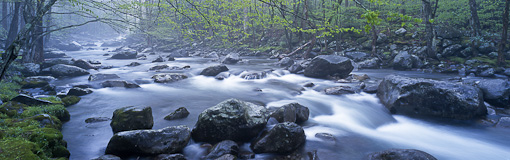
Spring mist rising on Roaring Fork, Great Smoky Mountain National Park, Tennessee, 617 format film.

With digital, I quickly set my Nikon vertically in a special rig that allows me to swing around the lens nodal point, and I can zoom to compose precisely. My “35mm” lenses allow me to get into tighter spaces and see higher and wider. Long time exposures are linear as opposed to film, so no reciprocity failure to calculate in, and the camera processes out the noise. And with digital capture being “free” ( not counting the massive investment in upgrading cameras, computers and software ), I save a lot of cheeseburgers. Yum.

Maybe creating panoramas with digital cameras is quicker and easier. Yet film is more contemplative and precise. So I’ll just pick the tool that works best for my subject and creative ends.
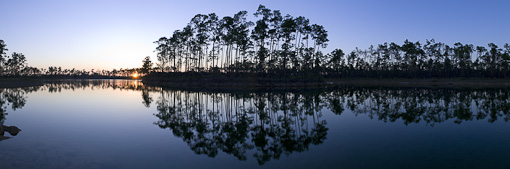
Sun setting in endangered pine woods, Everglades National Park, Florida, 170 degree digital assembly.

I'm looking forward to visiting Qinghai, one of China’s least populated provinces with not quite six million people ( out of 1.2 billion ), and it’s nestled up against Tibet to the West. I’ll be traveling with colleagues Nancy Brown of Boca Raton and Tania D’Avigon of Boston, both have also been to China multiple times, and we will drink a toast or two with our Chinese friends from previous trips.

The photo festival has invited many “foreign photographer friends” to attend and exhibit, including our American Society of Media Photographers South Florida chapter, which has sent their Light of Florida photography collection.

If you are interested in seeing the panoramic cameras used for these photos, I’ve posted a little more information on my Miami panoramic photography portfolio site.

Thursday, February 11, 2010

Wide & Skinny Panoramic Photographs


Even though I’ve been distracted in recent years photographing with digital cameras and their traditional format, I always enjoy returning to view the world in the wide and skinny panoramic format.

I’m forced to see in different terms when my picture telling canvas is three times as wide as it is tall. Sure the rule of thirds aids my composition, but mostly I lead the viewer’s eye from left to right or vice versa, allowing them to roam along and discover the exciting corners of my narrow frame.

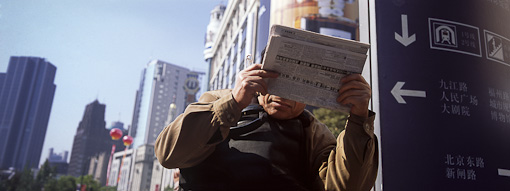
In China last Fall I used my Hasselblad XPan II for both street photography and landscapes. Here a morning commuter reads his morning newspaper outside the subway stop at the end of busy Nanjing Road in Shanghai.

The X-Pan is a 35 mm film camera that is small and portable and focuses with a traditional range finder. You look through the clear view finder, not the actual picture taking lens as a single lens reflex, and frame your photo with brightly outlined frame lines. With no auto focus motor you actually turn your fingers to focus, lining up two frosted rectangles. I gotta admit, sometimes in switching from my SLR to the X-Pan and seeing everything sharp, I forget to focus.

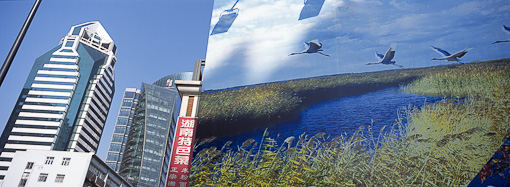
Continuing to walk the chaotic streets of Shanghai, I selected this nature-landscape-within-urban-jungle combo. Click photo to enlarge.

Generations of street photographers have utilized rangefinder cameras in their work. The cameras are quiet and stealthy, and being unencumbered with all the latest auto everything, micro processors and super telephoto lens, your mind is clear to really make photographs. I do utilize the XPan center weighted aperture priority auto exposure, and the motorized film transport frees up my thumb for hanging onto the camera.

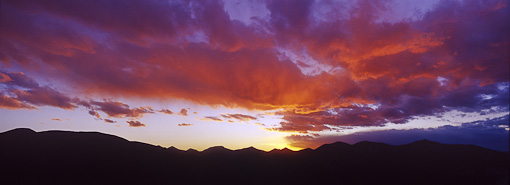
This November landscape shot was captured at sunset in  Sichuan, China, as we crested a 14 500 foot pass.

Often one thinks of panoramic photography when they need a wide angle view to encompass a dramatic landscape ( Here are examples of large format panoramic photography. ), like the Grand Canyon at sunset, but use of a pan camera need not be limited to landscapes. I use the format to extract bits from my confusing surroundings, some times very tightly, and to hand hold during people photography.

In panoramic the aspect ratio of width to height is at least 2 to 1, with 3 to 1 being my favorite. The XPan is 2.6 to 1. Any wider than three times the height, you have difficulty viewing in traditional display prints or in print publications, however on the web very wide aspect ratios work well in virtual reality applications. 

On an earlier China trip several years ago the XPan street credentials help me capture this brick yard worker

and these People’s Liberation Army soldier flag bearers at a festival opening ceremony.

The XPan is no longer manufactured, a victim of the decline of film photography, and prices on E Bay continue to be very strong.

Having E-6 color transparency film processed is a challenge now, with not one single South Florida lab reliably running it. I now express ship film to BWC Photo Imaging in Dallas, much more complicated and expensive than just a few years ago when two hour turn around at more than a dozen Miami labs was routine.

I love the advantages of digital and have never looked back since switching from film for assignments in 2006, yet for quietly capturing those wide and skinny photos of people, I’ll stick with old fashioned film and my Hasselblad XPan.