Showing posts with label Audio Recording. Show all posts

Tuesday, July 29, 2014

Explaining "Flipping The Classroom On Its Head"

Principal Doug Romanik was very excited about his school’s new educational philosophy and how they were “flipping the classroom on its head” at his 300 student Catholic high school in Miami’s Little Haiti neighborhood. The teachers were not lecturing any more, the students were empowered to learn on their own, iPads were every where, he told me on the phone. 


Multimedia story explaining the One To One Learning Program was delivered in June 2014. Email,  iPhone & iPad link.

Beginning with the Fall 2013 term Archbishop Curley Notre Dame Prep had become the first, and only, school in the United States to fully implement this new program. Teachers and students were adapting pretty well, but all the changes were causing some confusion amongst the parents, school supporters and incoming students.

He wanted me to come in to discuss how a web site video could explain ACND’s pioneering program. Of course I would!
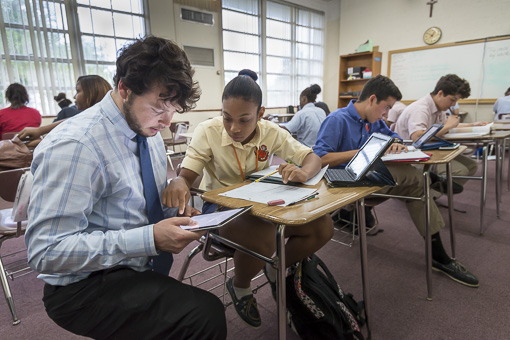

 Math teacher James Harnage gives one on one time to Jennifer Lamy.

Fonton Relational Education was created in 1957 by two Spanish psychologists and had been incubated at several schools in Colombia. (Great video by IBM here.) FRE had helped adapt and implement their framework and software platforms at ACND, so I began my research on their site. I quickly bogged down trying to understand sentences such as
Fontan Relational Education is a pedagogical model that customizes learning paths for different learners at an individual unique learning rhythm based on each students’ abilities and interests.
Not having a PhD in educational theory, I was as confused as the parents, and quickly realized that my challenge was to transform the complex and abstract into a concise and emotional multimedia story about the One To One Learning Program. 
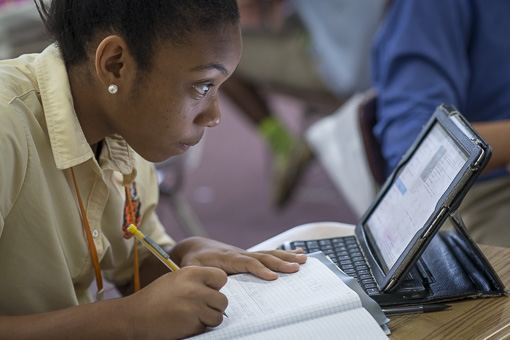

 Junior Jennifer Lamy combines pencil, paper and iPad on calculus homework.

My challenge was threefold:
  1. With interviews allow students in their own words describe their apprehension and eventual mastering of the changes. After conversations with ACND staff I drew up questions designed to elicit answers to hit target points, and to discover emotional surprises the kids might share.  
  2. With still photographs, and sit down interview video filmed by colleague Pascal Depuhl, I would put a human face on the program, show new classroom layouts and technology in use.
  3.  I would convert what I call all the Blah Blah Blah by writing a concise description of the One To One Learning Program to scroll at the end of the video. I realized there was no way the kids could hit all these points without sounding scripted. 

One To One Learning Program multimedia currently featured on ACND home page.

The non-visual aspects of One To One are explained by video end scroll:
At Archbishop Curley-Notre Dame High School, the One To One Learning Program is flipping the classroom on its head as teachers no longer lecture and students are responsible for mastering class material through guided independent study.
Teachers become coaches, first by laying out academic goals, then helping each student write their own Individual Learning Plan to achieve those goals, and  finally guiding the plan’s implementation throughout the term.
Working hand in hand with the school, students take control of their own learning while gaining time management skills, strong study habits and confidence.

Rather than sitting back during lectures, students discover the information on their own, and have instant one-on-one time with their teacher. As they move from teacher dependent to student autonomous, teachers are freed to tap into student’s individual learning styles, and students are encouraged to incorporate areas of personal interest.

During regularly scheduled classes students complete most of their homework, study in groups, and give presentations.  Grades are still earned, essays written and tests taken as students prepare for college.

Each student is issued an Apple iPad for 24/7 access to electronic books internet resources, and access to Qino, cloud storage for their learning plan and grades. The portal Showbie allows paperless submission of documents and homework.

Currently the ACND home page posts the version with end scroll, and is in standard definition. Version at top has no scroll and is in high definition.

Do you now understand what is meant my "flipping the classroom on its head"? Let me know if we were successful in explaining the One To One Learning Program in a concise and emotional manner ... there is room below for your comments.

Thank you Doug Romanik, ANCD Public Relations Specialist Lisa Morales, Pre Calculus teacher James Harnage, AP English teacher Beth Love, Daniel Briz, and Jennifer Lamy.
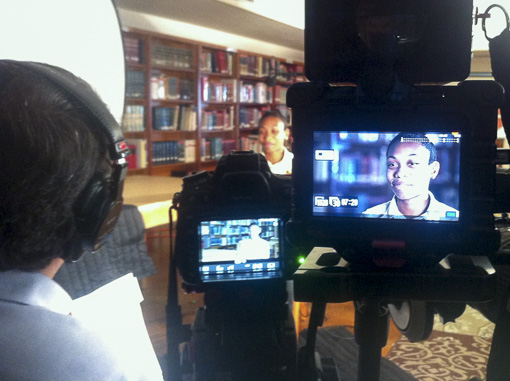

 Production photographs by Pascal Depuhl.

Technical Notes:

Pascal Depuhl lit and shot the video interviews, a 70 - 200 and Canon 5D Mark II for camera 1, and Nikon D610 and 85mm for camera 2 and on a slider for video portraits. I recorded the interviews with both Tram 50 lavs and a boomed Sennheiser MKH8050 hyper cardioid, the latter I much preferred due to it’s fuller sound, and used that track only. Wild sound was recorded with concealed TR50s tucked between Jennifer and Daniel shirt buttons, with Sennheiser G3 wireless packs. Stills were shot on Nikon 610 full frame cameras, with 16 - 35 f4, 28 mm f1.8 and 85 mm f1.8 primes. Sound was synced with Plural Eyes 3.0, video edited in Premier Pro CS 6 and sound sweetened with Audition, all on a Mac, of course.


Monday, June 30, 2014

Sounds Overheard: Saskatoon Saskatchewan


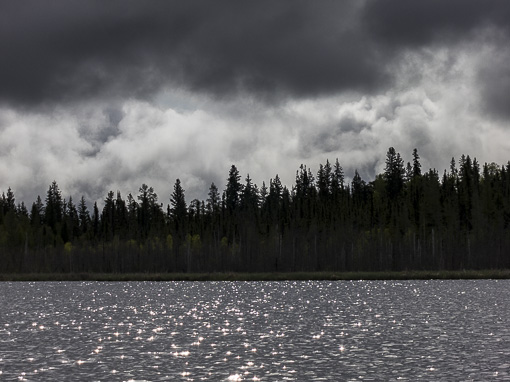
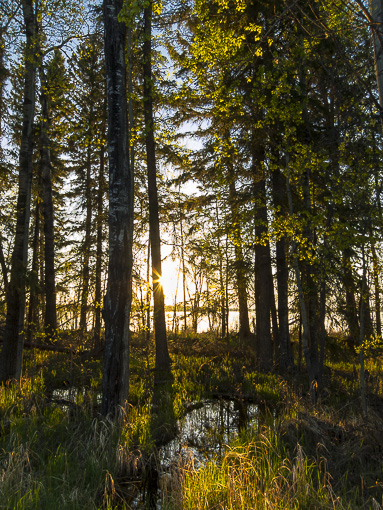
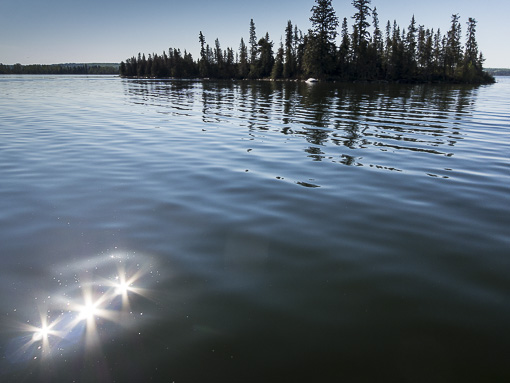
Just a couple of weeks after winter's ice melted on Dore Lake North of Saskatoon, summer's sun warms the waters off Eagle Island. All photos shot with Canon S100 point 'n shoot.


Field-recorded sounds of song birds, yakking raven, buzzing fly, water birds and far off loons are captured on this 1:15 recording. iPhone and iPad version. 

All the Canadians I met earlier this month were awfully nice and friendly, and I know they often vacation down here in Florida when the winters get to be 40 degrees below up north of the border. But do they chuckle at the sound of our Florida names, Miami, Okeechobee, Apalachicola or Boca Raton?  Translated to “Rat’s Mouth”, that last one even makes me smile.

While fishing a couple of weeks ago at Dore Lake, located north of Saskatoon ... giggle ... I just loved the sound of Saskatoon, and spoken with the province Saskatchewan, I enjoyed the geographical mouth full every time I said them out loud. 


For years my brother in law Jo had been telling me about his annual fishing trip, a group of 18 mostly men from the Colorado Springs area that have been making the 1250 mile trek for 29 years. Jo finally talked me into joining them this year, even though I hadn’t been fishing since I was a Boy Scout in Idaho. I flew to Colorado, and at 4 AM the next day we loaded up his Toyota Tundra CrewMax and headed out for Canada.

I guess I never really looked at a map before we left. We drove north through Colorado, across eastern Wyoming, to spend the night in Miles City, Montana. I had forgotten how wide and open the western United States is, mile upon mile of rolling grasslands, oil wells and on occasional town. As it was late Spring, everything was a pretty green. The next day we drove and drove, over Lewis and Clark’s Missouri River, crossing into  Saskatchewan where the border was a thin wire fence marching across wheat fields. In Saskatoon ... giggle ... we spent night two. Not there yet, as we couldn’t check into camp until Noon. So on day three, after a leisurely breakfast, we entered the boreal forest. Boreal forest? Are we in the neighborhood of the Arctic Circle? Are we there yet? Startling a bear rooting for tender greens, we finally reached the dead end of a 65 mile dirt road and emerged at Dore Lake Lodge.


I suddenly realized that this trip was the equivalent of asking some of my buddies to go fishing, we just need to drive from Miami to New York city over three days!

I soon found out why this crazy group of fishing buddies drive this far. The fishing was terrific! Within minutes of casting onto the lake I was reeling in Northern Pike as long as my arm. Throw ‘em back, I was told, that’s to small. Sure enough, bigger fish were out there, including some delicious walleye. Even though I didn’t win the $80 pot for the largest fish of the week, I caught fish every time, trolling the deeper holes or casting into the weeds, rain or shine. One of our group brought in, and then released, a 31 pound pike. Lots of 8 to 12 pound walleye. As we could only keep six fish each for the week, other than the ones we ate, it was catch and release all day long.


Jo was chief cook and his cabin was the mess hall where we gathered every evening for liquid refreshment and tall stories of monster fish which got away. Some of the crew were younger than me, including two teens, a very competitive brother and sister and their taxidermist dad. But most of the fishing buddies were long retired, a former Catholic priest, an ophthalmologist, weather scientist, accountant, long distance truck driver, a jet fighter pilot. A fun group with lots of stories. Did I mention the lying about big fish?

As I was the new guy, I steered away from the potential controversy of politics or religion, yet on the last night mentioned to a dinner companion my lifelong membership in one of the two major political parties. The genial white haired gentleman, who had spent hours in my boat teaching me the finer points of fishing, growled “If we had known that sooner, we would of cut you up for bait!”

Between spirited fish strikes, beaver and bald eagle sightings, I shot a few photos and recorded a little sound and soaked in Dore Lake’s wide open skies. Will I go back fishing next year? Definitely, but I just might fly to Saskatoon ... giggle ... and skip most of the drive.

Sunday, June 22, 2014

History Detectives: Students' Civil Rights Legacy

I believe few Americans still hold out hope that we are living in a post racial society, now that we are well into the second term of President Barack Obama and we are finding our civic discourse just as fractured and angry as ever. For a while after we as a nation elected our first African American president in 2008, I read in magazine essays and overhead in coffee shops that "maybe race doesn't matter anymore?" 


Hopefully this 5 minute multimedia story about high school students discovering how the civil rights era of the 1960s shaped their lives is just as insightful as when completed in 2011. Please read my original blog post .

In spite of opinion polls indicating most people (mostly whites?) see no racism in their lives, I feel race still matters in almost everything we as a nation and as individuals do every day. There are under currents that race matters popping up all the time. Some could observe:

- The President is being disrespected by his political opponents because of his race. 

- A billionaire basket ball team owner is a total monster because of his comments on race.

- Miami-Dade police shoot and kill in the streets an inordinate number of young black men.

-  OJ is still suspected/ still guilty/ still acquitted because of his race.

These thoughts were going through my mind this week as I was re-editing my History Detectives multimedia piece I was commissioned to create three years ago. Archbishop Curley Notre Dame Prep in Miami's Little Haiti neighborhood asked me to explain the importance of their being the first high school in the then segregated state of Florida to integrate 50 years before.

Taylor Altidor,  then a 16-year-old Junior, told me "...we just couldn't believe that Florida used to be racially segregated, that blacks and whites didn't eat in the same restaurants...". I followed her advanced placement history class as they researched segregation and interviewed students from the early 1960s and prepared for a Black History assembly. Former students and now adults well into their 60s, Paul Wyche told me he was called the N-word at a high school basket ball game, and Constance Moor Thornton recalled "colored" water fountains.

The researching students understood such overt racism that thrived in the Jim Crow era was thankfully no longer and was not part of their teen lives. But was racism completely gone? The student detectives questioned, discussed and completed class projects that brought the topic into the open.

Addressing the assembled student body in a clear and optimistic voice, one civil rights era student said "We come from different circumstances, but color doesn't matter, it is what is in your heart." 

I hope so, and I hope some day we will be living in a truly post racial society.


Technical Notes:

This month I was in the process of updating my Miami multimedia photography portfolio and had begun transferring the original History Detectives from a Flash based player made in Sound Slides to a more universally accepted and iOS friendly H 265 video format, when ACND called looking a new high resolution file. Good timing.

I reprocessed all 123 original still photographs in the newest Adobe Light Room 5, squeezing additional color quality and dynamic range from the newest RAW processor. I always export as Tiffs with medium sharpening, believing compressed Jpegs, and over sharpening, could potentially cause video jitter. I cropped the original 4:3 aspect ratio to the video standard 16:9. This cut a little close to some image content, as I was not thinking 16:9 originally and had composed my images differently.

I added the stills to a Adobe Premier Pro CS6 timeline, imported my original sound track made with Apple Logic, and switched in a couple of new images but pretty much left the timing alone. I no longer liked the Ken Burns movement on some photos in the original, and removed it. I added a new title and credit page with a typewriter effect in Adobe After Effects CS6 ... a lot easier than this amateur video editor thought. On your P Pro time line >  right click the title > open as a After Effects composition > in AE Effects & Presets search "typewriter" > drop that puppy onto the composition and bingo, you have the type type type effect all done for you.

I digress. And I used the American Typewriter font in PP to make new lower thirds. I couldn't figure out how to animate them too, so decided would be less busy without. I exported through Adobe Media Encoder with the Vimeo 720 p presets, and uploaded to Vimeo. Easy peasy.

Wednesday, April 30, 2014

Talking Picture Postcard - Suwannee River


Green lightening bug last week streaks across still frame from moonless sky time lapse, Nikon D 610, Nikkor 16 - 35 mm at widest end, 30 seconds at f 4.0, ASA 3200, no noise reduction.

It's 3:30 AM as I crawl out of my tent pitched along the Suwannee River at the Florida state park of the same name, and I'm groggily peering up through the trees searching for the bright stars that dotted the sky when I had entered my sleeping bag five hours earlier. But I don't see a thing in the dark.  Double checking that my glasses are on my face, I switch on my head lamp only to see hazy water droplets suspended in foggy air.


View 1:29 video on you iPhone or iPad.

As I stumble down the trail toward my camera I worry if my time lapse was completely obscured by the cold morning fog creeping amid the slash pine and live oaks. I soon hear the camera still clicking and am reassured by the green glowing lamp as images are written to the memory card.

With two 30-second time exposures taken every minute for the past five hours,  I held the review button down to quickly spin the individual still photographs across the screen, magically moving the stars along their orbits in the heavens. Wow, condensing hours into a few seconds, that's cool!

I turned the camera and head lamp off to toss my head way back and look up. I knew there was six feet of dangling Spanish Moss above me as I could feel it tickle my nose. But I couldn't see the moss, nor the trees nor beyond. I could only feel the wet fog on my face, and hear a thousand thousand croaking frogs way off along the flooded banks of the Suwannee . Wow, being out doors in the middle of the night is really cool too!

My plan was to kayak and explore the historic river and had driven the 435 miles from Miami due North to within a half hour of the Georgia state line and the Okefenokee Swamp, from which the Suwannee originates. Only problem was I didn't call ahead, I guess the dry season in South Florida is not necessarily the dry season up here. An unseasonably rainy winter had forced the river up to 15 feet above flood stage, to dangerous to paddle. 

No problem, though, I found lots of scenic country to photograph, natural sounds to record and the nearby Santa Fe river fed by springs, one of my best paddles ever. A great trip with enough to fill an entire post card, a Talking Picture Postcard for sure.

Thursday, March 6, 2014

Talking Picture Postcard - Florida Keys Slow Time


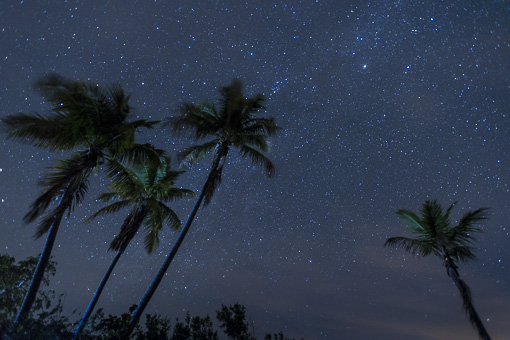
On a moonless night last January, coconut palms are silhouetted against star filled sky at Bahia Honda State Park in the Florida Keys. With Nikon D610 30 seconds f 2.8 at ASA 1600. A series of similar time exposures at near by Sand Spur Beach were assembled into a time lapse making up the second half of the Talking Picture Postcard below.

The Florida Keys are a pretty magical place to visit, and I often become confused with the changing pace of time I experience on the island chain. Rushing down the highway from Miami my body struggles to slow down and relax. Gotta answer emails, gotta get to where I'm going. But by the time I make it below Marathon, about Mile Marker 40 or so, I'm looking off at the blue Atlantic from up high on the Seven Mile Bridge, the sun is shimmering off the wave tops, and I see a lone sail boat miles off at the edge of the Gulf Stream. 


Real time video captures a slow moving sailboat for 19 seconds, and then an hour long time lapse reveals stars rotating above the ocean at Bahia Honda State Park in this 36 second Talking Picture Postcard. Field-recorded natural sound captured nearby. iPhone & iPad link or if your receiving this by email.

That boat is barely moving, it's is so sloooooow, just a tiny triangle of sail on the horizon. Time seems to stand still. The Keys' magic dust is sprinkling down on me now, transforming my fast time to Keys time, slow time, time to take in all the sun and water and stars up in the pitch black sky. In a blink I find myself on the beach, long after sunset, hours from the moon rise, I'm soaking in all those pin pricks of light  I forgot even existed.

Time to write home about this time warp I'm experiencing, but not the fast way by posting to social media. I'll take the old fashioned way, I'll write on the back of a postcard a couple of lines, stick a stamp on it, scribble an address, and mail another Talking Picture Postcard.

Tuesday, February 11, 2014

Talking Picture Postcard - Everglades Web

Sunday while loading up my kayak and paddle, I threw in my new Nikon D610 DSLR camera and small audio recorder, along with a sandwich and one bottle of beer. I had no set plans other than spending a day in Everglades National Park about an hour south of Miami. I could paddle inland through tunnels covered with mangroves, or across open Florida Bay skipping from island to island.

If while out in nature I heard a cool sound, I could record it. If I saw great light, I could shoot a picture. Or if something intriguing moved, I could capture video. What ever happened would be just fine with me.


 This 30 second Talking Picture Postcard was shot Sunday, with sound captured nearby. Listen first for a red-winged blackbird, and then a red- shouldered hawk. Direct link for iOS devices.

Right after entering the park at sunrise, I noticed  the subtle movement of dew covered spider webs blowing in the breeze on a vast saw grass prairie. I was just beginning to become familiar with the video controls of my camera, and other than shooting video of my cat Shadow, who at age 14 and weighting 19 pounds does not move much, the webs were my first "action" subjects.

After a long paddle, the sandwich, beer and a nap, the setting sun was back lighting gently flowing Spanish moss hanging from live oak trees. Seeing this "action" as a bookend to the morning's spider webs, I realized I could edit a short video from the day.

It's been three years since I contributed to my occasional Talking Picture Postcard series on this blog, so Everglades Web is a revival of sorts. Back in 2010 I described my interest in postcards:
I’m trying to think of each [ short video ] as a couple of lines on the back of a picture postcard, like those I’ve discovered while rummaging through dusty boxes in antique stores over the years.
After gleaning what I can from the photos, I turn the cards over to read the hand written lines, often family news, weather reports and plans about the future. I wonder how the parties to the correspondence lived their lives and what happened to them. Those few lines can be the best part, ease dropping on people who’ve long since passed away.
 Sorry I won't mail this postcard to you, you're have to read it here, as I'm saving the .49 cent stamp.

Thursday, December 19, 2013

Sounds Overheard: Smog, Muzak & Crickets


The 13 story tall Iron Pagoda of the Buddhist Youguo Temple dating from 1049 pierces the smoggy sky last September in Keifeng, Henan Province, China. 

 
Ambient sounds recorded in Iron Pagoda Park range from tranquil to chaotic: 0:00 gabbing tourists, 0:14 background music on loud speakers, 0:31 parakeets for sale,  0:46 children's train ride, 1:23 cooing while feeding pigeons, 1:40 grand children & grannies, 1:48 crickets compete with music in quiet corner. Direct link for iPhones & iPads or if receiving post via email.

One of the surprises of traveling off the beaten tourist track in China is finding authentic photographs and sounds in not so glamorous places, so as dawn broke over Keifeng in China’s Henan Province, I was excited to get going.

This being my eighth trip to China, I knew from experience that Sunday morning last September that I could stumble onto interesting people doing interesting things in colorful ways.

Once in Yunnan I left a history museum tour and discovered a bride and groom in full wedding regalia strolling through the park. A random turn off the highway led to Buddhist monks in Qinghai inviting me into their yak hair tent to listen to eight-foot-long horns. In Inner Mongolia I sipped warm horse milk inside a yurt and met Westernized tweens texting in bunny slippers. All these chance encounters made terrific memories.


Early morning exercises follow well worn track around trees in park surrounding the Iron Pagoda in Kaifeng, city of five million on the banks of the Yellow River.


This morning as the sun rose it feebly punched through the thick gray smog. Buildings across a four lane street were obscured, and it was hot and humid too. Ugh, I thought as I optimistically entered the park surrounding a temple. There had to be a picture here in spite of the horrible light. There had to be sounds of everyday life here somewhere.


Yes and yes, within minutes I found both,  photographs and ambient sounds depicting off the beaten path China. Maybe not as colorful or glamorous as my other Chinese experiences, but authentic enough for another terrific memory.

During my assignments and travels I've been recording the sounds I overhear, and many don't have supporting photographs or stories. This occasional series will be my excuse to share my audio orphans, these Sounds Overheard.

Monday, November 18, 2013

12,000 Kung Fu Children

The 12,000 young boys and girls kicked and thrust, their shouted responses echoed from the tall dormitories and off the concrete drill field as their instructor’s Chinese commands squawked from loud speakers. Kung Fu movements in unison as far as I could see, the children and teens were in endless formations radiating in all directions like corn blowing in the wind.


iPhone & iPad friendly version or if you've received via e-mail. Listen to 1:30 of field-recorded sound and watch still photographs from Weseng Tuan Training Center in September, associated with legendary warrior monks of China's Shaolin Temple. 

In September I was visiting the Weseng Tuan Training Center on the same day as picture day, and this being China, picture day was a BIG deal. Mr. Qin Hua was eight stores up with his Nikon to capture the assembled thousands in a grand panoramic view. I opted for a view from ground level.

The school is closely associated with the Shaolin Temple at Song Mountain in China’s central Henan Province. The temple’s legendary warrior monks date from the chaotic politics of the sixth century, when the emperor awarded favors to Buddhists with fighting skills. For centuries many martial arts traditions flourished as trade and religion between China and India flowed, with the Shaolin form of Kung Fu becoming the most prominent.


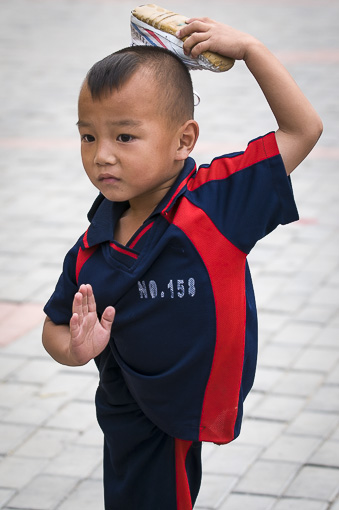
After just three months at boarding school, five-year-old demonstrates Kung Fu moves. 

From Wikipedia:
Kung Fu is a Chinese term referring to any study, learning, or practice that requires patience, energy and time to complete, often used in the West to refer to Chinese martial arts ... Originally to practice Kung Fu did not just mean to practice Chinese martial arts. It refers to excellence achieved through long practice in any endeavor. 
Today this blending of hand to hand fighting with Buddhist ideology continues to embrace self-defense, body-building and athletics, with Kung Fu becoming a world wide personal philosophy and sport.

Tuition, room and board at the Wuseng Tuan school is around $ 4,800 a year, a considerable sum for a Chinese family in spite of the country’s recent economic growth. Besides good basic academic education, many students hope to join the military or work as body guards. There are thousands of Kung Fu schools throughout China, all competing for a piece of a very big business. Yet the day before I saw a group of a half a dozen English speaking twenty something men and women training one on one with a saffron robed monk in the nearby Shaolin Temple.


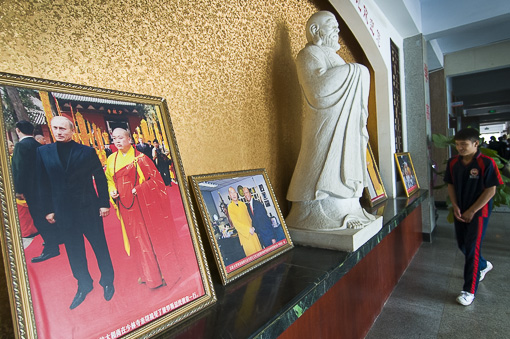
Photograph of Russian President Vladimir Putin and Shaolin Temple abbot is proudly displayed at the Wusen Tuan training center in Henan Province, China.

With the school enrolling 15,000 students, I was wondering where the other 3,000 were, as I had taken on face value their assertion of 12,000 Kung Fu children in front of me. Give or take a handful, seemed reasonable to me.

Just as I was about to ask, several accomplished five-year-olds were trotted out to perform for us. With just three months at the boarding school these cute tikes whipped through their foot kicking, hand chopping routine, climaxing with placing one foot behind their heads while standing perfectly still. Were the future generals of the People’s Liberation Army before me, standing like tall storks? With the world’s largest armed forces, China could always use one more Kung Fu practitioner.

Thursday, October 31, 2013

Sounds Overheard: Pingyao's Chaotic Streets


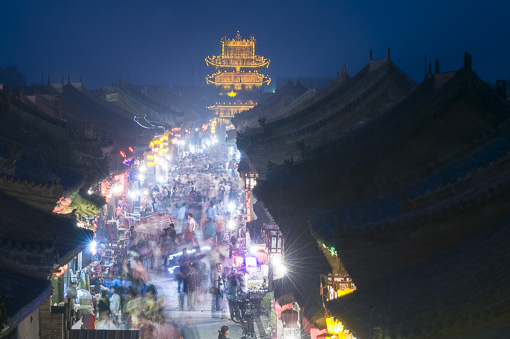
At dusk the 14th century Market Tower rises from cobblestone streets teeming with people in the Ancient City of Ping Yao in China's Shanxi Province in September.


 0:00 traditional instruments, 0:14 bamboo flute, 0:32 swarms of people, 0:40 fire crackers, 0:49 street vendor, 1:01 toy rubber chicken seller, 1:15 outdoor wok, 1:30 police cart, 1:43 live bar music

iPhone & iPad friendly link, or if you've received an email without audio player.


Considering only pedestrians and pedal powered bicycles are allowed into the central core of the ancient walled city of Pingyao, an amazing tapestry of sound is generated in this city of 50,000. Not ear shattering New York City jack hammer and subway loud. But just as enveloping ... shouting vendors, crackling fireworks, banging gongs, sizzling woks, bicycle bells, conversations soft and shouted. Here sounds are every where, sharpening your senses, your eyes noticing more detail, your nose discovering new flavors wafting on the air.


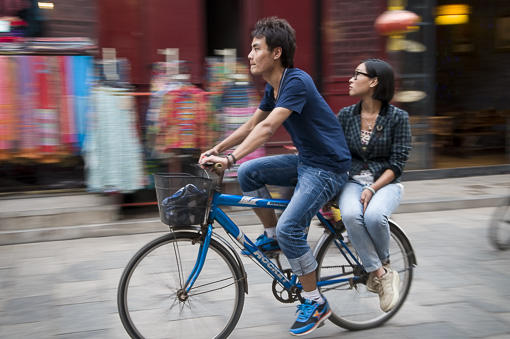
As shop lights twinkle on, a young couple thread Pingyao's narrow streets last month. 

 When the magic hour arrives at dusk, the sky goes from deep blue to black and the red cloth lanterns twinkle on in the restaurants and shops, there is no quiet spot within these stone walls built over 500 years ago.

 It's due to the hordes of Chinese and foreign tourists and businesses catering to them. So many visitors flock to what are considered among the best preserved city walls in the world - Pingyao is a UNESCO World Heritage Site - that rampart tourism and development are considered a major threat.


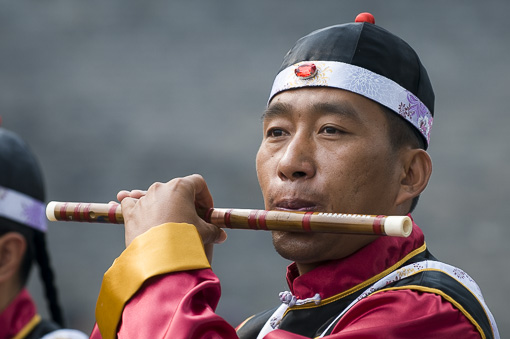
Costumed musician plays bamboo flute below the South Gate in the 6,000 meter stone wall that encircles Pingyao, which is about 450 miles West and a little South of Beijing.

Don't let the crowds discourage your visit, there's lots of room. What fun being a fly on the wall among the throng, people watching, recording sound and taking photographs. If those pursuits aren't enough entertainment, then a $5.00 foot massage lasts almost an hour. At a street side table a large bottle of warm beer is 75 cents and great dinner of stir fried pork and eggplant a few dollars more. The pandemonium becomes background music

I never experienced a quiet and calm Pingyao. I suspect there's an hour when the nightly hubbub dims as the shops and bars close and visitors stroll off to bed. Probably when the sky brightness early in the morning the streets are momentarily quiet as the city regains it's strength, soon to murmur back to life.


Preparing Mahua, a friend dough twist cooked in peanut oil, on the sidewalk of the Zhauji family shop.

During my assignments and travels I've been recording the sounds I overhear, and many don't have supporting photographs or stories. Well, today there's a short story and a few pictures. This occasional series will be my excuse to share my audio orphans, these Sounds Overheard

Friday, May 31, 2013

Sounds Overheard: Florida Bay Deserted Island

 One of the tiny Oyster Keys floats in Florida Bay earlier this month a short paddle from Everglades National Park's Flamingo Visitor Center. 


I was paddling my kayak on the mirror smooth waters of Florida Bay when two tiny dots off on the horizon caught my eye. Out there where the blue sky meets the even bluer water I had no idea how many miles into the distance I could see. But it was far enough for my mind to imagine the curving of the earth causing some distant islands to slip below the waterline just far enough for me to barely detect the tippy tops of the three-story tall mangrove trees.

I knew I was just an hour of paddling from the mainland, about four miles out, but with my back to the shore and my face into the sun facing South West, I pretended I was lost in a vast wilderness and needed to reach those distant fuzzy dots in order to survive. 

At low tide the the mangroves revealed a tiny opening on the lee side just big enough for me to beach my kayak on dry land, climb out and begin soaking in the amazing sounds emanating from this island about the size of a city home lot. A chatty king fisher scolded me and great blue heron squawked, seemingly to complain about my presence. But a cricket hidden under a rotten log didn't seem to mind, nor the thousands of bees seeking nectar from the mangrove flowers high up in the forest canopy. I popped on my headphones and set up my recorder and began to preserving the sound of my wilderness island.

iPhone & iPad friendly link to audio recording.

During my assignments and travels I've been recording the sounds I overhear, and many don't have supporting photographs or stories. This occasional series will be my excuse to share my audio orphans, these Sounds Overheard

Wednesday, February 27, 2013

Sounds Overheard: Parking Lot Wild Life


Once the sun sets nature can often be heard from parking lots of such places as Bahia Honda State Park, in the Florida Keys, photographed in December 2012.

Last month after a long day kayaking in the Florida Keys, I left my camp site close to midnight and drove to the end of the road at Bahia Honda State Park. All the day visitors were long gone, I had the crashing waves on beautiful Sand Spur Beach all to myself, and I stumbled along with my tape recorder by starlight. Just steps from the car I picked up a lone cricket in my head phones, fiddling away underneath the concrete parking bumper, giving me a pretty cool recording right in the parking lot. I realized that I've often captured the sounds of wild life from parking lots, often in very urban settings.


Examples of wild life recorded from parking lots and urban settings: 0:00 frogs in motel parking lot, 0:25 cricket under concrete bumper, 0:46 vultures have kerfuffle, 1:12 mocking bird in city. iPhone & iPad friendly link to 1 min 48 sec MP3. 

I was attending a workshop in Chapel Hill, North Carolina, last year, and after a long evening of slaving over a hot video editing workstation, I returned to my hotel wedged between a busy ring road and a strip mall. A wonderful sound caught my attention, what seemed like a million croaking frogs were jamming in a living room sized water retention pond alongside the parking lot. I just had to make a recording.

In the clip above I also have the sound of turkey vultures flapping and fussing over a bit of road kill in a parking lot in Everglades National Park, and a male mockingbird over stoked on testosterone in the middle of the night alongside my drive way in Miami. Listen for the passing car with boom box.

During my assignments and travels I've been recording the sounds I overhear, and many don't have supporting photographs or stories. This occasional series will be my excuse to share my audio orphans, these Sounds Overheard. Please also visit my Miami commercial photography portfolio.

Saturday, December 29, 2012

Sounds Overheard: Alcatraz Listens To Freedom


After rowing around Alcatraz Island for sport, two athletes return to the freedom of downtown San Francisco.  

The long concrete cell blocks rose three stories high above the prison floor, their steel doors permanently open and silent. Even though hundreds of visitors passed where nearly 1,500 of the country's most dangerous prisoners spent years of their lives, including Al Capone and Robert "The Birdman" Stroud, only a quiet murmur floated about the concrete and steel.


Listen to the sound of footsteps recorded in The Hole contrast with birds, waves and far off bell, sounds of freedom wafting into Alcatraz. iPhone & iPad friendly version.

Last November I was visiting Alcatraz Island, one of the Golden Gate National Parks, a rocky outcrop in San Francisco and a scant 1.5 miles from the downtown skyline. 

Inside the notorious D-block, also known as The Hole, where the worst of the worst were housed for bad behavior, I entered an eight by eight foot all steel cell. My steps thumped from the floor, off the  walls and bounced from the ceiling. I paced back and forth between the to close walls. Was this what a prisoner heard while isolated in near darkness?

Now a National Park, the federal prison on Alcatraz Island housed the USAs toughest convicts, from 1934 through 1963.

Outside the cell house and along a cliff side trail, my attention was drawn to the sound of waves lapping the shoreline, and the sound of birds nesting along the rocky cliffs. The low drone of an unseen airplane passed overhead. I wondered if these sounds of the outside world ever reached the confined convicts ... maybe on a very still day.

As I explored the walled recreation yard where prisoners could see the blue sky and breathe fresh air, work out or play a game of baseball, I could not see San Francisco Bay, but I could hear it as a navigational buoy bell clanged every few seconds.


Wild flowers grow through concrete of the high walled recreation yard, one of the few places prisoners could enjoy the out doors. It is within earshot of crashing waves and a buoy bell along the island's rocky shore.

What was it like for prisoners, confined in the toughest federal prison in the country, to hear these sounds from the outside world, the sounds of freedom drifting into their grim world?

During my assignments and travels I've been recording the sounds I overhear, and many don't have supporting photographs or stories. This occasional series will be my excuse to share my audio orphans, these Sounds Overheard. Please also visit my Miami commercial photography portfolio.

Tuesday, October 23, 2012

Sounds Overheard: Chants At Rebuilt Monastery


Incense wafts on late afternoon sunlight at Reting Monastery North of Lhasa, Tibet. 

The Reting Monastery’s 11th century walls were freshly painted bright white, deep orange and dusty red. Gilded deities kept an eye on me from their perches atop cracked timbers supporting the roof. I felt I could reach up to touch the brilliant blue sky, as I was standing extra close at over 13, 000 feet. It was completely quiet. No breeze rustled the fall leaves, no birds chirped, no footsteps distracted me.


Listen to 1:22 recording of two Tibetan Buddhist monks chanting and playing drum and cymbals. Try headphones to hear stereo effect. iPhone & iPad link.

Suddenly two young monks rushed across the temple courtyard and disappeared through a narrow stone doorway, their red robes a quick flash of color. Soon a loud drum shattered the silence, boom, boom, boom. Then brass cymbals crashed. I followed the rhythm through the doorway and into a narrow room, a sliver of stony space with candle soot blackened walls rising two stories to an open window high above. 

The two monks began chanting in Tibetan, rapid fire fast, their voices drawn up and out the window and over the hillside temple complex, calling their brother Buddhist monks to evening prayers.

During China’s chaotic Cultural Revolution, this magnificent monastery North of Tibet’s capital Lhasa was nearly destroyed, stones and timbers torn down and salvaged for building projects, it’s monks harassed and disbanded. Since Reform and Opening of the late 1970’s, China has slowly become an economic power house tolerant of religion and money making, as long as the Communist Party is not threatened. Government and private funds are rebuilding many cultural sites, and Reting’s former splendor is slowly rising from the large piles of rubble awaiting rebirth.

During my assignments and travels I've been recording the sounds I overhear, and many don't have supporting photographs or stories. This occasional series will be my excuse to share my audio orphans, these Sounds Overheard. Please also visit my Miami commercial photography portfolio.

Thursday, August 9, 2012

Sounds Overheard: Seeing Tibet With Closed Eyes

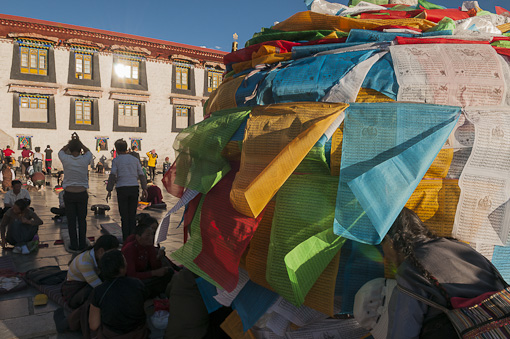
Pilgrims worship at the Jokhang Temple, Tibetan Buddhism's holiest site.

Exploring Lhasa on my first day in Tibet was so overwhelming that I was having trouble seeing photographs. Crowds of Buddhist pilgrims dressed in regional costumes streamed down every street, Han Chinese merchants in Barkhor Square sold everything from prayer wheels to yak butter and the occupying Chinese army marched with assault rifles at the ready.

I was gasping in the thin air at 12,000 feet altitude. My stomach was deciding if it liked my yak stew lunch. Colors were way to saturated, the blue sky, the monk’s saffron robes and the rooftop golden lambs.

So I closed my eyes and started listening for pictures.


Close your eyes, listen to the sounds around the Jokhang Temple in Lhasa, and tell me what you see. iPhone & iPad link to 1:48 long MP3.

The first sound I heard was a far off rhythmic slapping and chanting.  I discovered over a dozen workers, men and women, building a traditional aga earthen roof atop the Jokhang Temple. They were on their hands and knees with hand held wooden paddles compacting the mix of gravel, dirt and water infused with willow tree bark.

I recorded the sound of wooden and leather hand protectors scraping on the cobble stone temple square as the pilgrims prostrated them selves in repetitive prayer. They stood with their hands together above their heads, then down on their knees, then on their stomachs with arms out stretched.

My ears discovered a man singing prayers from a well worn book of Tibetan script, his voice competing with the thousands of pilgrims circumambulating the mile-long circuit around the temple.

Slowly the sounds awakened the visual corners of my brain, I opened my eyes  and began making photographs.

Editors note: If you visit the "aga earthen roof" link above, poke around the site a little and see how the Chinese government views the Tibetan people.

During my assignments and travels I've been recording the sounds I overhear, and many don't have supporting photographs or stories. This occasional series will be my excuse to share my audio orphans, these Sounds Overheard. Please also visit my Miami editorial photographer portfolio.

Friday, May 18, 2012

Sounds Overheard: Tibetan Monks' Spirited Debate

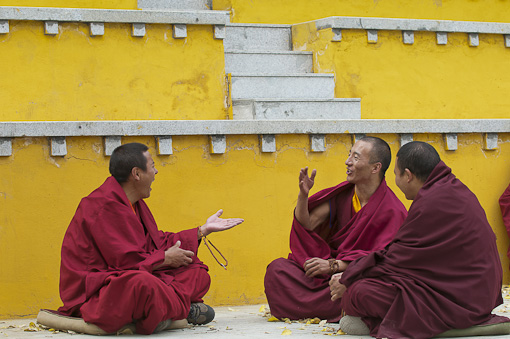
Spirited debate between Tibetan Buddhist monks at the Drigung Thel Monastery, Lhasa.

While traveling in Tibet last October, Tibetan Buddhist monasteries were not only locations to create some great photographs, but were also sources of terrific natural sound.

Today's post is short and sweet, three photos of debating monks from three monasteries, and a short recording of natural sound from one of them.

Listen to this 1:13 field-recorded natural sound of Tibetan Buddhist monks debating at the Sera Monastery.  iPhone & iPad friendly version.


Monk debates at the Sera Monastery, Lhasa.

From an earlier post on this blog, a little background on the debates:
Debate is an important part of a Tibetan monk's training, and is said to help expand the mind, increase mental sharpness, develop analytical skills and help gain mental clarity. The debates follow a strict form, with the standing questioner challenging the thesis of the humbly sitting defender. As the questioner raises doubts, the exchange becomes increasingly animated, with exaggerated body language, lunging, hand slapping and loud shouting. The defender mostly sits quietly and looks away, occasionally making a counter point by waving his arm.
As one monk, left, encourages the defender, right, the challenger, center, claps and lunges to make his point at the Reting Monastery.

During my assignments and travels I've been recording the sounds I overhear, and many don't have supporting photographs or stories. This occasional series will be my excuse to share my audio orphans, these Sounds Overheard. Please also visit my Miami commercial photography portfolio.

Friday, February 17, 2012

Sounds Overheard: Key West Sunset Celebration


Sky high street performer entertains last month at Key West's Sunset Celebration.

If you visit Key West, or the Florida Keys, or Florida, or for that matter, the USA, and haven't attended the eclectic daily celebration of the sun sinking into the brilliant blue Gulf of Mexico, you are missing an amazing experience.

Somehow the official description from the Sunset Celebration organizing committee doesn't capture all the flavor and quirkiness:
Sunset Celebration is a nightly arts festival at Mallory Square Dock in Key West, Florida. The participants of this Key West attraction consist of arts and crafts exhibitors, street performers, food carts, psychics and of course the thousands of tourists from around the world who visit this Key West art show. Each night around two hours before sunset masses of people, both locals and tourists alike, flock to the water's edge to experience a multicultural happening and to watch the sun sink into the Gulf of Mexico.

So I've stuffed some of that Key West fun into a glass bottle for you, and thrown it into the sea in hopes of your finding it washed ashore on a deserted beach. The two minutes of field-recorded natural sound includes:

0:00  bag piper
0:23  escape artist schmoozes for tips
0:47  banjo player
1:13  pop corn pops
1:20  one-man band plays harmonica, guitar, drums and more
1:46  crowd applauds

Here is an iPhone & iPad version.

During my assignments and travels I've been recording the sounds I overhear, and many don't have supporting photographs or stories. This occasional series will be my excuse to share my audio orphans, these Sounds Overheard. Please also visit my Miami commercial photography portfolio.

Wednesday, January 18, 2012

Sounds Overheard: Yaks & Pilgrims Ring Bells

Moving shaft of sunlight warms young Buddhist Tibetan Monk studying at temple entrance, Thasilhunpo Monastery, Shigatse, Tibet.

Traveling requires all of your senses to fully experience your surroundings, whether they are in exotic Tibet or some place closer to home, like the dusty strip of sprawling gas stations, fast food joints and mini marts you've stumbled upon after getting off the interstate highway.


Listen to one minute recording as birds chirp and large brass temple bell rings, then to nomad yak herders in outdoor market shopping for bells to hang around their livestock. 


Stand still for a moment in front of that mini mart and listen ... traffic and horns assault you, sure. Wait a moment, between traffic lights, those little chirping birds, probably sparrows, hopping around the trash filled hedge. Gee, they are pretty sounding. Hear the salsa music wafting out of that bodega over there, that sound adds some more color. A nice gentle breeze rustles the tree leaves above your head, a bossy black crow barks down from atop the power pole.

Listening to the details, sometimes loud, sometimes subtle, makes this place, this very moment in time, much richer to you. OK, I know, the light has changed and this spot is getting just plain loud, so lets relocate to Tibet. Poof!

Now we're standing under a foot tall brass bell, green with age, hanging from colorful braided cords from the hand hewn rafters of one of the Tibetan Buddhist temples in the Thasilhunpo Monastery. Founded in 1447 in Shigatse, Tibet's second largest city, the monastery is both very quiet and very full of sound. Pilgrims jump with outreached finger tips to ring the bell hanging just out of reach, rich tones reverberating and fading into background sound of happy birds chirping in the sunny courtyard.

An hour later we're visiting the outdoor market in busy downtown Shigatse, and are eavesdropping on two men dressed with red cloth braided into their long hair, silver jewelry around their necks and on their fingers, staying warm in sheep skin jackets.They are test ringing inexpensive bells to hang around the necks of their livestock, some as big as their fists for yaks, some walnut sized for sheep.

Listening carefully can enrich our travel experiences no matter where we are. Now let me decide, do I stay in Tibet, or Poof, I teleport back and dig into a lime green Double Big Gulp at the mini mart?

During my assignments and travels I've been recording the sounds I overhear, and many don't have supporting photographs or stories. This occasional series will be my excuse to share my audio orphans, these Sounds Overheard.  

More stories from Tibet are elsewhere on this blog, and more examples of field-recorded natural sound are at my Miami multimedia production portfolio site.

Friday, December 16, 2011

Sounds Overheard: Incantations Of Tibeten Nuns

Buddhist nuns wear elaborate head dresses while chanting last October in Lhasa, Tibet.

While visiting the Anezamkang nunnery in Lhasa I was reminded of the nugget of video production wisdom that goes "seventy five percent of what you see is what you hear".
 
Do you "see" more when you play 1' 15" natural sound recording of nuns chanting?

I must admit I was in a heck of an visually exotic spot, inside a tiny Tibetan Buddhist temple draped ceiling to floor with colorful banners, filled with three dozen nuns wearing elaborately embroidered robes and hammered silver-paneled hats topped with tall turbans. The nunnery was hidden down a tiny stone alley in Lhasa's ancient Tibetan quarter, out of sight of the Chinese army troops patroling with automatic weapons a few blocks away. I was gasping in the thin air at 12, 000 feet, and contentedly digesting a meal of yak noodle soup.

But listen to the above field-recording audio file of the nuns singing and chanting, ringing brass bells and swinging small paddle drums, and tell me how exotic the scene feels to you now ... seventy five percent better? I would say the experience is immeasurably more intense and real.

During my assignments and travels I've been recording the sounds I overhear, and many don't have supporting photographs or stories. This occasional series will be my excuse to share my audio orphans, these Sounds Overheard.  

More stories from Tibet are elsewhere on this blog, and more examples of field-recorded natural sound are at my Miami multimedia production portfolio site.

Wednesday, November 30, 2011

Faces of China Photographic Exhibition Now Online

I’ve been hearing from some of my friends and colleagues that they’ve been unable to see my Faces of China exhibit currently hanging at the Archbishop Curley Notre Dame Gallery of Art, which opened earlier this month, and closes January 21, 2012. Their work or personal schedules have interfered, and some aren’t from the Miami area and won’t have the opportunity to visit.


Faces of China slide show runs just two minutes ... iPhone & iPad version.

So I decided to set up an on-line version of the 38 image exhibit, viewable right here in your web browser. Each image is on screen for just three seconds, so the entire show will take barely two minutes of your time, 30 seconds more if you read the shortened artist’s statement at the end.

For the show’s opening November 5, I mixed a 20 minute audio track of field-recorded natural sound from my trips to China, which played in the background, giving visitors an extra dimension of understanding to the photographs.

This on-line edition of the exhibit is accompanied by a brand new sound track of a guzheng, a multi-stringed Chinese instrument that is plucked, which I recorded at the Buddha Zen Hotel in Chengdu on my last night in China in October. A very peaceful waterfall accompanied the lovely young lady who was performing that evening.

Six images from Tibet are included, shot just two weeks before exhibit opened.

In September I wrote about the then upcoming Faces of China exhibit, and I’ll take the liberty of reprinting my artist’s statement here:
Visiting China as a photographer for the first time was very intimidating. With a population of 1.3 billion and one of the planet’s most ancient cultures, I worried that my images would not contribute anything new. How could I tell the story of the political transformation since Liberation in 1949, the legacy of the Cultural Revolution, and an economy that’s moved hundreds of millions of rural peasants to the cities and transformed the nation into world power?
I decided to meet China’s people one at a time, capture a tiny bit of that nation’s character one photograph at a time. I went into the streets and markets and temples with no particular agenda other than to see the relaxed and candid side of people from a culture very different from my own.

After seven trips to China I present here no insights into their political, economic and environmental challenges. I simply try to look into a pair of eyes just like mine, accept them for who they are at that moment, make a connection that I can digitize, take home and share. These Faces of China are fleeting glimpses of people that are like you and me, people who are trying to live their lives to the fullest, plan for the future, contribute to their community. And sometimes they sneak a peek at an unusual Western visitor with a camera.

My technique to capture these photographs is very basic: I show my subjects respect, smile, indicate an interest with body language, and treat them as I would want to be treated. I say hello in badly mispronounced Mandarin, “ni hao” throughout China, “sain baina uu” in Inner Mongolia, and in traditional Tibetan regions of Sichuan, Gansu and Qinghai, “tashi dele” brings out the smiles.

Captions accompany maps with featured Chinese province.

For more examples of field-recorded natural sound combined with photography, please visit my multimedia portfolio site. More examples of journalistic photography from China can be viewed at my Miami corporate photography site.

Wednesday, November 16, 2011

Sounds Overheard: Tibetan Lute Melody And Song

Musical detail from Buddhist temple wall painting, Reting Monastery, Tibet.

The singer's soulful voice cut through the noisy traffic, his fingers racing over the strings of his lute-like instrument while pilgrims flowed through the gates of the Dreprung Monastery on the outskirts of Lhasa.

His voice was rather raspy, yet melodic, and blended well with the tune he produced from his worn dramyin, a traditional Himalayan folk music lute common in Tibet.  Sitting cross legged on the ground, he was accepting offerings of small Chinese currency, many Fen, worth a couple of pennies each, with a few one and five Yuan notes in his collection box, valued at a couple of dimes.


Listen to natural sound recording of street performer singing folk song and playing a seven stringed dramyin. 1 minute 23 seconds. 


Last month while traveling in Tibet I encountered several such minstrels, who carry on the Tibetan tradition of oral story telling through song, with dramyins often accompanying their narratives. While in the field I simply enjoyed the music and ambiance of the the ancient temple setting, but upon my return Wikipedia's technical description of the Tibetan lute helped explain what I was hearing.

The dramyin is a long-necked, double-waisted and fretless lute. It is usually hollowed out of a single piece of wood and can vary in size from 60 cm to 120 cm in length (2 to 4 feet). Unlike a contemporary guitar, the dramyin does not have a round sound hole in the wooden sounding board but rather a rosette-shaped ones like a lute. Of its seven strings, only six continue to the pegbox. The seven strings occur in two double courses, and one triple course.

The triple course of the dramyin typically contains the half string on the left, which is usually tuned an octave above the middle unison strings. One of the other two courses are typically tuned an octave apart. The courses are normally plucked in unison during playing. Typically a single note is played at a time, making for melodic music and not harmony. 
During my assignments and travels I've been recording the sounds I overhear, and many don't have supporting photographs or stories. This occasional series will be my excuse to share my audio orphans, these Sounds Overheard.  More examples of journalistic photography from China can be viewed at my Miami corporate photography site.