Showing posts with label Environmental Portraiture. Show all posts

Wednesday, December 31, 2014

Flaming Portraits & Tight Environments


This Fall I shot two environmental portraits that presented photographic challenges to solve, which is the fun part of creating custom imagery for my clients.  The first challenge was shooting a cover image in a narrow office hallway, and the second, squeezing a fire hot photo from a tiny commercial kitchen. Both were assigned by Group Art Director Sean Barrow at Rep. magazine, which covers the financial advisory industry.


Available light scouting shot of cramped hallway where I will create a magazine cover photo ... yikes!


Sucking in my stomach to make room, I proceeded as follows:
  • 60" umbrella with shoot through  front diffuser for beautiful wrap around light.
  •   Dynalite Pencil Light on floor stand was black foil wrapped to allow about 180 degree fill onto back wall, with full Color Temperature Orange gel.
  • Upper left Dynalite head with 20 degree honey comb grid for hair and shoulder rim light.
  • Clipped on yellow flash head cover keeps having eyes poked out.


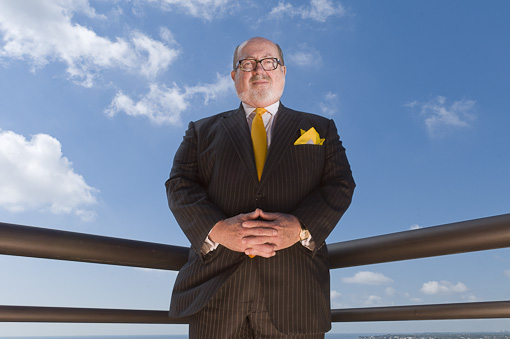
Marshall Leeds of Summit Advisers, Boca Raton.  85mm fF1.8 Nikkor, Nikon D610.


David Ortiz of Financial Chef in Coral Gables.  28mm F 1.8 Nikkor, Nikon D610.

Former chef David Ortiz remodeled a Coral Gables restaurant so the financial adviser can cook for and get acquainted with new clients right in his office suite. Art Director Barrow suggested "something with flames" for a photo, and I would have more than a hallway to work with this time.


Narrow and cluttered commercial kitchen greeted me in the offices of  Financial Chef

 Moving some of the clutter out of view, I squeezed these steps into kitchen:
  • Set Nikon D610 to tungsten color balance to give wall some blue color
  • Lit background with precisely aimed Dynalite Pencil Light by propping leg on spare speed ring
  • Goboed that light from my subject.
  • Placed small 24 inch umbrella to light subject and open area under hood, gelled double CTO
  • "Dragged" shutter 1/4 second to expose for flames


Small umbrella double gelled color temperature orange to add warmth to subject on top of the tungsten color temp on camera.


Editor's choice for full page with section head and copy.  Nikkor F 4 16 - 35 mm.

Thursday, October 30, 2014

Quick & Practical Lighting With Household Lamps


In movie making a practical light is a light source that shows in the frame and appears to be illuminating the scene, but usually isn't. The table lamp or candle may be too dim to reach the entire scene and fill light is carefully added that is "motivated" by the practicals. A talented Director of Photography will carefully craft the mood of the scene by blending all the light sources.


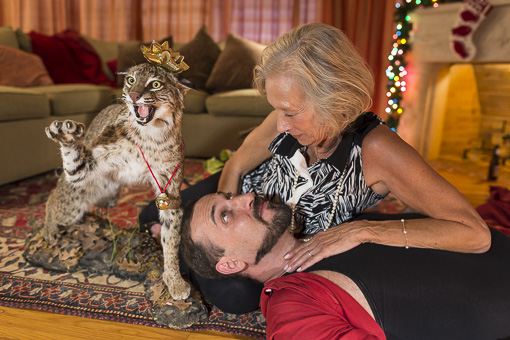
Or you could be like me and hurriedly throw together whatever lamps you find in your living room and garage and pray you can pull something off. In September I was asked to create still photographs for the opening sequence of The Mens Room, a low budget short thriller involving a taxidermist, a secret man cave and a bloody knife.


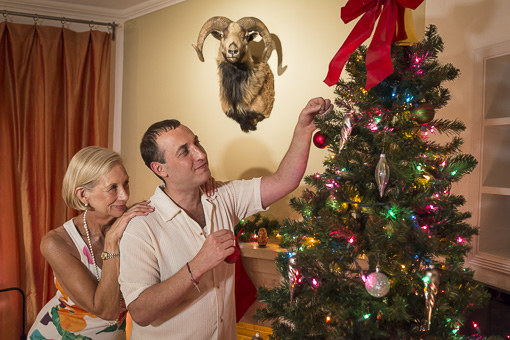
A couple's changing relationship was to be depicted over three Christmases, from happy newlyweds to eventual cold indifference, all to set up the thrills to come. No, I won't tell you what happens.


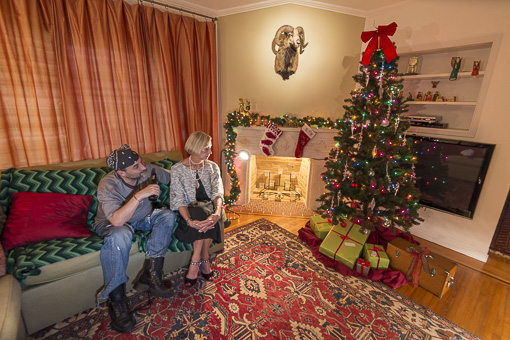
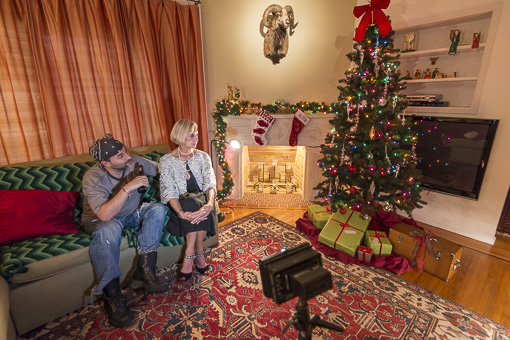
Our Miami Shores living room received an early Christmas make over thanks to the talents of Art Director Anais Sancetta and vision of Director Eve Ganzel. With about an hour before the actors arrived - Claudia Buckley playing Evelyn and Misha Kulberg as Bill - I marshaled a bunch of household lamps, window light and strings of Christmas lights to create a warm and cozy scene.

Here are the steps I took:


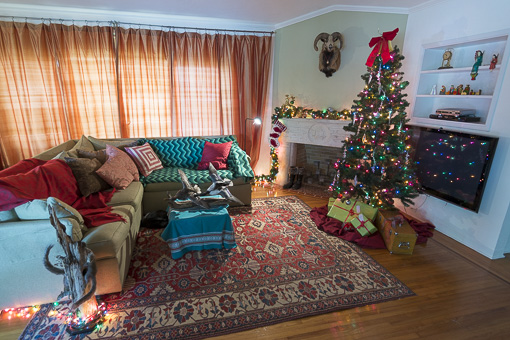
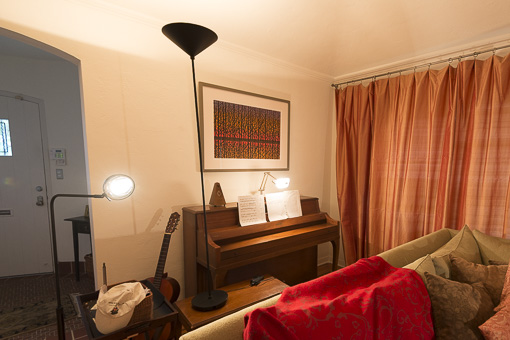
Practicals are the light coming through curtains and Ikea lamp that back lights stuffed ducks and carpet, with Christmas strings on. Curtains burned out, room too dark, contrasty and cold. I love the stuffed squirrel at lower left has own accent light, the taxidermist's gift to husband. How romantic.


 A big box store fluorescent work light is gaffered into the fireplace ... who knows what the color temperature is. Yes we should of lit the candles. Hey, it's a low budget film.


 A tall halogen floor lamp placed on piano bench provides overall fill off the ceiling, while music lamp and Ikea lamp rim the sofa.


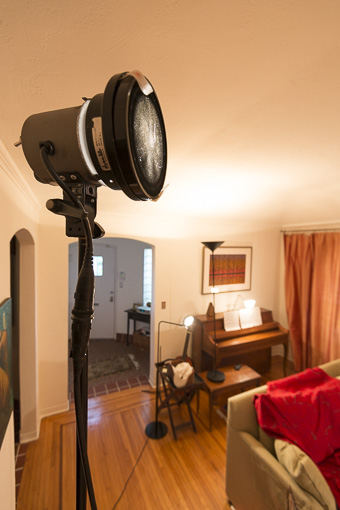
OK I cheated here, I pulled out my Dyna-Lite strobe head with honeycomb grid, but just used the modeling lamp to spot light the mountain goat above the fireplace. 


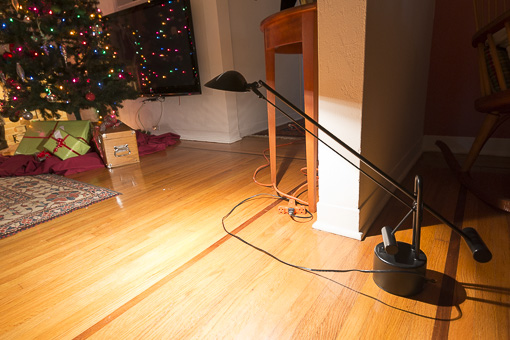
A halogen desk lamp indirectly opens up the bottom right floor by the Christmas tree.


And finally, a small LED dialed to tungsten color balance opens up the actors just a touch. Yes, I too see the black power cord snaking into the upper right fireplace.

Friday, November 29, 2013

Portraits From Nothing, Sometimes Easy, Often Hard

When one of my magazine clients assigns me to create an environmental portrait, the first few minutes on location are the most nerve wracking for me. I’m thinking, I have to make somebody look great in this location.

I see blank walls, florescent lights and another drab conference room. I worry about how to set up my lights and compose my portrait in order to make something out of this nothing.

Geeze Louise, what am I going to do?


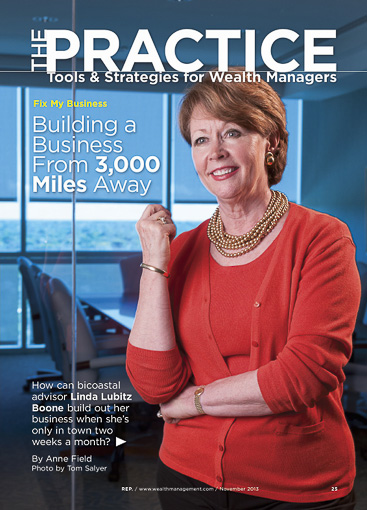
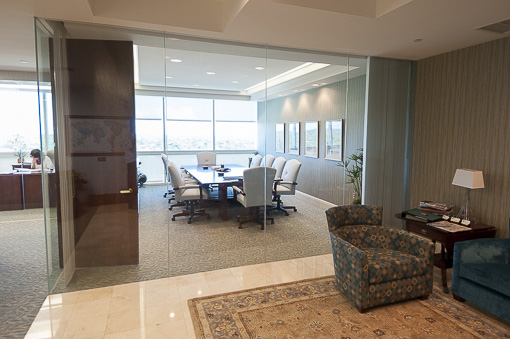
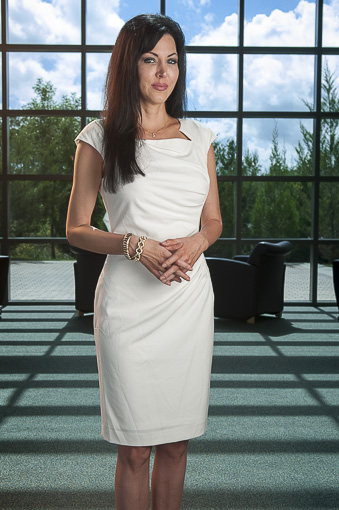
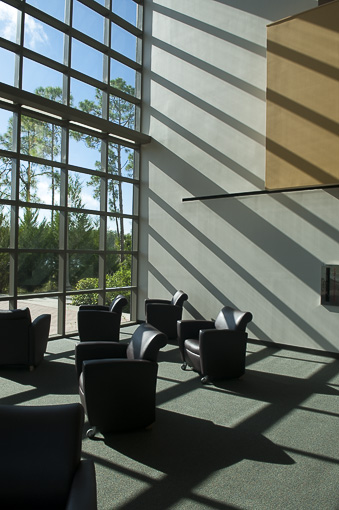
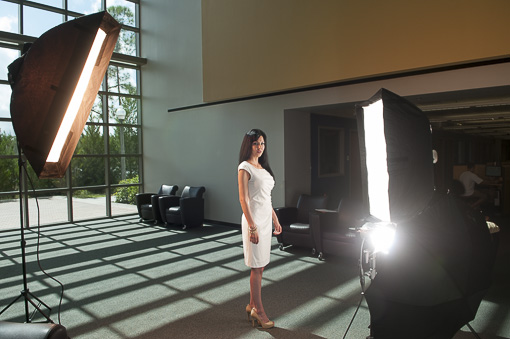
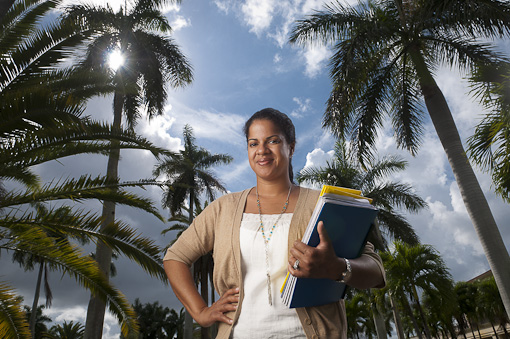
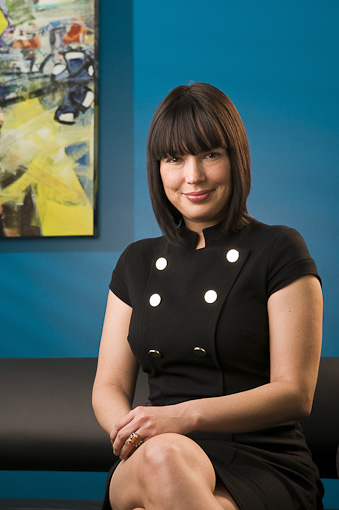
When I arrived to photograph Miami, FL, financial planner Linda Lubitz Boone for Sean Barrow at Rep. magazine, I began with the location below.


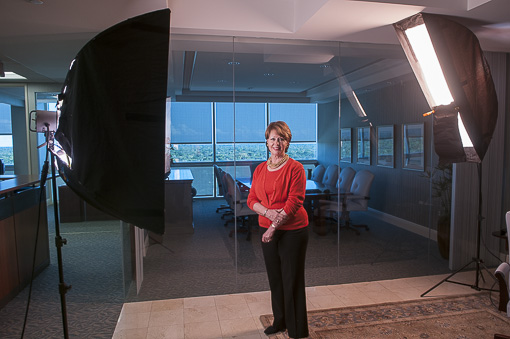
After working down my check list: 1) set medium softbox at left, and placed strip box at right for rim and hair light. 2) Color temperature on camera set to tungsten 3200 K, making window light blue. 3) Slow shutter speed exposed for outdoor light. 4) Gelled left strobe full color temperature orange,  and rim light full CTO + 1/2 CTO more.

 
In these moments I try to tell myself that pain and angst are part of the creative process, and I must work through this challenge by methodically coming up with a photographic solution. As I work through my mental check list, I travel from panic to confident :

- What’s the story I’m telling with this portrait? Is my subject powerful, so I want to shoot upward? Are they sympathetic, and I want soft lighting and a warm color palette?
- How can I use the environment to help the story? Do I want to show the developer looking over a grand city, or Is it a personality profile where location is not important?
- Will my art director run a large photograph so I can shoot wider, and do I need to shoot tight also for secondary use or table of contents? Horizontal, vertical, room for cover lines and copy?

- Will this space allow me to place my lights where I need to?
- How can I make limited lighting gear work here?
- And I check off the details: How long may I keep my subject in front of the camera? How long may I use this location? Will my cables and stands be in the way? May I turn the overhead lights off? Will my extension cords reach? When do the lawn sprinklers come on? Will the strobes mess with the fire alarms? Does my executive wear glasses? Does he have hair or is he bald?


Scouting locations at Florida Gulf Coast University in Ft. Myers, FL, I just had to photograph Rebekah Wells in the dramatic light streaming in the library windows, a rare gift. Shot for Bob Fernandez at the ABA Journal for a story on "revenge porn". A very interesting read, as is Ms. Wells' site Women Against Revenge Porn. 


Very simple lighting: 1) medium soft box on right is main light, no gells 2) strip light on left gelled full CTO 3) small beat up umbrella at lower right provides fill at 2 - 3 stops under, no gells 3) regular daylight shutter speed to expose for sky and clouds.


As the pieces come together and I fire off a few test frames to check on the back of my camera, my photograph begins to materialize from my imagination. By now I know that when my subject walks on set my environmental portrait will be a success.

Very important tip, nobody want’s to hear their dentist say “oops!”, so while your creative mind is panicking and stumbling, keep it inside and don’t let ‘em see you sweat.

I must admit, every once in a while I walk into a location and immediately see a terrific solution. Wonderful sunlight and shadows cascading through magnificent windows, or a grand interior with soaring architectural details. Or maybe just a prop will make my day, a model airplane or basketball, whoopee!

I accept these occasional gifts with grace and enjoy not having to torture myself on the way to making one more photographic portrait out of nothing.

Friday, March 8, 2013

Single Woman Adopts Brothers With Rare Syndrome

I've had a lot of fun photographing portraits of orphan children living in foster care for the Heart Gallery of Broward County (FL), and like the more than two dozen other professional photographer volunteers, have felt the thrill of seeing our subjects find adoptive homes.

Upon viewing the portraits for the first time, prospective parents often report an instant connection to the child. Putting the faces of a real children onto dry case files is why over 100 Heart Galleries in the USA exist.


Brothers Royce and Noah paused for a rare quiet moment in the group home bed room they shared when I photographed them in 2009. Now ages 18 and 14, they've been adopted out of foster care. Born with 5 p minus, they are developmentally at 4 and 5 year-old levels.

This week I realized the handful of hours we photographers contribute are really nothing compared to the commitment and devotion required of  the adoptive parents and their children in creating new families. Heart Gallery Executive Director Barbara Schechter has written this week a newsletter story about a 28-year-old single woman who adopted two teenage brothers who have the same rare genetic disorder two of her siblings were born with. Tabitha found the boys from a photograph after ChildNet, the private agency contracted with the State of Florida to facilitate adoptions, used innovative recruitment techniques to find her.

Young Mom Adopts Brothers With Rare Genetic Syndrome

By Barbara Schechter

Royce and Noah have been in foster care most of their lives. They have been photographed for the Heart Gallery and featured in Forever Family news segments several times over many years. They are gentle, sweet boys, now ages 18 and 14, but their rare medical condition, known as 5 p minus, scares most adoptive families away. People assume that their needs are more than they can handle - times two.

"Too much to handle" never even occurred to Tabitha, a single, 28-year-old woman who adopted the boys last fall. As soon as she saw their photo, she knew that she wanted to adopt them. 5 p minus, also known as Cri du Chat Syndrome, has touched Tabitha's family deeply. She is one of ten children, two of whom were born with this disorder.

5 P Minus occurs in only 50 to 60 births a year. It requires lifelong therapy, but the children are usually friendly and happy. Most can have a normal life  expectancy and lead full lives. Royce and Noah are developmentally at 4 and 5 year-old levels.

The connection between Tabitha and ChildNet was the result of some creative family finding on the part of Jessica Samuels, Wendy’s Wonderful Kid Recruiter at ChildNet. “No one ever called about these boys. I knew I had to try something different”. So she Googled and found the Five P Minus Society, a support organization for families of children with the syndrome. Jessica contacted the Society and they permitted her to submit a short article for their newsletter along with their Heart Gallery photo. The rest is the beginning of an amazing journey…

As soon as Tabitha saw the photo of Royce and Noah in the newsletter, she got on the phone to Jessica. Jessica then sent her a Forever Family video and she knew that they were supposed to be her boys. She came to Fort Lauderdale from out of state three times to get to know them and every time found it difficult to leave. Royce and Noah are much higher-functioning than Tabitha’s siblings, one of whom died right before Tabitha decided to adopt. In fact, their ability to speak and interact has brought her family close to them and created a wonderful support system for this single parent.

The boys lead busy lives that include special needs scouting and Special Olympics (three sports!). Tabitha left her job as a special education teacher to care for the boys. Her training has helped her to anticipate their emotional and social needs. They have adapted beautifully to their new life.

Gia Tutalo-Mote, of Forever Family, sums up our sentiments. “It thrills my heart to know that Royce and Noah have finally found that loving forever family we’ve been searching for. This proves once again that there is a family out there for every waiting child.

Heart Gallery Updates: Celene, the Heart Gallery teen who declared "Adopt Me, I'm Unforgettable" in an audio slide show featured on this blog in 2010, was adopted in 2011. Her friend in the video, Sheaundra, now 18, was just adopted this month, along with her now adult brother, by the same family. Laterence's adoption, featured here last September, should be finalized this month. Teenager Corey, who admitted struggling in foster care after the death of his mother, has turned 18 and "aged out" of the foster system and is out on his own.

Saturday, November 17, 2012

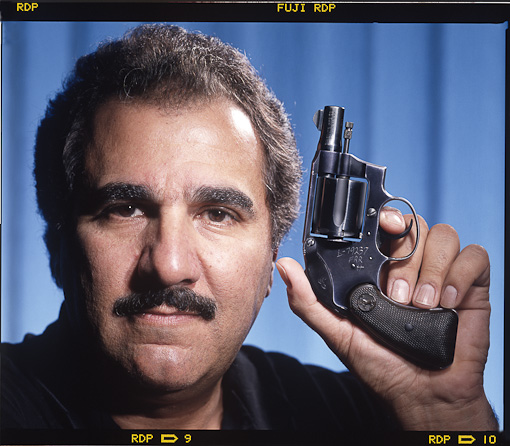
Photographing Revolver That Killed JFK Assassin

Holding the snub nosed .38 caliber Colt Cobra revolver in my hand, I expected to feel the weight of history slam down hard. This weapon was used to murder the assassin that shot JFK. Gripping it’s handle firmly, resting my finger on the trigger, sighting down it’s short barrel,  the gun didn’t seem all that special. At first I felt nothing exceptional.


Real estate developer and memorabilia collector Anthony Pugliese holds the snub nosed .38 revolver that Jack Ruby used to kill JFK assassin Lee Harvey Oswald. Photographed in 1993 for Newsweek. Notations scratched onto weapon by Dallas police detective.

It’s flat black finish was worn away on the edges. Crude numbers and letters scratched onto the flat metal near the chamber scared the handgun.

The letters were initials, I began to remember, the initials of the Dallas police detective investigating a shooting. The detective placed his notation on this revolver himself,  days after the nation reeled from the killing of President John F Kennedy. This very weapon I now held was connected to one of the greatest chapters of United States history.

Finally the weight of history caught up with me ... cringing, I set the infamous item down gently onto the conference table.

November 22, 1963, the President is shot while riding in his open top limousine, dying in his wife’s arms. Hours later a suspect is arrested, Lee Harvey Oswald, and booked into the Dallas police headquarters. Two days later, a local night club owner, Jack Ruby, freely walks up to Oswald, pulls this .38 caliber Colt Cobra revolver from his pocket and shoots Oswald in the abdomen, killing him.

Like most Americans alive at the time, I remember where I was when I heard of JFK's death. Seventh grade class, Mountain Home, Idaho, the announcement crackled across the loud speakers. As school closed early, my classmates and I were stunned, not really understanding what the news meant. I remember flickering black and white television images of the Oswald shooting and from JFK's funeral. Holding Jack Ruby's revolver I shivered as it physically connected me to this awful history.


Wearing this hat, holding this revolver loaded with these bullets, Jack Ruby was photographed the split second he shot Lee Harvey Oswald on November 24, 1963. 

History and childhood memories were on my mind in the conference room of South Florida real estate developer and memorabilia collector Anthony Pugliese in the Fall of 1993. I was on assignment for Newsweek to photograph Jack Ruby’s gun, the hat and shoes he was wearing during the shooting, bullets from the revolver and telegrams sent to Dallas police supporting Ruby.

Mr. Pugliese simply handed my assistant and me a box with the items, told us to take our time, and left us alone in the room. As alone as one could be with the full weight of this terrible history bearing down. The photos ran on the 30th anniversary of the assassination.

When I realized another anniversary would be arriving next Thursday, the 49th since President Kennedy’s death, I recalled the Newsweek assignment and found the original color transparencies. Shot on my beloved Mamiya RZ67 medium format camera, the 6X7 format transparencies were in an envelop unceremoniously labeled “Ruby Gun”.  As I laid the ‘chromes down on my light table, I realized I had forgotten the tactile feel of film. The images were three inches wide and sharp as a tack, their colors glowing back up at me. We shot the portrait with a 180 mm tele, wide open, and the still life with my favorite lens, a 50 mm wide angle, lighting with several tight grid spots.

History Update - Jack Ruby, whose conviction for murdering Oswald was overturned,  died of cancer in prison awaiting a new trial in 1967. So technically, he is innocent. The Warren Commission concluded both Oswald and Ruby acted alone, but conspiracy theories persist to this day. The snub nosed .38 caliber Colt Cobra revolver was put up for auction in 2008, but prices did not reach expectations and it did not sell.  The sale was to help finance memorabilia collector Anthony Pugliese’s plan to turn Florida scrub land into an Eco-sustainable city. The Destiny project vaporized with the real estate crash. This October Pugliese was charged with money laundering and fraud in that development plan.

Thursday, June 7, 2012

Seat Of Your Pants Location Lighting

Lighting environmental portraits on location is always challenging for me. I have to find and light a great composition, coax compelling expressions from my subjects and tell my magazine’s story, all as quickly as possible.  For a while I just plain go nuts with all the moving parts of the photograph tugging for my attention. But once I start flying by the seat of my pants, I’m able to relax and my image comes to life.

Lighting formulas usually don’t work for me. The physical layout of locations vary, every portrait subject is different, and, well, I never learned many formulas while earning my BS in Electrical Engineering. I meet the subject, recall the art director’s brief and adapt the basic lighting gear I own to tell my story.
 
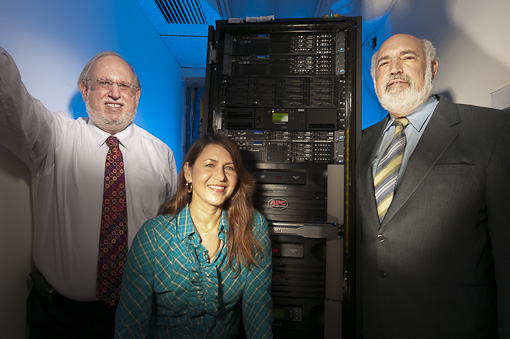
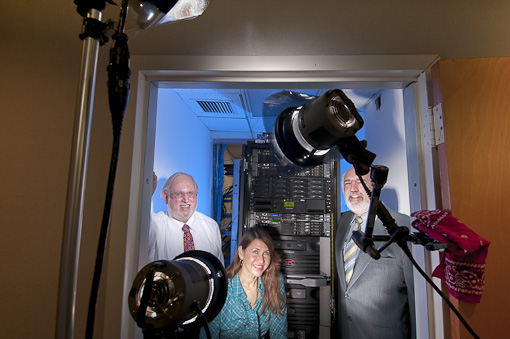
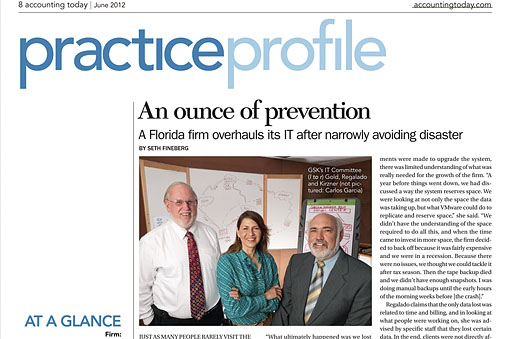
Posed in a closet with computer are Goldstein Schechter Kock's, from left, Zvi Gold, Amelia Regalado and Alan Kirzner. Three grid spots for faces, forth spot on floor lights computer, a bare tube with blue jell behind rack is light number five. 

In May I flew by the seat of my pants on an assignment for Source Media's Accounting Today. I was tasked with creating two environmental portraits of three accounting firm principals, one with a tech theme for the tabloid style cover, one for the inside profile. The partners were only available at 10 AM, and the very earliest I could get into their offices was 830 AM. An hour and a half for two portraits, for me, is tight, especially without scouting ahead of time.

Assistant Jonathan Rios with computer and closet before we began setting lights.

I began my going nuts phase when I decided the best idea available would be to cram three adults into the former coat closet that now housed their computer server. Arghhh, what have I got myself into, I wondered. We quickly set up,  jammed, really, three grid spots into the doorway, one clamped onto the door with a magic arm and super clamp, with a small spot open for me to insert my 18mm wide angle lens. A forth grid was mounted on the floor facing up to catch the equipment, and flash number five, a bare pencil light with blue jell, went into the back of the closet.
I barely had room to insert my camera between two light stands and super clamp plus magic arm attached to open closet door.

With two power packs and five flash heads spoken for, I only had one pack and two heads left to light the secondary portrait. I popped open a  60 inch soft box over my shoulder to light the thee subjects, dragged the shutter to bring in the window light. But how was I going to light the the background white boards and wall with my one remaining light?  Arghhh. 
Paper sheets torn from presentation easel become my background light. 
I grabbed several sheets of the presentation paper off it’s easel, laid them on the carpet, and pointed my last flash head directly down at them, bouncing a broad and soft light onto my background. A quick chimp at the histogram, and I was good to go.

Were my solutions contest winners or fine art? No. But flying by the seat of my pants allowed me to adapt to difficult locations and pull of another successful assignment.


To see more environmental portraits visit my Miami commercial photography portfolio site.

Monday, April 30, 2012

Magic Dust Not Just For Professional Photographers

This week I'm giving two presentations about photography and multimedia production to advancement and marketing professionals representing educational institutions from around the USA. As most of them will be executives with basic hand's on experience shooting or working with multimedia, I hope to help them improve their own skills, and learn when to call in a pro.

The idea for the Multimedia For Small Shops workshop in Naples, FL, April 30 and May 1, is that with today's digital cameras and recorders, and with the development of user friendly video and audio editing software, successfully multimedia can be created by non-specialists. Not every piece for social media outlets needs to have top production values as long a a good story is told.

Photography 101 will contain samples shot for the presentation at Miami's Barry University. Thanks to subject and assistant Silvia Arbelaez

My audience will be members of CASE, an international association of educational institutions:
The Council for Advancement and Support of Education is a professional association serving educational institutions and the advancement professionals who work on their behalf in alumni relations, communications, development, marketing and allied areas. CASE helps its members build stronger relationships with their alumni and donors, raise funds for campus projects, produce recruitment materials, market their institutions to prospective students, diversify the profession, and foster public support of education.

My first talk will be Photography 101 where I will be presenting tips on how non- professional photographers can improve their photography and how to recognize good photography they may be commissioning by others. I'll cover the basics, such as treat your viewfinder as you canvas, the rule of thirds, change your perspective, be aware of light and show a sense of place.

I also want attendees to not worry about being laymen taking photographs:

The most important tip I can give you is, use your eyes to carefully observe your world. Then apply your unique life experiences - who you are, what you’re curious about - to how you want to capture your photographs.  You get to choose the story you want to tell. Use the skills you possess to capture the scene in front of you.

It’s all about how you use the building blocks of good photography - composition, moment, light - not the latest giga megapixel camera, carbon fiber tripod nor trendy software technique. It’s your “eye” or “vision” that makes you a great story telling photographer.
 Successful photography also relies on your people skills, patience, insight and resourcefulness, all skills you already have.
Yes, the professional photographer has mastered a lot of craft, the nuts and bolts of f-stops and lighting ratios, and this mumbo jumbo can help them pull off very demanding shots. But what makes a professional photographer unique you can have too, your own magic dust: your ability to see and tell a story. Pick up a camera and get out and create come photographs!


Basic off camera flash demo shot for Photography 101 presentation. Thank you assistant Jonathan Rios, far right.

I will segue to when you should call in a professional photographer, how to find one and evaluate if their skills matches your project, and what a commissioning party should think about before they call. I'll cover how a photographer will describe the shoot's treatment, and how creative fees and expenses can be discussed. I'll also discuss how photographs are licensed and how licensing protects the client and accommodates value.

I recommend down loading the PDF file for Photography 101 (link at bottom), as it contains extensive resources of how to work with a professional photographer, and has web links to several colleagues who have graciously allowed me to refer to their work, and to the American Society of Media Photographers.

Specifically:
  • 10 reasons to hirer a professional photographer P 19
  • How to find a  photographer P 21
  • How to evaluate a photographer P 22
  • Stuff to think about when you want a quote P 24, 25
  • How a photographer will present an assignment estimate p 26
  • Why license photography P 29
I will write about the second CASE presentation, Audio Photography,  in another post.

CASE attendees PDF downloads:

Wednesday, February 29, 2012

Photographic Environmental Portraits Step By Step

I've just returned from giving a location lighting demonstration at the Art Institute in Ft. Lauderdale, FL, where I introduced the photography students to making interesting environmental portraits out of just about any drab location that assignments can throw at them. They've learned formulas for light placement and lighting ratios by working in the blank slate environment of a photography studio, but are just beginning to venture into the real world with their cameras.

They peppered me with detailed questions about my "work flow" for creating an environmental portrait on assignment for magazines and corporations, so I've decided to write my answers down for the next class ... I'll just have their teacher, Steven Nestler, share this blog link and I can stay home next time. ( Insert smiley face here. )


Veterinarian Dr. Albert Williams of the Arch Creek Animal Center, North Miami Beach, FL, an environmental portrait for credit card processioning services advertisement in "Costco Connection" magazine, to be published in March.

- After receiving an assignment via email or telephone, I ask my client what look and feel they are after, do they see examples on my web site, do they have any layouts for art direction?

- What is your deadline? Do you want to select from web galleries, deliver master files to your FTP site or mine? File size, format, color space?

- We discuss budget and the usage they wish to license. Confirmation emails or written contracts are exchanged.

- For future marketing, I'll find out how they found me, internet search, portfolio portal, or email promotion.

- I'll research my subject's company by visiting their web site, view photos of my subject, their facilities, read enough so I have a working knowledge of their business.


Assistant Steven Morse holds an invisible dog and sits in for vet. Main light for environmental portrait is 60 inch PhotoTek umbrella with front cover, set to underexpose white lab coat about 1.5 stops. Far left is 5 degree grid spot opening up Dr. Williams' face. Upper right corner, Chimera strip light rims Dr. Williams' face and shoulder. Behind Steven is a floor light, aimed straight up far wall. And slow shutter exposes for two operating room spots.

- Then I'll telephone my subject or their assistant, introduce myself, enthusiastically describe the project, get them invested in the photo shoot. We will discuss potential locations, what they look like, how the sun falls, do we need to reserve the board room.

- Details are important. Who has the keys to the roof? What time do the lawn sprinklers come on? Where is the fuse box? Where can I park?  Phone number of person who authorized this? Do they need a certificate of insurance?

- We're discuss the subject's wardrobe. Avoid stripes and polka dots, white shirts, Grateful Dead t-shirts. Women usually know how to do their own hair and makeup, but I suggest men wash their faces for shine and freshen up their shave.

- I rarely scout a location in advance, as budgets are so tight that I can't afford the time.

- I'll pack up my cameras and lighting gear, and brief my assistant on the job in the car.

- No, since the recession hit I rarely have the budget to work with an assistant. Yes, I work with students who will work for free in exchange for the learning experience and a cheeseburger. I'll explain I can't offer an internship due to strict enforcement of labor laws.


Dr. William's operating room awaits photographer's lighting magic, while I get distracted with newly developed no-feed pet.

- I arrive on location around two hours in advance, less if I can drive right up and work out of the back of my SUV, such as an outdoor portrait, or a little more if I have to look at multiple potential locations spread around a large facility.

- I introduce my self, get a quick peak at my subject or ask for a photo, determine if they have hair, are bald, how tall are they, do they wear glasses, all factors in how I set up my lights.

- I'll compose my portrait around a story telling element if I can, a soaring land fill behind a civil engineer, eye catching green oxygen bottles for a story on home medical equipment. With lawyers and business managers, I'll find interesting light from a large window, an architectural detail to anchor the photo. Sometimes, I create interest in a blank hallway or room with dramatic lighting alone.

- Almost all my portraits are shot between 28mm and 85mm equivalent on APS sensor Nikon D300s, and lit with four or five Dyna-Lite heads and about 1000 watt seconds or less.

- No client has ever asked what brand of gear I use, they just want great images. Frankly my clients don't pay enough for me to spend top dollar for high end gear, and the web, magazines nor annual reports can reproduce the difference.

- My assistant, the PR representative or an officer worker will sit in as I finalize my light and test my concept.

- With my subject on set, I explain my concept, take several test frames or two so I can quickly adjust my lighting. I will share the image on the back of my camera with the subject only if necessary to sell my idea or settle their nerves.

- I can shoot from 10 minutes to over half an hour, depending on the number of variations I need and the subjects's mood.

- Once complete, I thank them for their extra effort, assure them they look will look great in print, and start packing up.

- After delivering master files, I follow up three or four days later by email to make sure my client received everything they expected. If they are happy, great. If some detail got overlooked, I immediately address their concern head on.

- Following up a couple of weeks later with a hand written thank you note on a custom greeting card
featuring your persoanal work is priceless.

Students, that's all the wisdom I've got for you today, so now it's your turn to go out there and create some killer portraits! 

Examples of Miami corporate photography can be viewed on my portfolio site.

Thursday, June 30, 2011

Yes Toto, There's An Illusion Behind The Curtian

Earlier this month I was invited back to the Art Institute in Ft. Lauderdale by photography teacher Steven Nestler, who asked me to show his Introduction to Photography students examples of my environmental portraits. For this visit I decided to pull back the emerald green curtain, just like Dorothy's little dog Toto in The Wizard of Oz, and show the very ordinary reality of location photography.


While photographing an attorney on top of wind swept terrace high above Coconut Grove, I was unable to keep my usual soft boxes from blowing over. So I improvised, taping a silk down, and blew light up from it, filling in his face with a tight grid spot.  Lession, wing it, but hide your tricks behind a curtain. (Andrew Hall, defense attorney for John Ehrlichman of Watergate fame, for the ABA Journal.)


The students were so early in their studies, Steven explained, that they had no idea how portraits of people could be created outside of a studio.  Previously, for more advanced classes I've gone into detailed explanations of cross lighting, light modifiers, lighting for depth, dragging the shutter and playing with color temperature. I've then followed up with live lighting demonstrations, picking a cluttered classroom, an empty stairway or outdoor parking lot in which to create an interesting portrait. The students would haul out my lighting kits, and under my direction, set up the scene, translating the theory they had been learning into real life photos.

At those live demos students told me they were surprised you could make such interesting portraits out of such uninteresting locations. So for this most recent class visit I thought I would speed over a lot of the technical stuff that the beginning students had not covered yet, and stick to opening their minds to the possibilities of location portraits.


Photographing in a tiny office, the main soft box stood barely a yard in front of subject, causing me to just poke my lens from underneath. A hard light outside the window projected through blinds from camera left, and a strip soft box stood outside the slightly open door at right. Magazines helped with positioning. (Rita Johnson for My Business.)


From my digital archive I dug out several series of photos, first the final successful portrait, then the very first test shot with no lights, followed by images showing the lights as I added them in. The work in progress shots showed the less than ideal locations I had squeezed photos out of.

It's the finished photograph that counts, I explained, not textbook lighting diagrams and mathematically precise ratios. You do what ever it takes, placing the lights where you are able, flying by the seat of your pants, just so the subject looks great and your client receives a terrific story telling portrait.

And while sweating the lighting, calculating exposure, schmoozing the subject and shooting, I advised, don't let anybody know that behind the photographic magic curtain, there is an every day guy pulling the levers as best he can, hoping for the best. In the end, getting back home to Kansas is all our readers and clients really care about.

To view more Miami corporate photography, please visit my portfolio web site.
Thursday, June 17, 2010

Portraits Anchor Multimedia Start To Finish


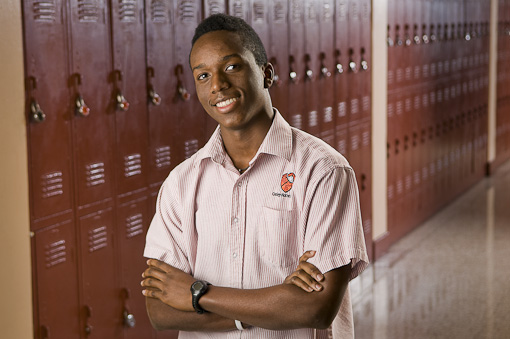
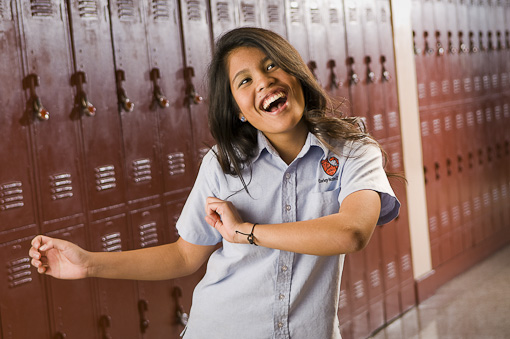
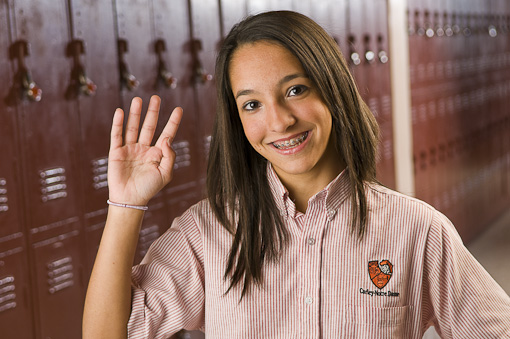
I knew from the start of story boarding I wanted to feature environmental portraiture in the recently completed six part “There’s A School For That” multimedia series. Unique portraits around school would introduce each featured student, book ending candid photography making up story center with final portraits shot along a locker lined hallway, each student posed in that same location.


Leading each audio slide show with students looking at camera, I hoped to immediately establish a connection with the young eighth graders who might be considering Miami’s Archbishop Curley Notre Dame. Plus the environment and activities would say “high school is interesting sweet".

Environmental portraits are a lot of fun, as I have an opportunity to create one photograph that tells the whole story about my subject, show their personality, place them in their environment, each item I include adds to their story.  This lead portrait must grab you as the show opens, while variations changing every few seconds hold your attention.

With Michael, a junior who enjoys math, I was faced with two challenges: 1) come up with an interesting visual concept that says “math” and 2) find an environment that contributes to the story telling.

In his case the concept also became the environment, and a simple two light setup would pull it off.

After scratching my head for a few minutes, no really, after a week of weighing options, I decided to flat bed scan pages from Michael’s Pre-Calculus notebook, projecting the formulas complete with blue grid lines onto a classroom wall. I placed him in the beam of the LCD digital projector and added one flash head with a very tight 3 degree grid spot aimed at just his face. A short time exposure held the projection,
which became both fill and main light, with the gridded flash exposed about one and one-third stop over that drew attention to his face and darkened the environment.

I also used environmental portraiture to wrap each show and visually tie all six together.

Each interview ends with the student emphasizing why they enjoy ACND and/or who inspired them, and concluding “There’s A School For That”, while their lockers-and-hallway portrait holds on screen. The same slogan and hallway location form a common thread through all six shows.

At the end of Michael’s interview he says “ If you want a school where your friends push you to succeed just as much as your teachers, there’s a school for that, Archbishop Curley Notre Dame". Credit for the slogan must go to Public Relations Coordinator Katherine Doble and Principal Brother Sean Moffett.

Hopefully the use of environmental portraiture tells the school's unique story while holding viewers attention from beginning to end. If so, that would be really cool sweet.

Additional multimedia photography from Miami may be viewed at Miami Multimedia Photographer.

Monday, March 29, 2010

When In A Jam, Bread & Butter Portrait Light


When I started learning to light environmental portraits, a more experienced photographer friend gave me some advice that has served me well ever since. Perfect one or two “looks” that you can whip out of your equipment cases in a hurry, when you are in a jam and up against the wall with little time to set up or stuck in a horrible location.

For an assignment last month for Paul DiMattia, Art Director for Business Miami, the University of Miami School of Business Administration’s alumni magazine, I utilized one of my bread and butter looks. I wasn’t in a jam, but I needed to work in a hurry, adapt quickly to changing conditions and work without an assistant.


I was to meet three students at three separate times, each about a half an hour apart and in the same general outdoor campus location, creating portraits that would relate to each other and be run as a triptych. 

My first light was the overall ambient coming from the late afternoon sun slicing through the heavy tree cover. By placing the students with their backs to the sun, I let God light the overall background and project a nice back light onto their head and shoulders. I underexposed the ambient a stop or so with my shutter speed, just enough to save the sparkly highlights in the leaves, but dark enough to allow my subjects to pop off the background.

The bread and butter formula called for my second light to be a medium soft box at arm’s length off to camera right just a touch and adjusted to give me nice skin tones and details in their clothing. (You need to use at least a moderate wide angle, like 35 mm, or the box will be in your way.) The box had enough angle to give me some definition by cross lighting their faces, but not to much to be unflattering. If I’m using a lower camera angle looking up, I will lower the box to keep a catch light in their eyes. I will never use the soft box from a high angle.


I will place the main light either left or right, depending on how they part their hair, where the sun is or physical limitations on placing light stands in a crowded spot ... or in this case, all on the same side to work in the triptych. This light could be from two thirds to a stop and a half over the ambient, first set with a flash meter, then adjusted to taste by viewing the camera’s histogram. If the soup needs more salt, I adjust to taste.

The third light was a subtle touch but a vital part of making the formula light a great light. I set it up on the side opposite of the main, higher and behind. It skimmed the hair, side of face and shoulder, helping to separate my subject from the background. A bare head with gobo made of tape and cardboard or whatever is handy helps control flair, and as it is usually a lot hotter than the soft box. I pull the stand way back to adjust it to about a stop over, depending on clothing, hair or skin color.

When I received the bread and butter light advice, I was still a staff photographer with United Press International shooting news and sports almost always on the run. What ever light and circumstances thrown at me I would work with, making the best photograph I could while never breaking the journalistic barrier of influencing the subject in any way that would not depict the truth. Sure, the very acts of deciding on a particular moment to trip the shutter or selecting what to put in or exclude from our photographs would influence the “truth” we put on the wire for newspapers around the world .

But we didn’t debate those philosophical questions very often ...  we just didn’t set up a news photos or ask someone to do something they didn’t normally do.

When I went freelance I found that portraiture for business and feature magazines was a very different beast. 


Firstly, a portrait by definition is having a subject pose for the viewer and is not “truth. Yet viewers accept the fact that people normally don’t freeze with hands on hips or arms crossed in every day life, with just the perfect bit of authority, warmth or attitude on their face. And secondly, most business portraits have to be set up in order to choose an environment that not only helps tell the subject’s story, but also is artistically pleasing.

Oh, and set it up all fast because Mr. or Ms. Executive is Very Important and only has a few minutes to allow you to capture that perfect fleeting moment that distills their essence in a photograph!

Pun warning: over the years I’ve saved my bacon by pulling out the bread and butter when I’m in an environmental portrait jam.

Here's a link to more Miami corporate photography.

Friday, January 8, 2010

Lighting Cover Photo In Warehouse


A recent conversation with my teen aged daughter got me thinking about the bulk of the photography I do, shooting environmental portraits for magazines and corporations. I guess I’m really a problem solver, creating interesting photographs of people in usually very uninteresting surroundings - making something from nothing - and it’s a lot of fun.

I’ve been working on a multimedia project my daughter’s high school, which I will report about here soon, and some of her friends saw me on campus and asked her at lunch what I did for a living. When she answered that her dad was a photographer, they all said “Cool !”, implying an understanding that in our society photography is glamorous.

But I don’t shoot celebrities, professional athletes or rap stars, nor do big name travel magazines assign me to photograph tropical islands. My work is not glamorous, as a case history of an executive portrait shoot in a dingy warehouse will demonstrate.


My assignment was to create a compelling cover photograph of Rob Brant, owner of Miami’s City Medical Services, for Ascend Media’s HME Today, a small trade magazine covering the Home Medical Equipment supply industry. Rob had been very active in the trade’s effort to stay above the Medicare national billing fraud scandals plaguing a tiny portion of the industry, with Miami-Dade County being ground zero for hundreds of millions of dollars of government losses.

My photographic challenge began as soon as Rob showed me around his small warehouse situated in an industrial district. At first brush there were nothing interesting visually to work an environmental portrait around, with shelves and tiny passages jammed to the concrete ceiling with jumbles of wheel chairs, medical beds and breathing machines. There were no clean backgrounds, no sexy piece of medical machinery to set my composition around.

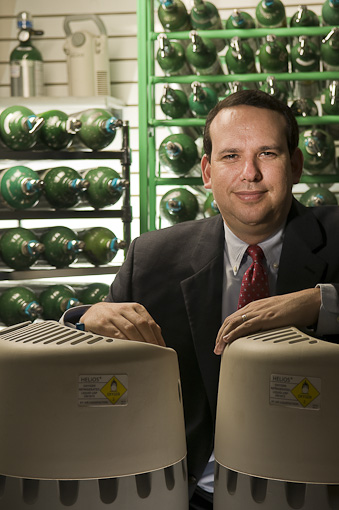
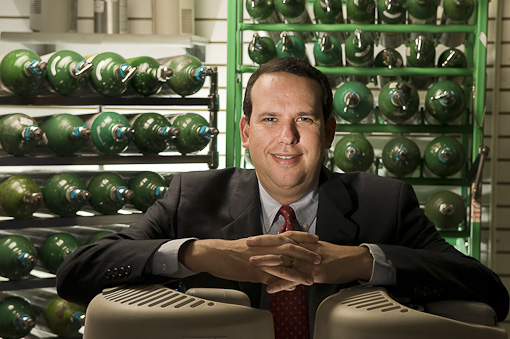
Poking around and scratching my head on my own for half an hour, I finally discovered two heavy racks of green oxygen bottles almost hidden in the corner by a garage door. At that point I was grateful for any color, and green caught my eye, as did the repetitive pattern offered by the storage racks. And the oxygen related to Rob’s business.

With warehouse staff help we dug the racks free and filled in the empty spaces with bottles from around the building. Now I had a background with potential visual interest, stuck in a dark corner.


I placed my first flash, a bare tube on a short stand behind the racks and against the cream colored wall, a space of only a few inches. A bare tube is simple flash unit about an inch in diameter and six inches long without modeling light, reflector or cooling fan, with a long cord attached. They are a lot of fun to hide and insert light in difficult spots. The flash bounced off the wall and all around to back light the racks and opened up the dark corner.

Now I needed to place my subject in front of the background, and turned an empty bucket upside down for a short stool. To hide the bucket, give Rob something to place his hands upon ( I think hands are very expressive in portraits ) and add more medical equipment clues to the photo, we rolled over two large tanks that take oxygen from the air. First we had to dig them out of the mess, unwrap them and clean them off.

My second flash was a three degree honey comb grid from camera left, a spot light that at this distance, four feet, lit just a six inch circle, to open Rob’s face with light and not throw extra light all over the set, destroying the mood I was creating.

Light number three was a narrow strip soft box high above Rob at camera left to throw straight down a rim light on his hair, shoulder and hands on the tank tops. The strip was about 14 inches wide and 40 inches long, and also kept stray light from being thrown all over.

At that point I thought the front of the oxygen generators were to dark, so I added light number four, pointed straight down from six inches above the gray concrete floor. Turned to very low power, it added just enough fill light at a cool upward angle to complete the shot.

With a warehouse worker sitting in, I adjusted the lights with flash meter and camera histogram, and about two hours after arriving I was photographing Rob for his first magazine cover.

I love it when I successfully create an environmental portrait that my client is happy with and was a challenge of logistics, aesthetics and photographic lighting. It’s fun, and to me, even a bit cool. But glamorous, sorry kids, I would have to say no.

Here's a link to more Miami corporate photography.