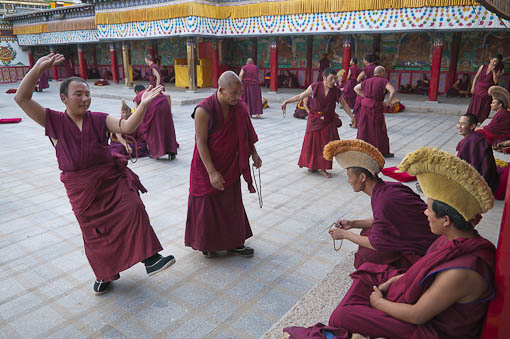
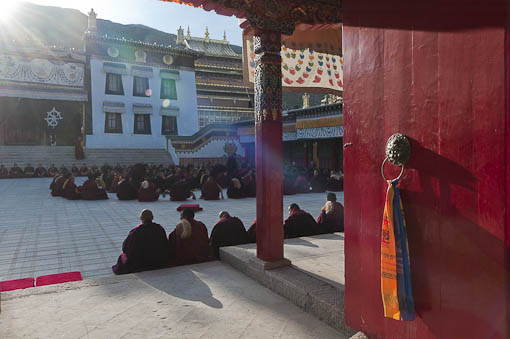
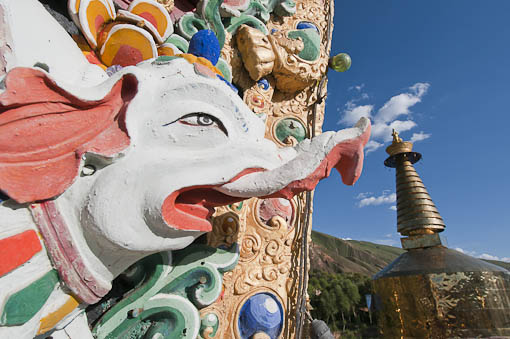
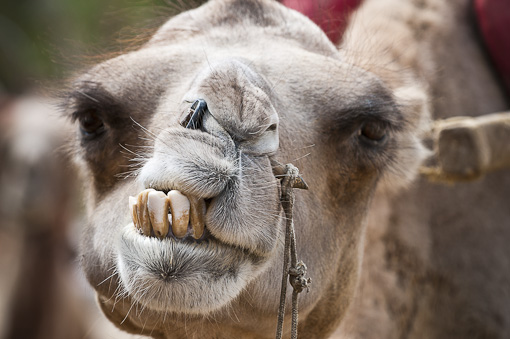
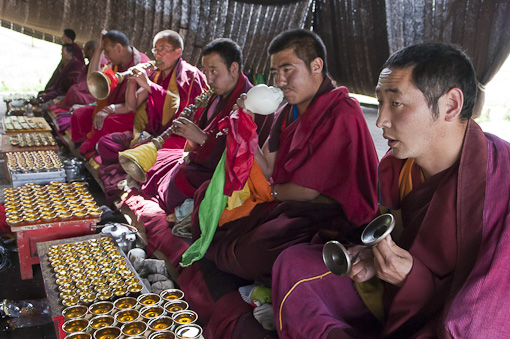
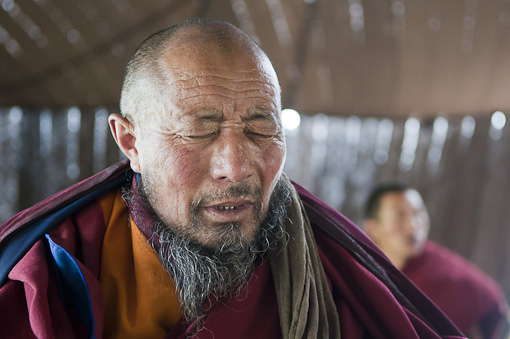
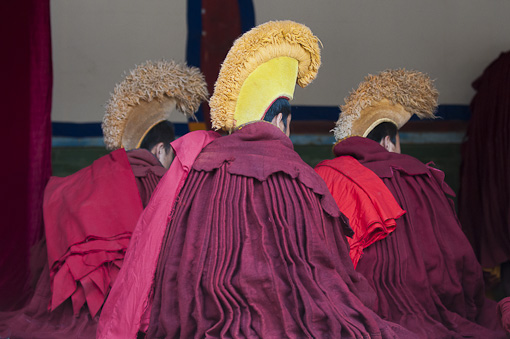
Every July shamanistic festivals featuring ritual dances, holy skin drums, and food offerings are designed to appease the mountain gods and guarantee good harvests in villages around Tongren. After three frenzied days of communicating with ancient Mongolian army generals, reincarnations of the gods, the shamans go into deep trances.
Link to iPhone & iPad friendly version of multimedia audio slide show.
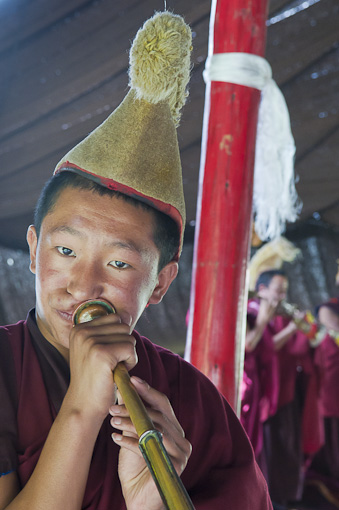
Although not officially Buddhist, the festivals take place in and around Tibetan Buddhist temples and monasteries, and attract hundreds of observers and participants. Wearing distinctive peaked hats with red tassels, young boys through middle aged men dance for hours, circling the walled courtyard. Senior men carry flags and banners. Young girls solemnly march, enduring heavy coral beads and silver medallions braided into their long hair.
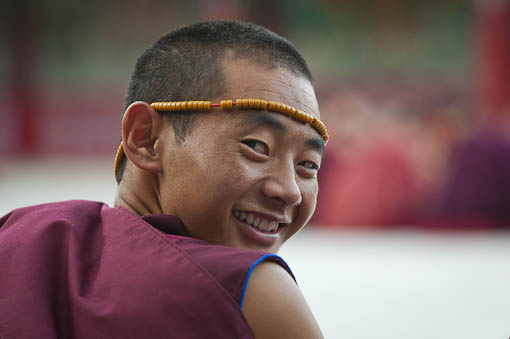
Ethnic Tibetan dancer takes break during Tongren Shaman Festival, Qinghai Province, China
Villagers bring offerings, including long bolts of beautiful fabric that are tied horizontally from the temple’s decoratively carved timbers. Offerings of food arrive, small plates of tsampa, a Tibetan barley flour bread, fruit, flowers and candy. Offerings of liquor are drunk by the shamans, shared with dancers and finally poured on the ground.
I photographed this Tongren Shaman Festival by walking up a steep hill from downtown Tongren, a small dusty town two hours from Qinghai Province's capital Xining. The amazing sounds of goat skin drums, silver bells, brass cymbals and the “brrrrrrrr” of the frenetic shaman were all recorded in the field as I photographed the festivities.
View more multimedia audio slide shows from China, and Miami Multimedia Photography. Last summer I wrote almost daily from my trip to Qinghai, China.
Showing posts with label China Qinghai Trip. Show all posts
Monday, July 25, 2011
Friday, January 28, 2011
Talking Picture Postcard - Tibetan Harvest Prayers
While Buddhist monks chanted and tossed paper prayers up to the blue sky, ranchers and farmers whooped, hollered and sprayed cheap liquor over the two dozen people gathered at the edge of Qinghai Lake. Last July an extended family of ethnic Tibetans were praying for a successful harvest and green pastures for their livestock.
View an iPad friendly version of this 28 second audio slide show.
Monks carefully placed prayer flags to capture the breezes at this tiny holy place, a row of low stupas sprouting from the rocky and treeless soil where green grass, endless sky and brilliant blue lake merged.
We had spotted the multiple colors while speeding by on the highway, and when we followed the rutted track toward the lake, the only people around were two dirty children willing to pose for coins atop a horse. I wandered over to the fluttering flags, and within minutes the celebrants arrived, monks and civilians pouring out of 4 x 4 pickup trucks.
Located in a depression of the Tibetan Plateau 10,000 feet above sea level, saline Qinghai Lake has no outlet and is China’s largest. Qinghai means “Blue/Teal Sea” in Chinese, and also names this sparsely populated province that contains only about 6 million of China's 1.3 billion people.
Like the few lines we scribble and mail home describing our vacation travels, this Talking Picture Postcard, a brief five photographs and 28 seconds of field-recorded sound, is my way of saying “The weather is fine, having a great time, which you were here.”
And also, "have a great harvest!"
View more Miami multimedia photography at my portfolio site.
View an iPad friendly version of this 28 second audio slide show.
Monks carefully placed prayer flags to capture the breezes at this tiny holy place, a row of low stupas sprouting from the rocky and treeless soil where green grass, endless sky and brilliant blue lake merged.
We had spotted the multiple colors while speeding by on the highway, and when we followed the rutted track toward the lake, the only people around were two dirty children willing to pose for coins atop a horse. I wandered over to the fluttering flags, and within minutes the celebrants arrived, monks and civilians pouring out of 4 x 4 pickup trucks.
Located in a depression of the Tibetan Plateau 10,000 feet above sea level, saline Qinghai Lake has no outlet and is China’s largest. Qinghai means “Blue/Teal Sea” in Chinese, and also names this sparsely populated province that contains only about 6 million of China's 1.3 billion people.
Like the few lines we scribble and mail home describing our vacation travels, this Talking Picture Postcard, a brief five photographs and 28 seconds of field-recorded sound, is my way of saying “The weather is fine, having a great time, which you were here.”
And also, "have a great harvest!"
View more Miami multimedia photography at my portfolio site.
Wednesday, December 15, 2010
Finding Sounds Among The Trees
Sometimes making sense out of a complex soundscape is like photographing a chaotic scene ... at first, you just can’t see the forest through the trees.
Which are my key sounds ? Can I isolate them from the background noise ? Is that sound reconcilable? How will it help tell my story ? Will the viewer experience the real life scene in front of me ?
In the above audio slide show listen for horns, conch shells, and cymbals fading to chanting, then scooped rice and finally clanging tea cups. I Pad friendly version.
Upon entering the Arou Ba Temple in China’s Qinghai Province, my senses were blasted by the monks blowing low notes on eight-foot-long brass horns. Squawking reed instruments competed with ringing finger cymbals. The Yellow Hat sect Tibetan Buddhist monks were chanting, slowly at times, then as rat-a-tat-tat fast as an auctioneer.
At first I listened and watched to get a handle on the action, and for the monks to become accustomed to my presence. I began to use my recorder’s shotgun microphone to select one sound at a time, choosing my story building blocks carefully. If one monk’s chanting was distinctive, I recorded it. When all the instruments played at once, I sensed the complex acoustic mix would be my intro. Three voices were playing off each other, so I placed my omnidirectional mic to capture the layers of sound.
I especially enjoyed discovering the sound of rice being scooped up and dropped over a series of decorated silver bowls and rings, a meditation performed together by two monks.
As I saw a compelling image, I’d break for photography. One by one my story elements, once hidden between the trees, showed themselves to me and were recorded or photographed. An incredibly fascinating forest emerged.
Here's a link to past posts from my three week trip to China last July.
Which are my key sounds ? Can I isolate them from the background noise ? Is that sound reconcilable? How will it help tell my story ? Will the viewer experience the real life scene in front of me ?
In the above audio slide show listen for horns, conch shells, and cymbals fading to chanting, then scooped rice and finally clanging tea cups. I Pad friendly version.
Upon entering the Arou Ba Temple in China’s Qinghai Province, my senses were blasted by the monks blowing low notes on eight-foot-long brass horns. Squawking reed instruments competed with ringing finger cymbals. The Yellow Hat sect Tibetan Buddhist monks were chanting, slowly at times, then as rat-a-tat-tat fast as an auctioneer.
At first I listened and watched to get a handle on the action, and for the monks to become accustomed to my presence. I began to use my recorder’s shotgun microphone to select one sound at a time, choosing my story building blocks carefully. If one monk’s chanting was distinctive, I recorded it. When all the instruments played at once, I sensed the complex acoustic mix would be my intro. Three voices were playing off each other, so I placed my omnidirectional mic to capture the layers of sound.
I especially enjoyed discovering the sound of rice being scooped up and dropped over a series of decorated silver bowls and rings, a meditation performed together by two monks.
As I saw a compelling image, I’d break for photography. One by one my story elements, once hidden between the trees, showed themselves to me and were recorded or photographed. An incredibly fascinating forest emerged.
Here's a link to past posts from my three week trip to China last July.
Wednesday, October 20, 2010
Faces On The Radio
As my ears thumped to the pounding rhythm of goat skin drums, my eyes were arrested by the heavy coral beads hanging from the young Tibetan girl’s hair. I heard tinkling silver bells. I saw orange color. I heard the crowd, then saw her intense expression. Sound and sight sent my brain the story of hundreds of folk dancers and musicians driving the devil from a Buddhist temple.
Click here for an iPad friendly version of the audio slide show above.
While traveling in China’s remote north western province of Qinghai this July, I found that my ears had become just as sensitive as my eyes. I would discover an interesting natural sound, bleating sheep, whooping celebrants, chanting monks, and then I’d find a portrait to photograph, putting a face on that sound.
When working in multimedia I like to close my eyes and imagine the sound coming from my car radio, and ask, “do I see what I’m hearing” ? Yes, then lets put a face to the sound. Lets put a face on the radio.
Photography and natural sound work together beautifully to produce a richer, fuller story than either component could on their own. In this two minute audio slide show I chose 13 portraits of Chinese I met - Han, Tibetan and Hui - and wrapped a field-recorded sound clip around the photograph.
Close your eyes and listen ... what can you see? Now open your eyes to hear even more.
I wrote almost every day about my July experiences here. More multimedia photography from China can be viewed here.
Click here for an iPad friendly version of the audio slide show above.
While traveling in China’s remote north western province of Qinghai this July, I found that my ears had become just as sensitive as my eyes. I would discover an interesting natural sound, bleating sheep, whooping celebrants, chanting monks, and then I’d find a portrait to photograph, putting a face on that sound.
When working in multimedia I like to close my eyes and imagine the sound coming from my car radio, and ask, “do I see what I’m hearing” ? Yes, then lets put a face to the sound. Lets put a face on the radio.
Photography and natural sound work together beautifully to produce a richer, fuller story than either component could on their own. In this two minute audio slide show I chose 13 portraits of Chinese I met - Han, Tibetan and Hui - and wrapped a field-recorded sound clip around the photograph.
Close your eyes and listen ... what can you see? Now open your eyes to hear even more.
I wrote almost every day about my July experiences here. More multimedia photography from China can be viewed here.
Friday, July 30, 2010
Tibetan Monk Hand Clapping Debate: Qinghai, Day 16
Yesterday evening I was exploring this sprawling Tibetan Buddhist monastery and came upon 250 yellow hat sect monks chanting in the fading summer light and seated in a beautiful outdoor courtyard. After about 45 minutes, the orderly formation broke up into a wild scene of shouting and hand clapping as pairs of monks practiced their traditional form of debate.
Listen to hundreds of monks debate in this 40 second sound clip, then fade into deep throated leader and group chanting.
Debate is an important part of a Tibetan monk's training, and is said to help expand the mind, increase mental sharpness, develop analytical skills and help gain mental clarity.
The debates follow a strict form, with the standing questioner challenging the thesis of the humbly sitting defender. As the questioner raises doubts, the exchange becomes increasingly animated, with exaggerated body language, lunging, hand slapping and loud shouting. The defender mostly sits quietly and looks away, occasionally making a counter point by waving his arm.
This is probably my last post from this province in China's north west. With just 6.5 million of the country's 1.3 billion, it's strong ethnic Tibetan and Muslim ethnic minority population, has given me some amazing photographs and sounds.
I also enjoyed making new Chinese photographer friends at the Qinghai Three Rivers Photography Festival, and along with colleague Nancy Brown of our South Florida chapter of the American Society of Media Photographers, had a blast helping to judge the 6,000 entries.
Wednesday, July 28, 2010
Stupa & Dalai Lama Objects Of Veneration: Qinghai, Day 15
Sangge Shong Monastery, Rebong, Qinghai, China:
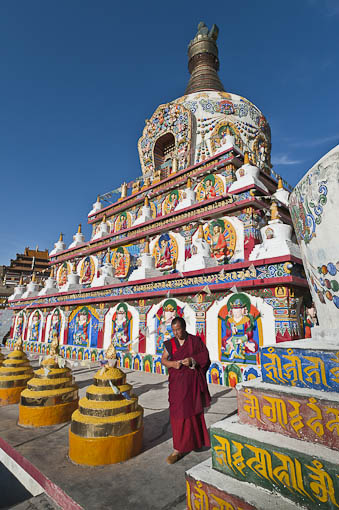
The Stupa of Kalachakra is an amazing technicolor object of veneration, at six stories tall it's a long way from the original simple mounds of mud that are thought to have housed the remains of the Buddha several millennia ago.
A monk of the Tibetan Buddhist Yellow Hat sect carried a large ring of keys yesterday evening as he opened giant red wooden doors at the stupa's base, and led us clockwise up the layer cake of ramps and steps, circumambulating to a tiny chapel housing a multi-armed and multi-headed goddess.
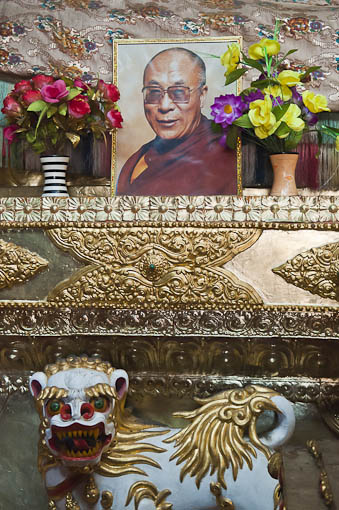
I noticed a small photograph, about 3 by 4 inches, of the Dalai Lama under the goddess, and when we visited several other temples within this large monastery complex near Tongren, I saw the Dalai Lama's portrait on every altar.
His Holiness the 14th Dalai Lama of Tibet's portrait in Temple of Tsongkapa last night.
While in China these past weeks I've noted photographs of His Holiness the 14th Dalai Lama of Tibet in every Tibetan temple, and have wondered if his difficulties (to put it mildly) with the Chinese authorities are somehow thawing in a small way. I've read that visitors should never give his portrait as a gift as possessing one is a serious offense for Chinese citizens.
Monday, July 26, 2010
Hui People Practice Islam: Qinghai, Day 13
Guide, Qinghai Province, China;
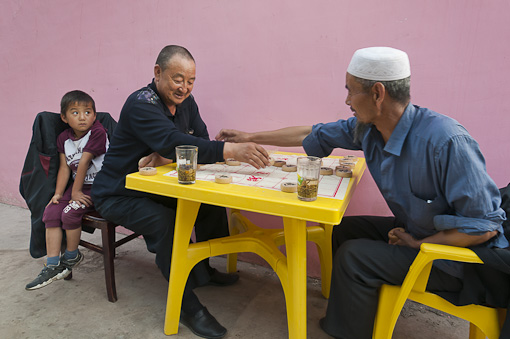
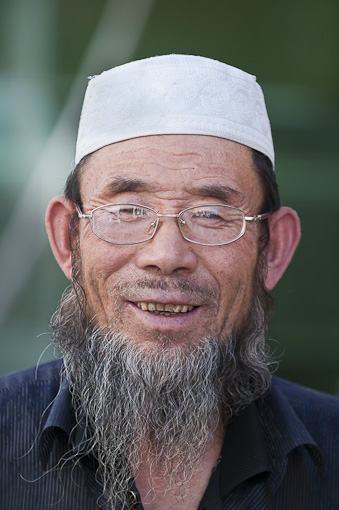
While traveling these past weeks in China's northwestern province of Qinghai, I've been meeting many Hui in addition to Tibetans, both among China's officially recognized 56 ethnic groups. Traditionally the Silk Road passed through Qinghai and Gansu, bringing Central Asian influences including the Muslim religion to China.
Above a grandson looks on as his grandfather and relative play a board game over tall glasses of herbal tea outside Quilian.
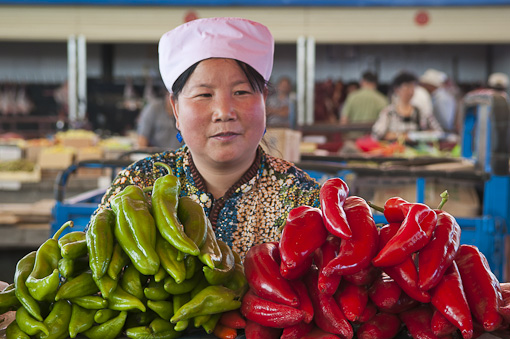
Today I met this Hui woman selling red and green peppers in Guide's market, and this Hui butcher took a break from chopping up mutton to pose for a photograph.
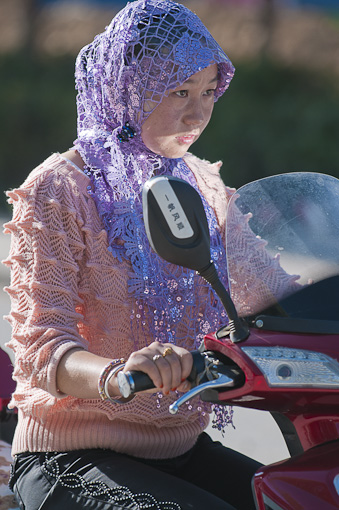
The Muslim influences I've seen are the distinctive caps for men and scarves for women, golden mosque minarets peaking above city skylines, and lots of spicy mutton at meals.
Below, a young Muslim woman rides her scooter to work while wearing a sequend head scarf, photographed yesterday in Wulan.
For more photographs from China please visit Tom Salyer Photography.
Sunday, July 25, 2010
Self Confident Chinese Women: Qinghai, Day 12
Wulan, Qinghai Province, China:
Today I awoke in Wulan, a small dusty town that could pass for dozens of other Chinese towns I’ve been in ... a wide modern boulevard lined with shops and restaurants, people riding bikes and scooters to work, cooking smells wafting about. No quaint architecture or chic shopping district in Wulan, it sits on the edge of Qinghai’s western desert and is off the main highway.
As often encountered in China the sidewalk I was strolling on was a construction site, no warning barriers of course, just a four foot deep trench where a sewer line was going in. Carrying the bricks and mixing the mortar for support walls were these two women laborers. Posing for me with their protective scarfs lowered, I was impressed with their easy relationship and self confidence.
Heading east, as we entered the Qinghai Nanshan Mountains, the landscape turned to rich green grasslands and we climbed to about 10,000 feet. At this altitude families of Tibetan herders were tending their yaks, sheep and goats and were camping in summer tents.
Just inside the door of one tent I met another very self confident subject, a Tibetan girl about six or seven years old who proudly showed off her festive costume.
Friday, July 23, 2010
Sand Dune Camel Chaos: Qinghai, Day 10
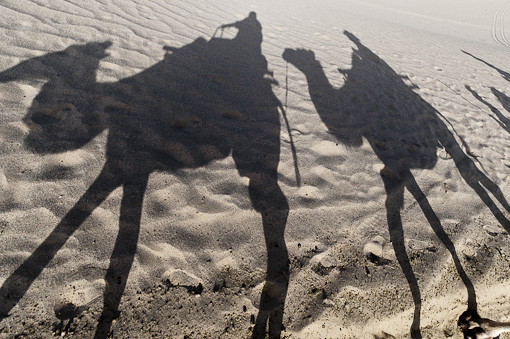
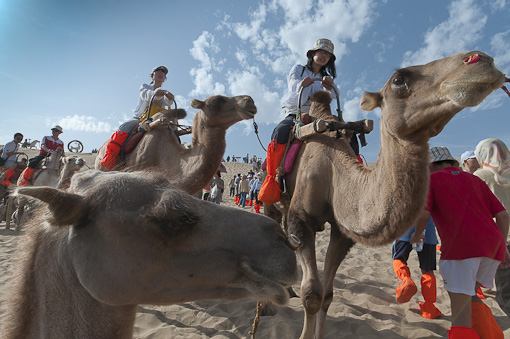
With their prosperity growing along with their world dominating economy, the Chinese are visiting the far corners of their country as tourists, and today it seemed to me that a goodly percentage of this nation of 1.3 billion had descended upon the same sand dune. What makes the scene even more fun are we were all mounted atop lumbering, grumbling camels.
Listen for tinkling camel bells, shouting camel drivers, bellowing beasts and the shouting chaos of a happy tourist crowd in this 32 second sound clip.
I’m visiting the Mingsha Shan Sand Dunes just outside of Dunhuang, a small oasis town in Gansu Province that once prospered as the last stop on the Silk Road. Here the ancient trade route split north and south to skirt the Taklaman Desert. I’ve read that Taklaman roughly translates to “you go in, you don’t go out”.
After leaving Qinghai Province yesterday, we drove west 700 km ( 350 miles ) across Gansu’s stony desert, which must be the bleakest territory I’ve ever seen. And hot, 39 degrees Centigrade, which I really don’t need to convert to Fahrenheit to know it’s crazy to be out in the noon day sun on top of a camel on top of a giant sand dune. But hey, the camels and tourists don’t seem to mind.
Wednesday, July 21, 2010
Horse Hair Temple Musical Riot: Qinghai, Day 8
Arou Ba Temple, Quilian, Qinghai Province, China:
The crisp staccato of finger cymbals cut through the musical riot emanating from the monk’s instruments, two high pitched reed horns, a seashell and the long low blasts from a six foot long bass horn. The chanting weaved under, over and around the music, the two dozen monks filling the horse hair tent temple with worshipful sound.
Listen for horns and cymbals in this 36 second audio clip, then brass teacups and chanting.
Today we stopped by a dusty little temple complex situated in the treeless highlands in far northern Qinghai Province, in China’s northwest corner, and way in the back the chocolate colored tent was set up to let warm summer breezes enter through open sides.
While chanting each monk, of the Tibetan Buddhist yellow hat sect, filled several dozen brass teacups on a small table, then emptied them, wiped them dry, and poured tea again.
While kneeling on the ground, one young monk rolled his bass horn toward my microphone and blasted me, to the amusement of all. Another pulled a point-n-shoot camera from his robes to snap my photo. I enjoy the personal touch such small monasteries provide and feel close to a culture very different from mine.
Monday, July 19, 2010
Tibetan Heritage Festival: Qinghai, Day 6
Haibei, Qinghai Province, China:
Today I attended a Tibetan heritage festival complete with singing contests, amazing costumes and jewelry, all spread across a green grass meadow dotted with wildflowers. At the top of the hill prayer flags quietly flapped in the breeze.
Off in the distance I could see the town of Haibi, the birth place of China's atom bomb, a very strange juxtaposition indeed.
No story telling today, the long days are catching up with me, and we are off tomorrow to travel away from the capital city of Xining through Qinghai Province and into Gansu Province, all the way west to the silk road. I will post when I have internet access ... what did Marco Polo do without it ?
Sunday, July 18, 2010
Sun For Embroidery Buddha: Qinghai Day 5
Kumbum Monastery, Huangzhong, Qinghai Province, China:
Today dozens of monks struggled up steep steps carrying the long rolled Thangka. Accompanied by blowing silver horns and clanging cymbals, hundreds of pilgrims struggled to touch the giant embroidery. Once unrolled and it’s yellow silk protective cover removed, a magnificent Buddha covered the entire hillside.
Once a year this beautiful embroidery Buddha is given sunshine at the Kumbum Monastery of the Tibetan Buddhism yellow hat sect, and is the centerpiece for an elaborate devotional service. With incense burning, pilgrims throw scarves, paper prayers and money onto the Thangka, which is then rolled back up hill by dozens of shouting young monks.
As the Qinghai Photography Festival winds down this weekend colleague Nancy Brown and I had the option of visiting a Tibetan cultural museum, or break away to follow up a tip we received several days ago chatting with a Chinese student practicing English on us. I’m glad we skipped the museum.
Saturday, July 17, 2010
Yellow Hat Monks & Parasols: Qinghai Day 4
Kumbum Monastery, Huangzhong, Qinghai Province, China:
Today I visited one of the six great monasteries of the Yellow Hat sect of Tibetan Buddhism again, as did thousands upon thousands of Tibetan pilgrims, Chinese tourists, and several hundred photographers attending the Qinghai Photography Festival.
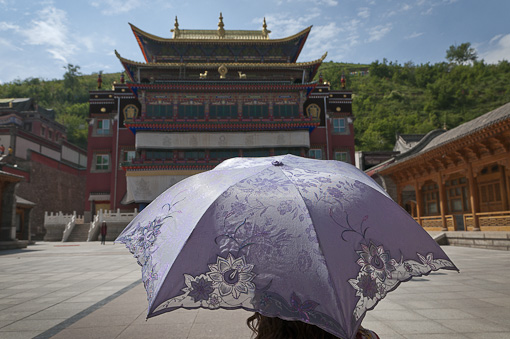
But in spite of the multitude I was struck by two things: 1) the monk’s daily routine and worship probably haven’t changed for centuries, such as these three wearing their distinctive yellow hats and pleated crimson robes, and 2) Chinese ladies are capable of wearing six inch heels to climb stone temple steps and simultaneously carry dainty lace parasols for sun protection.
More photographs from China may be viewed at my portfolio site.
Friday, July 16, 2010
Call To Prayer In Muslim China: Qinghai Day 3
Dong Guan Grand Mosque, Xining, Qinghai Province, China:
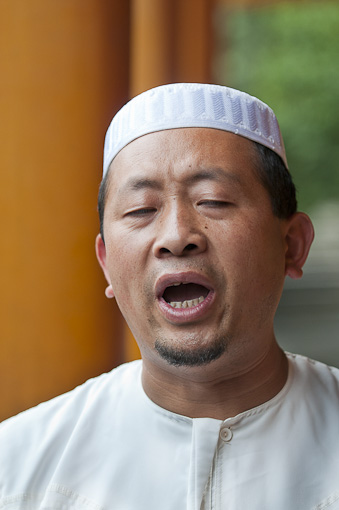
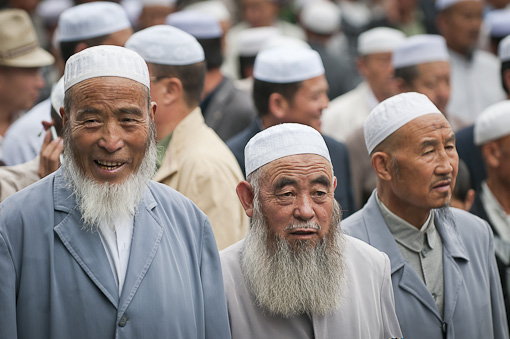
Thousands of men were streaming from the mosque onto busy Dongguan Street after Friday afternoon prayers, greeting friends with warm handshakes and stopping to chat. Most had beards and wore embroidered white caps, and ranged from young teen boys through middle age and beyond.
58 second audio clip of the Muslim call to prayer recorded today:
I was visiting the Dong Guan Grand Mosque in Xining, capital of Qinghai Province where several hundred thousand Chinese pilgrims worship during Ramadan. Qinghai has a large Muslim population as historically Central Asian influences have infused this northwestern corner of China since the ninth century.
More Miami Multimedia Photography may be viewed here.
Thursday, July 15, 2010
Laughing In The Street Market: Qinghai Day 2
Mo Jiajie Market, Xining, Qinghai Province, China:
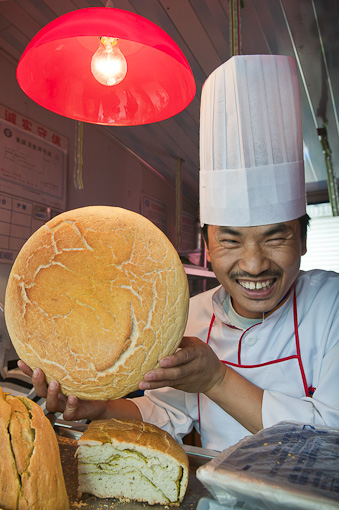
I was busying myself photographing the usual suspects, pigs feet, live fish, delicious looking fresh vegetables stacked chin high in the stalls when the young baker beckoned me over to show off his beautifully baked round bread just out of the oven. We didn’t need to speak each other’s language to see the pride in his eyes. He wanted me to take his photograph, which I did, sharing the results with him on the camera’s screen.
I was walking through the Mo Jiajie Market in the center of busy Xining, the capital of Qinghai Province, nestled up against Tibet and Sichuan and Gansu. I hope to blog a photo or two and several paragraphs every day I have internet access.
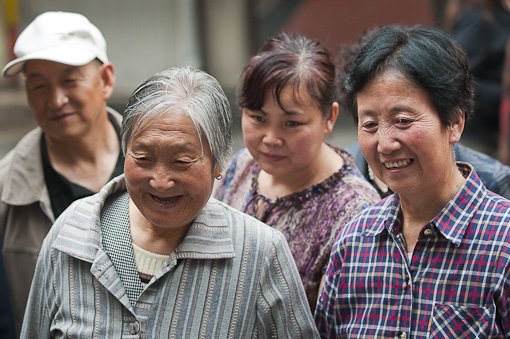
Further down the street I saw a large crowd gathered outside a music store, the laughter rolling out and into the market. It was coming from the shoppers and the television set outside on the steps playing a comedy show. Everyone was transfixed with smiles on their faces.
I quietly slid through the crowd and up and into the store to shoot out of sight as if in a duck blind. No need really, the crowd didn’t notice me until much later and then the two ladies pictured wanted to see their photos. They seemed pleased, they giggled and pinched my cheek before walking down the street. I wonder if they bought the pigs feet.
To view more photographs from China, visit my portfolio site.
Wednesday, July 14, 2010
Buddhist Monks, Young & Old: Qinghai Day 1
The young monk must of been about 12 years old, and after a half dozen prostrations on the ground, he would stand back up, wipe the sweat off his face, and look around at the hundreds of Chinese tourists thronging past the steps of the temple in the pounding rain. About a minute of rest, down to his knees, hands on two cloths, he would face downward and push off until he was lying flat on the ground in complete reverence, only to pull back to his knees a moment later and repeat.
I couldn’t help thinking about the 12-year-olds living in my Miami neighborhood, what they would be doing on this same July morning ... playing with a GameBoy if raining, riding bikes or taking tennis lessons? A long way from this Yellow Hat sect monastery of Tibetan Buddhism about a half hour outside of Xining, the capital of Qinghai. A sparsely populated province with only about 6 million of China’s 1.3 billion people. Qinghai is sandwiched between Tibet to the west, Gansu to the north, and Sichuan to the south.
On the other end of the temple platform was a monk several generations older than the young boy, so old he could only sit on the stone step and slip into his own thoughts. I wondered how many prostration prayers he made when younger.
I’ll be spending about three weeks traveling here - attending a photography festival, judging a photo contest and exploring - and will try to post a photo or two along with a paragraph or two every day I have internet service.
More photos from China may be viewed at Tom Salyer Photography.
Subscribe to:
Posts (Atom)