Thursday, June 17, 2010

Portraits Anchor Multimedia Start To Finish


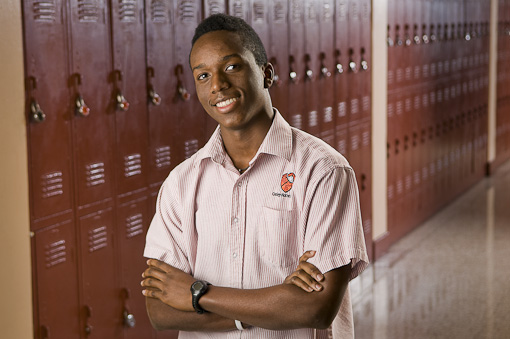
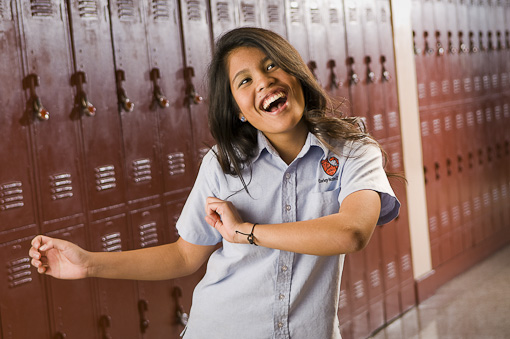
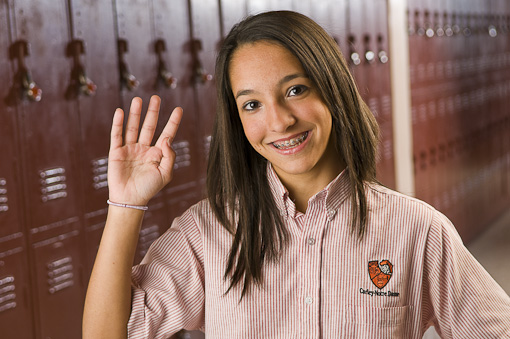
I knew from the start of story boarding I wanted to feature environmental portraiture in the recently completed six part “There’s A School For That” multimedia series. Unique portraits around school would introduce each featured student, book ending candid photography making up story center with final portraits shot along a locker lined hallway, each student posed in that same location.


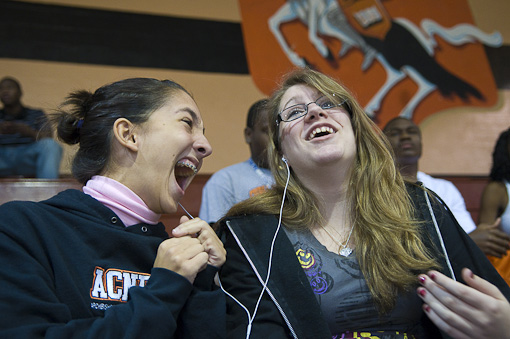
Leading each audio slide show with students looking at camera, I hoped to immediately establish a connection with the young eighth graders who might be considering Miami’s Archbishop Curley Notre Dame. Plus the environment and activities would say “high school is interesting sweet".

Environmental portraits are a lot of fun, as I have an opportunity to create one photograph that tells the whole story about my subject, show their personality, place them in their environment, each item I include adds to their story.  This lead portrait must grab you as the show opens, while variations changing every few seconds hold your attention.

With Michael, a junior who enjoys math, I was faced with two challenges: 1) come up with an interesting visual concept that says “math” and 2) find an environment that contributes to the story telling.

In his case the concept also became the environment, and a simple two light setup would pull it off.

After scratching my head for a few minutes, no really, after a week of weighing options, I decided to flat bed scan pages from Michael’s Pre-Calculus notebook, projecting the formulas complete with blue grid lines onto a classroom wall. I placed him in the beam of the LCD digital projector and added one flash head with a very tight 3 degree grid spot aimed at just his face. A short time exposure held the projection,
which became both fill and main light, with the gridded flash exposed about one and one-third stop over that drew attention to his face and darkened the environment.

I also used environmental portraiture to wrap each show and visually tie all six together.

Each interview ends with the student emphasizing why they enjoy ACND and/or who inspired them, and concluding “There’s A School For That”, while their lockers-and-hallway portrait holds on screen. The same slogan and hallway location form a common thread through all six shows.

At the end of Michael’s interview he says “ If you want a school where your friends push you to succeed just as much as your teachers, there’s a school for that, Archbishop Curley Notre Dame". Credit for the slogan must go to Public Relations Coordinator Katherine Doble and Principal Brother Sean Moffett.

Hopefully the use of environmental portraiture tells the school's unique story while holding viewers attention from beginning to end. If so, that would be really cool sweet.

Additional multimedia photography from Miami may be viewed at Miami Multimedia Photographer.

Friday, May 28, 2010

Film Or Digital, Panoramic Landscapes China Bound

Yesterday I was preparing a collection of panoramic landscape photographs to be exhibited in July at the Qinghai Sanjiangyuan International Photo Festival in China, and while rescanning some of my favorite large format film images I compared them at pixel level to my recent panoramas stitched in software from multiple digital captures.

Rocky Mountains at Lake St. Mary, Glacier National Park, Montana, captured on 617 format film ( 2 inches tall by 7 inches wide ), large format view camera.

I had forgotten about film grain! Slow speed digital doesn't have any. Film horizons are straight lines! Rotating a digital sensor in a circle for a stitch curves the horizon and you need to hide the distortion. Light table viewing of film with 4X loupe misses seeing tiny cars parked a mile across mountain lake! Processing digital on a giant computer monitor you see all the flaws.

But I quickly stopped pixel peeping and was transported back to those outdoor locations to soak in the beauty I experienced when the shutter clicked, and realized it really didn’t matter if I was capturing my small slice of the world with a piece of film or a digital sensor.

Pretty obvious really, the story, emotion and sense of place in the photograph is what matters.

 Hammock filled with and bald cypress and air plants, Everglades National Park, Florida, 220 degree digital assembly.

I can’t say which panorama making technique I like the best. With film, I have to slow down, think and be deliberate, as it requires setting up a heavy tripod, assembling the view camera rails and bellows, then attaching a lens. This makes me choose my subject carefully.

Under a dark cloth, I view the image upside down, so the scene becomes abstract, helping me balance my composition. I then remove the cloth, insert a preloaded magazine, and have four shots on one roll of film. Oh, exposing color transparency film is tricky. And nerve wracking, each frame costs the equivalent of a small cheese burger.

Spring mist rising on Roaring Fork, Great Smoky Mountain National Park, Tennessee, 617 format film.

With digital, I quickly set my Nikon vertically in a special rig that allows me to swing around the lens nodal point, and I can zoom to compose precisely. My “35mm” lenses allow me to get into tighter spaces and see higher and wider. Long time exposures are linear as opposed to film, so no reciprocity failure to calculate in, and the camera processes out the noise. And with digital capture being “free” ( not counting the massive investment in upgrading cameras, computers and software ), I save a lot of cheeseburgers. Yum.

Maybe creating panoramas with digital cameras is quicker and easier. Yet film is more contemplative and precise. So I’ll just pick the tool that works best for my subject and creative ends.

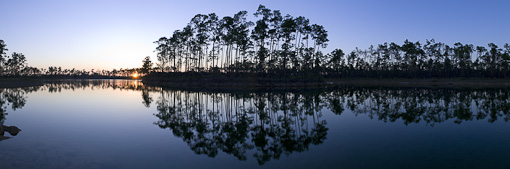
Sun setting in endangered pine woods, Everglades National Park, Florida, 170 degree digital assembly.

I'm looking forward to visiting Qinghai, one of China’s least populated provinces with not quite six million people ( out of 1.2 billion ), and it’s nestled up against Tibet to the West. I’ll be traveling with colleagues Nancy Brown of Boca Raton and Tania D’Avigon of Boston, both have also been to China multiple times, and we will drink a toast or two with our Chinese friends from previous trips.

The photo festival has invited many “foreign photographer friends” to attend and exhibit, including our American Society of Media Photographers South Florida chapter, which has sent their Light of Florida photography collection.

If you are interested in seeing the panoramic cameras used for these photos, I’ve posted a little more information on my Miami panoramic photography portfolio site.

Friday, May 7, 2010

Power of Ambient Sound: Sizzling Fries & School Bells


Do you ever hear an old song on the radio that immediately takes you back to your past? Maybe that wonderful summer after graduating high school, driving the back country roads of rural Idaho with your arm around Gloria, the girlfriend soon to be left behind on the way to college in the fall ?

I’m not a psychologist and can’t explain why music imprints into our brains, but I do know that sounds tap a deep emotional response in me. Just like that summer song triggering an old story, when I hear croaking frogs, I feel a rain forest in my head. When I hear wailing sirens, I’m surrounded by oppressive big city traffic. The Tibetan monk’s cymbal reverberating in my headphones, I smell yak butter tea.


Recording ambient sound is one of my favorite parts of multimedia, and for the second audio slide show I produced for Archbishop Curley Notre Dame High School’s “There’s A School For That” campaign, I had a lot of fun with sound.

What better way to trigger those high school emotions than recording the clanging class change bell and hallway voices. I lead the show with about seven seconds of only ambient hallway sound, then duck under her interview, leaving levels high enough to still hear the banging lockers and squeaking sneakers.

Here the ambient sound first catches your attention and draws you into the story, and before Silvia’s interview begins, hopefully you’re hooked. Then the sound bed drives the narrative along. Between Silvia’s thoughts, ambient sound levels rise, taking over the story telling, like at the basketball game where you hear the coach and players huddle, and the referee’s whistle.

Just like real life, our brains don’t concentrate on that sound bed, but we feel the sound, we see the the sweaty players, we know we’re in the high school gym.

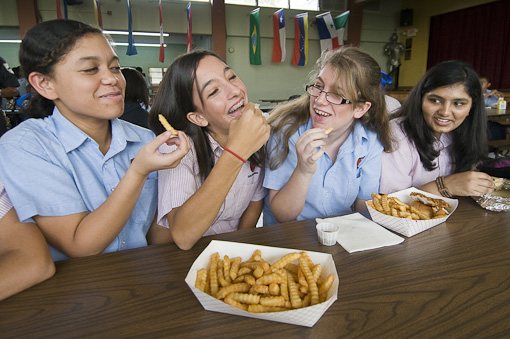
As the show winds up, the sound of frying french fries comes in strong before Silvia  beings her story of her older sister asking if Curley still serves the fries she loved. The bubbling of the cafeteria deep fryer catches and holds your attention, and as the sound bed ducks under, I can taste those same fries that she is talking about. ( Good fries, BTW, I tried and liked them, though maybe the accompanying cheese burger clouded my judgment ...)

I love the complex layers of  interview voice blending and threading around and over and behind the background sounds of life in a vibrant high school. I decided to run a sound bed under the entire length of each of the “There’s A School For That”  multimedia shows because, well, I love ambient sound. It tells me stories, triggers my emotions and just like that old song on the radio, makes my life a whole lot richer.

Here's a link to more ambient sound blended with multimedia photography.

Wednesday, April 28, 2010

Talking Picture Postcard - Mangrove Creek Songs


My favorite kayaking destination here in South Florida is any waterway that takes me though a tunnel formed by mangrove trees, a path that almost blocks out the sky above and forces me to inch along a glassy smooth tidal creek deep in the back country.

Earlier this month I spent four days paddling the 10,000 Islands area off Florida’s South West coast, putting in either at Everglades National Park’s Chokoloskee Bay ranger station in Everglades City, or off  the Tamiami Trail in the Big Cypress National Preserve.


On a Monday I quickly paddled past the off shore mangrove islands dotting the bay and entered Half Way Creek with a rising tide, utilizing the powerful tidal flows to my advantage. In about an hour I was wrapped in a mangrove canopy completely encompassing the narrow creek, all sound reduced to my splashing paddles.

Then I heard them, two different song birds, one hidden just out of sight in the thick red mangroves, it sounded like it was right on top of me, and the second, I guessed a different species, off at a distance. They seemed to be playing a duet, one trilling upward, and a moment later the closest one singing a six note refrain.

Water dripping from my paddle was the only sound between the songs. Using my recorder's built in stereo microphones I could hear in my headphones the notes echo back and forth through the mangrove tunnel and off the water. (If you’re a real sound geek, try ‘phones to hear the separation, water drip and mosquito buzz.) Then the birds flew off, leaving me in complete silence.

Halfway Creek flowed into the Left-Hand Turner River, and finally the mangrove cover opened up to small shallow ponds where sunlight rippled through tannin colored water, and when I entered Turner Lake, I paddled blue back country waters.

Turning South onto the Turner River I rode the outgoing tide back into Chokoloskee Bay, already missing my intimate mangrove tunnels and their hidden singers

Here's a link to more multimedia photography Talking Picture Postcards.

Tuesday, April 20, 2010

Multimedia Drives “There’s A School For That” Campaign

Designed to catch the attention of teenagers in the internet age, a series of multimedia audio slide shows I’ve just completed relates a Miami high school’s unique educational philosophy through compelling student profiles featuring custom created still photographs, combined with audio interviews and field recorded natural sounds.


Hopefully by watching you will see how Senior Melissa’s words and passion personalize the entire high school. The show is 2:14 long, and a larger version may be viewed here.

Archbishop Curley Notre Dame, a Christian Brothers’ college preparatory high school here in Miami, is making these shows the centerpiece of their “There’s A School For That” recruitment and marketing campaign.

With school and parent’s finding the economic downturn impacting their budgets, and educational alternatives competing for their prospective middle school applicants, ACND hopes to raise their current 302 enrollment closer to 400, a number that can be educated at the same cost, thus alleviating some of the financial pressure.


ACND, in Miami’s Buena Vista neighborhood alongside Little Haiti, offers students in grades nine through 12 a college preparatory curriculum in a Catholic environment, and for decades has been a leader in inclusiveness. In 1960 they admitted their first African-American students, the first Florida school to do so, while surrounding Miami-Dade County public schools were not integrated until ten years later, and then only by federal court order.

I’ve written here before that I’m really excited about how multimedia that combine journalistic photography and interview styles give audiences a fuller, more compelling experience than any one of these elements could by themselves, either on line or in print.

By attending ACND Melissa found she really loved to sing, and music director Daphne Dominique’s personal attention nurtured her talent. In four additional shows that I will post here in the coming weeks, a quarterback relates how his coach taps each student’s best, a student tells how friends help him academically, a student leader blossoms and a brand new freshman is just plain happy to come to school every day.

Principal Brother Patrick Sean Moffett, CFC, challenged me to capture one key aspect of each selected student’s excitement about the school. I needed to tell each story with a handful of sentences and a couple of dozen photos, plus a bed of ambient sound for depth and realism.

With running times between 2:04 and 2:24, each show required five to six days of work ... about a half day of interviewing, a day and a half for photography and ambient sound recording, and then at least three more days in post production computer time editing the audio and photos, assembling into the slide shows and processing for output.

These shows will reach ACND's prospective students, their parents and supporters when featured on the school’s web site, distributed on flash drives as pod casts, shared as videos via social media sites and played on TV screens at events.

I must thank Brother Moffett and his staff for their help producing these projects, including Public Relations Coordinator Katherine Doble and her Barry University intern Homma Rafi, Vice Principal of Student Services Douglas Romanik, and Secretary to the Principal Daphne Dominque.

More multimedia work can be viewed on my new Miami Multimedia Photographer portfolio web site.

Monday, March 29, 2010

When In A Jam, Bread & Butter Portrait Light


When I started learning to light environmental portraits, a more experienced photographer friend gave me some advice that has served me well ever since. Perfect one or two “looks” that you can whip out of your equipment cases in a hurry, when you are in a jam and up against the wall with little time to set up or stuck in a horrible location.

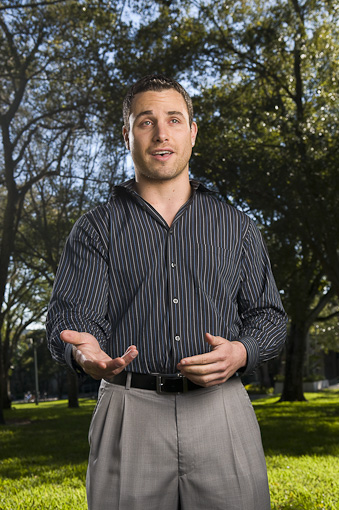
For an assignment last month for Paul DiMattia, Art Director for Business Miami, the University of Miami School of Business Administration’s alumni magazine, I utilized one of my bread and butter looks. I wasn’t in a jam, but I needed to work in a hurry, adapt quickly to changing conditions and work without an assistant.


I was to meet three students at three separate times, each about a half an hour apart and in the same general outdoor campus location, creating portraits that would relate to each other and be run as a triptych. 

My first light was the overall ambient coming from the late afternoon sun slicing through the heavy tree cover. By placing the students with their backs to the sun, I let God light the overall background and project a nice back light onto their head and shoulders. I underexposed the ambient a stop or so with my shutter speed, just enough to save the sparkly highlights in the leaves, but dark enough to allow my subjects to pop off the background.

The bread and butter formula called for my second light to be a medium soft box at arm’s length off to camera right just a touch and adjusted to give me nice skin tones and details in their clothing. (You need to use at least a moderate wide angle, like 35 mm, or the box will be in your way.) The box had enough angle to give me some definition by cross lighting their faces, but not to much to be unflattering. If I’m using a lower camera angle looking up, I will lower the box to keep a catch light in their eyes. I will never use the soft box from a high angle.


I will place the main light either left or right, depending on how they part their hair, where the sun is or physical limitations on placing light stands in a crowded spot ... or in this case, all on the same side to work in the triptych. This light could be from two thirds to a stop and a half over the ambient, first set with a flash meter, then adjusted to taste by viewing the camera’s histogram. If the soup needs more salt, I adjust to taste.

The third light was a subtle touch but a vital part of making the formula light a great light. I set it up on the side opposite of the main, higher and behind. It skimmed the hair, side of face and shoulder, helping to separate my subject from the background. A bare head with gobo made of tape and cardboard or whatever is handy helps control flair, and as it is usually a lot hotter than the soft box. I pull the stand way back to adjust it to about a stop over, depending on clothing, hair or skin color.

When I received the bread and butter light advice, I was still a staff photographer with United Press International shooting news and sports almost always on the run. What ever light and circumstances thrown at me I would work with, making the best photograph I could while never breaking the journalistic barrier of influencing the subject in any way that would not depict the truth. Sure, the very acts of deciding on a particular moment to trip the shutter or selecting what to put in or exclude from our photographs would influence the “truth” we put on the wire for newspapers around the world .

But we didn’t debate those philosophical questions very often ...  we just didn’t set up a news photos or ask someone to do something they didn’t normally do.

When I went freelance I found that portraiture for business and feature magazines was a very different beast. 


Firstly, a portrait by definition is having a subject pose for the viewer and is not “truth. Yet viewers accept the fact that people normally don’t freeze with hands on hips or arms crossed in every day life, with just the perfect bit of authority, warmth or attitude on their face. And secondly, most business portraits have to be set up in order to choose an environment that not only helps tell the subject’s story, but also is artistically pleasing.

Oh, and set it up all fast because Mr. or Ms. Executive is Very Important and only has a few minutes to allow you to capture that perfect fleeting moment that distills their essence in a photograph!

Pun warning: over the years I’ve saved my bacon by pulling out the bread and butter when I’m in an environmental portrait jam.

Here's a link to more Miami corporate photography.

Wednesday, March 17, 2010

Multimedia By Saying Hello In Chinese, Mongolian & Tibetan


I've been developing a web site to show case my multimedia work, and in the process of reviewing all my projects, I've decided to premier "Chinese Breezes" here. I produced it last Fall and it's never been posted for public viewing.

Breezes showcases 53 photographs created during my first four trips to China ( 2004 through 2008 ), and reflects my candid street photographic style plus the compromises inherent in traveling while partially on someone else's agenda. I wrote about those compromises and upsides earlier on this blog.

It's 3' 30" long. A larger version can be viewed here


The photographic technique I use to capture the relaxed and candid side of people from a culture other than my own is pretty basic. I show respect, smile, indicate an interest in them with body language ... the Golden Rule I guess.

My Chinese vocabulary is limited to a handful of badly mispronounced words. I can say "beer", "bottoms up", "spicy", "ice". Oh, and "ni hao" for "hello", the most important.

While in China's Inner Mongolia in 2008, I learned one word in Mongolian, sain baina uu, sorta pronounced "say ba nooh". We went 10 days without seeing a single other Western face, and often when approaching ethnic Mongolians were greeted with blank stares and open mouths. A smile plus "sain baina uu" immediately broke the ice.

And last year in the ethnic Tibetan regions of far Western Sichuan province,  "tashi dele" for "hello", pronounced by me as "sa shea daleah" worked just as well.

I really mean it, instant smiles in return.

I like to imagine my self walking down Ocean Drive on South Beach when a tall, green alien approaches me with a camera around it's triple neck ... a friendly "hello" in English would work as a terrific ice breaker. Would I sign a model release with one of those "for any use throughout the universe" clauses, well ....

Unlike some photographers I don't automatically offer to show my candid subjects their image on the back of the camera, as I feel that breaks the flow of the moment. If they are unsure of my intentions after one shot, and I can read that on their face, then the LCD may help. Or if I've shot a lot of my new found friend, I have images in the can, then sharing may cement our relationship.

I guess stopping to show the LCD after one or two frames feels to much like the concentration breaking practice of Chimping, looking down at the screen after each and every shot. Nothing brands the scarlet C on an amateur faster.

What is Chimping, those non photographers may be asking ? The story goes that in the early days of digital, like all of 10 years ago, news photographers gathered at large events were amazed by the ability to actually see their photos instantly on the back of their cameras' tiny one-inch screens.

They would point and say, " Look, cool ! Ooh, ooh, ooh ooh ooh !", sounding like chimpanzees.

The sound track on "Chinese Breezes" is the first multimedia program for which I have not recorded the sound bed. The upbeat Chinese themed sound track is called "Scarf Dance", composed by Jonathan Geer of Pot Of Earth Publishing.

Here's a link to more multimedia photography from China.


Thursday, March 11, 2010

Talking Picture Postcard - Sichuan Opera

At the end of my November trip to China's Sichuan Province, we spent several days in Chengdu, a city of about 10 million people who pride them selves not only being modern and relaxed, but also the center of the distinct art form called Sichuan Opera.


"Dear Kathy, in Chengdu tonight very funny henpecked husband character at Sichuan Opera a hoot, and secretive face changers amazing. Traditional musical instruments great, beer even better. Tom "

I was expecting the stiff and formal opera style often associated with Beijing Opera, notably a lot of loud screeching. I was quite surprised with the program at the Shufen Ya Yun Tea House, which in addition to the opera performance featured amazing musicians and shadow puppeteers.

Wikipedia describes it much better than I -  "...Overall the art form is well known for its singing, which is less constrained than that of the more popular Beijing opera form. Sichuan opera is more like a play than other forms of Chinese opera, and the acting is highly polished..."

The show wrapped with two secretive face-changing artists, who whipped multiple masks off their faces in a blink of the eye. We were told the skill is a highly guarded secret.

I can't say I did any fancy audio engineering to capture the sound bed for my second Talking Picture Postcard ... I simply left my recorder near the orchestra pit and let it run, leaving both hands free for either a camera or a cold beer.

Here's a link to more multimedia photography Talking Picture Postcards.

Sunday, February 28, 2010

Talking Picture Postcards Personal Challenge


Today I’m launching what I hope will become a challenging personal project, telling short stories from my experiences and travels by assembling just a handful of photographs and a few sound clips to tell short stories.

I’m calling them Talking Picture Postcards, and hope to write them fairly often and mail the multimedia shows on this blog.


“ Dear Mom, went camping in Everglades NP, found great Osprey nest with two chicks ... kayaking on Florida Bay at sunset another family squawked at me. Otherwise very quiet and peaceful weekend. Promise to find real job soon. Tom”

I’m trying to think of each as a couple of lines on the back of a picture postcard, like those I’ve discovered while rummaging through dusty boxes in antique stores over the years. I love those hand colored black and white photos of some some obscure vacation spot from the 1930s or 40s, or even the sepia toned ones from the early teens.

After gleaning what I can from the photos, I turn the cards over to read the hand written lines, often family news, weather reports and plans about the future. I wonder how the parties to the correspondence lived their lives and what happened to them. Those few lines can be the best part, ease dropping on people who’ve long since passed away.

But here I am 50 or 100 years later, reading about how they enjoyed their visit last weekend or how they are sending money to their sister.

With a postcard you only have room for the briefest of reports, so my challenge will be to use 20 to 30 seconds to scribble my couple of lines on the back of these digital postcards.

If you're reading this 50 years from now after discovering a dust covered box of antique blogs, I hope it was a bargain.

Here's a link to more Miami multimedia photography Talking Picture Postcards.

Thursday, February 11, 2010

Wide & Skinny Panoramic Photographs


Even though I’ve been distracted in recent years photographing with digital cameras and their traditional format, I always enjoy returning to view the world in the wide and skinny panoramic format.

I’m forced to see in different terms when my picture telling canvas is three times as wide as it is tall. Sure the rule of thirds aids my composition, but mostly I lead the viewer’s eye from left to right or vice versa, allowing them to roam along and discover the exciting corners of my narrow frame.

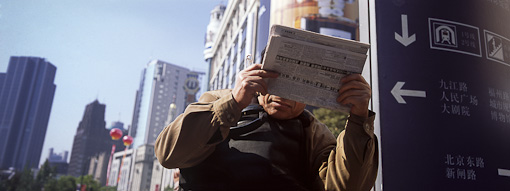
In China last Fall I used my Hasselblad XPan II for both street photography and landscapes. Here a morning commuter reads his morning newspaper outside the subway stop at the end of busy Nanjing Road in Shanghai.

The X-Pan is a 35 mm film camera that is small and portable and focuses with a traditional range finder. You look through the clear view finder, not the actual picture taking lens as a single lens reflex, and frame your photo with brightly outlined frame lines. With no auto focus motor you actually turn your fingers to focus, lining up two frosted rectangles. I gotta admit, sometimes in switching from my SLR to the X-Pan and seeing everything sharp, I forget to focus.

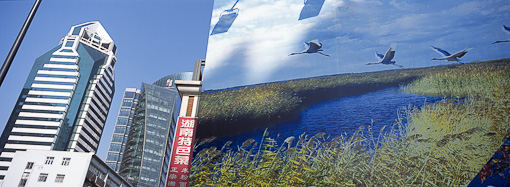
Continuing to walk the chaotic streets of Shanghai, I selected this nature-landscape-within-urban-jungle combo. Click photo to enlarge.

Generations of street photographers have utilized rangefinder cameras in their work. The cameras are quiet and stealthy, and being unencumbered with all the latest auto everything, micro processors and super telephoto lens, your mind is clear to really make photographs. I do utilize the XPan center weighted aperture priority auto exposure, and the motorized film transport frees up my thumb for hanging onto the camera.

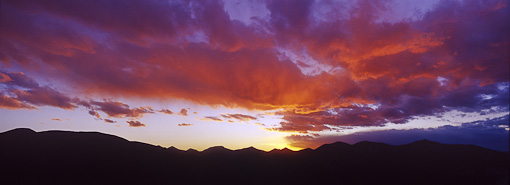
This November landscape shot was captured at sunset in  Sichuan, China, as we crested a 14 500 foot pass.

Often one thinks of panoramic photography when they need a wide angle view to encompass a dramatic landscape ( Here are examples of large format panoramic photography. ), like the Grand Canyon at sunset, but use of a pan camera need not be limited to landscapes. I use the format to extract bits from my confusing surroundings, some times very tightly, and to hand hold during people photography.

In panoramic the aspect ratio of width to height is at least 2 to 1, with 3 to 1 being my favorite. The XPan is 2.6 to 1. Any wider than three times the height, you have difficulty viewing in traditional display prints or in print publications, however on the web very wide aspect ratios work well in virtual reality applications. 

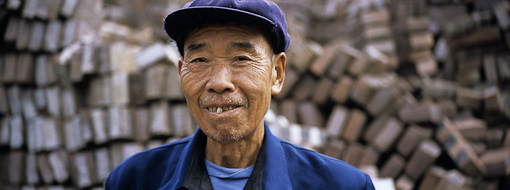
On an earlier China trip several years ago the XPan street credentials help me capture this brick yard worker

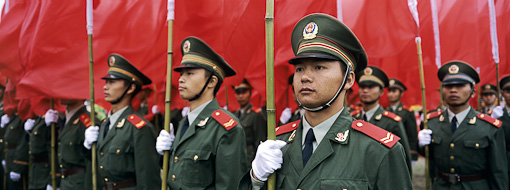
and these People’s Liberation Army soldier flag bearers at a festival opening ceremony.

The XPan is no longer manufactured, a victim of the decline of film photography, and prices on E Bay continue to be very strong.

Having E-6 color transparency film processed is a challenge now, with not one single South Florida lab reliably running it. I now express ship film to BWC Photo Imaging in Dallas, much more complicated and expensive than just a few years ago when two hour turn around at more than a dozen Miami labs was routine.

I love the advantages of digital and have never looked back since switching from film for assignments in 2006, yet for quietly capturing those wide and skinny photos of people, I’ll stick with old fashioned film and my Hasselblad XPan.


Monday, January 25, 2010

Sichuan Audio Slide Show Plays To Strengths


When I put together a multimedia presentation my goal is to combine still photographs with audio interviews and natural sound that give the viewer a fuller, more compelling experience than any one of those elements alone could do by themselves.

Story telling photographs can stand on their own quite well, say in a daily newspaper, as can an audio interview of the subject broadcast on the radio, yet the marriage of the two through multimedia on your computer screen or even as a podcast on your tiny iPod screen seems to present more information in a lot more exciting way. (If mentioning newspapers and radios in the same sentence dates me, well, so be it.)


Hearing the story subject speak in their own voice lends more legitimacy to the photographs, and photograph of the speaker places the voice in context ... the viewer can trust as real what they both see and hear.

And in my opinion adding a bed of natural sounds underneath the photos and interview adds a fourth dimension of spice, texture and realism to the presentation. Ambient sounds makes the entire dish sizzle with reality, like smelling the aroma of the chef’s creation as final proof the food is real.

I’m very excited about my latest multimedia project from my November trip to China’s Sichuan Province, 72 photographs with two dozen field recorded sound clips combined into an audio slide show. Relying on only natural sounds and no interviews, here is the three minute 20 second show.

You may ask, why not just shoot video ? The best answer is that I play to my strengths of being an experienced still photographer and a good listener. I know how to capture story telling moments in time as a photojournalist and portrait photographer, and understand how to blend photo selection, point of view and sequencing to linear story telling in multimedia.


And I’m finding recording audio in the field very fulfilling, as I’ve blogged about before here and here.

Both of these skills I can be good at on my own, a one man band in the field. Please note that good photography and good audio are two separate and equally important jobs. To do each one well requires close attention to creative and technical skills, so balancing both in the field is a dance of compromise.

At the Tagong Temple I was recording a monk playing drum and cymbal, and through the window could see more monks outside in the courtyard playing shell horns, a great photo. Grrrrr. But I had to remind myself to be happy with the moment, and I did record some great sound.

But with video, life becomes a lot more complicated. There is a reason they have “video crews”, with producer, director, director of photography, sound tech, camera operator, gaffer, caterer and on and on. And once it’s shot you need narration, music and full scale production services. Should a client need video, I partner with those who specialize in these areas.

On my own in China, I’ll keep it simple and keep listening for photos and looking for sounds.

Here's a link to more multimedia photography from China.

Friday, January 8, 2010

Lighting Cover Photo In Warehouse


A recent conversation with my teen aged daughter got me thinking about the bulk of the photography I do, shooting environmental portraits for magazines and corporations. I guess I’m really a problem solver, creating interesting photographs of people in usually very uninteresting surroundings - making something from nothing - and it’s a lot of fun.

I’ve been working on a multimedia project my daughter’s high school, which I will report about here soon, and some of her friends saw me on campus and asked her at lunch what I did for a living. When she answered that her dad was a photographer, they all said “Cool !”, implying an understanding that in our society photography is glamorous.

But I don’t shoot celebrities, professional athletes or rap stars, nor do big name travel magazines assign me to photograph tropical islands. My work is not glamorous, as a case history of an executive portrait shoot in a dingy warehouse will demonstrate.


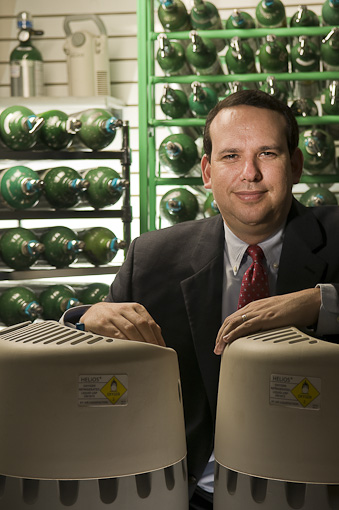
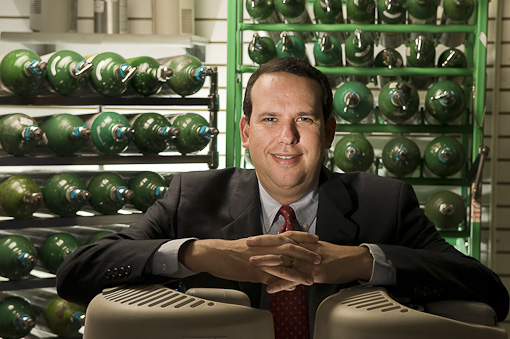
My assignment was to create a compelling cover photograph of Rob Brant, owner of Miami’s City Medical Services, for Ascend Media’s HME Today, a small trade magazine covering the Home Medical Equipment supply industry. Rob had been very active in the trade’s effort to stay above the Medicare national billing fraud scandals plaguing a tiny portion of the industry, with Miami-Dade County being ground zero for hundreds of millions of dollars of government losses.

My photographic challenge began as soon as Rob showed me around his small warehouse situated in an industrial district. At first brush there were nothing interesting visually to work an environmental portrait around, with shelves and tiny passages jammed to the concrete ceiling with jumbles of wheel chairs, medical beds and breathing machines. There were no clean backgrounds, no sexy piece of medical machinery to set my composition around.

Poking around and scratching my head on my own for half an hour, I finally discovered two heavy racks of green oxygen bottles almost hidden in the corner by a garage door. At that point I was grateful for any color, and green caught my eye, as did the repetitive pattern offered by the storage racks. And the oxygen related to Rob’s business.

With warehouse staff help we dug the racks free and filled in the empty spaces with bottles from around the building. Now I had a background with potential visual interest, stuck in a dark corner.


I placed my first flash, a bare tube on a short stand behind the racks and against the cream colored wall, a space of only a few inches. A bare tube is simple flash unit about an inch in diameter and six inches long without modeling light, reflector or cooling fan, with a long cord attached. They are a lot of fun to hide and insert light in difficult spots. The flash bounced off the wall and all around to back light the racks and opened up the dark corner.

Now I needed to place my subject in front of the background, and turned an empty bucket upside down for a short stool. To hide the bucket, give Rob something to place his hands upon ( I think hands are very expressive in portraits ) and add more medical equipment clues to the photo, we rolled over two large tanks that take oxygen from the air. First we had to dig them out of the mess, unwrap them and clean them off.

My second flash was a three degree honey comb grid from camera left, a spot light that at this distance, four feet, lit just a six inch circle, to open Rob’s face with light and not throw extra light all over the set, destroying the mood I was creating.

Light number three was a narrow strip soft box high above Rob at camera left to throw straight down a rim light on his hair, shoulder and hands on the tank tops. The strip was about 14 inches wide and 40 inches long, and also kept stray light from being thrown all over.

At that point I thought the front of the oxygen generators were to dark, so I added light number four, pointed straight down from six inches above the gray concrete floor. Turned to very low power, it added just enough fill light at a cool upward angle to complete the shot.

With a warehouse worker sitting in, I adjusted the lights with flash meter and camera histogram, and about two hours after arriving I was photographing Rob for his first magazine cover.

I love it when I successfully create an environmental portrait that my client is happy with and was a challenge of logistics, aesthetics and photographic lighting. It’s fun, and to me, even a bit cool. But glamorous, sorry kids, I would have to say no.

Here's a link to more Miami corporate photography.

Thursday, December 31, 2009

Open Mind Discovers Florida Keys Photos


This month I spent a windy, overcast and for us Floridians a chilly week in the Florida Keys enjoying the out of doors and taking a break from pushing pixels around on a computer screen.

No long philosophical essay here on the renewal of creative juices for those in the visual communications business. Nor will I evoke Henry David Thoreau’s Walden Pond to describe the spiritual benefits derived from being out-of-doors.

Just a short note to say I love the outdoors and being alone for a few days with nothing I have to do, and lots of optional creative outlets - photography and sound recording - available should I be moved to leave my campsite reading chair or find ocean kayaking in 30 mile per hour wind no longer relaxing.

You may click on any of these photos to enlarge them.


Without the pressure of having to produce a photograph to a client’s specifications I wandered about Bahia Honda State Park - one of the most beautiful state parks in the country and which has a beach once voted the best in America - struggling to abandon any previous techniques that would box me in to capturing the same old same old photo.

I arrived late in the afternoon and set up my tent in the wind and rain, and it was after “sunset” that I was walking along Sand Spur Beach on a very gray day when I noticed lightening bolts opening up the inside of storm clouds off shore in the Atlantic Ocean. “Thats cool”, I thought, all lit up from inside.

I threw my camera on a tripod, guessed a 30 second time exposure at F 11 might blur the water and if I was lucky I might catch a lightening flash. I was lucky, on the first frame only and created a photo I had not anticipated.


During the day I was looking for a way to make the drab, flat, overcast light interesting and was poking around the dry, sandy scrub land that makes up the interior of the island. I noticed some new bright green Sea Grape leaves, about five inches across, and wondered what they would look like if I lit them with just a light from behind. I placed a flash underneath, blew the light through a white diffusion cloth, and exposed to see the veins and detail thingies inside the leaf. Sorry I’m not a botanist, but I loved finding a new way to discover the complexities of a leaf.


The next evening there was a five minute window at sunset as the sun sliced under the heavy cloud cover and skimmed from the West right along Sand Spur Beach, highlighting the wave ripples as they quietly created patterns that changed several times a second. Here a telephoto lens and fast shutter speed gave me a new insight.

Here's a link to more editorial photography from Florida.

Monday, December 14, 2009

Still Photos Tell Time With Time-Lapse Photography


With some basic experiments in time-lapse photography I’ve been tackling one of the conundrums of multimedia audio slide shows, how do you depict the passage of time with still photographs that do not move.

You may click on photo to see larger.

Below is a 12 second Quick Time movie depicting stars rotating around Polaris - the North Star - in Everglades National Park earlier this year. Or click here for a full size version. A photograph was made every four minutes over 72 minutes, from 12:38 Am to 1: 50 AM, and when assembled to play over 12 seconds, the rotation is really cool.


Slide shows posted to the web have to grab the viewer’s attention and keep it or they will click onto something more interesting, like kittens clapping their paws in time to music on You Tube. Keeping the story’s pace moving and varied is important and can be done in several ways;

  • limit the time each still photo is on screen to under six seconds or so
  • vary the screen time from image to image
  • utilize close up detail photos to balance wide scene setters
  • make sequences of the same portrait setup varying subject size & placement in frame
  • pan across a photo with a “Ken Burns” effect
  • and lastly, utilize time-lapse sequences of still photographs


In the above 22 second Quick Time movie shot on South Beach this Fall at sunrise, 55 photos were captured at five second intervals over just five minutes. A full size version can be seen here. By the way, all three movies attached here are accompanied with natural sound recorded on scene.

Cinematographers have been using time-lapse photography since the early days of movies by capturing each frame of film at a rate much slower than will be played back. A regular feature film is shot at 24 frames a second, and when projected at the same frame rate the motion seems normal to us. Filmed at a much slower rate but played back at 24 fps, the action is sped up. (If shot at a faster frame rate, but played back at 24 fps, we perceive slow motion. ) We’ve all seen time-lapse sequences of flowers blooming, where one frame is shot every hour or so and petals slowly unfold, or a glacier receding from year to year, with one frame per day captured.

Changes across time too subtle for the human eye to detect, such as stars moving in the sky or the sun rising, are slowed down for our study and enjoyment by a slower replay frame rate


From the 47th floor penthouse looking South in August down Miami Beach’s Collins Avenue, the Atlantic Ocean on the left and downtown Miami at upper right, shots were made every 30 seconds or so over 37 minutes for this 21 second Quick Time movie. Full size version available here. I enjoy seeing the clouds slide by, a boat zip up the intra-coastal and post sunset glow settle onto the city.
This sequence with fewer frames included opened the multimedia show I wrote about here.

Time-lapse photography is adding a fun dimension to my multimedia projects by allowing me to show the passage of time. And I'm combining the outdoor and skyline photography I love with my photojournalism and environmental portraiture.

Here's a link to more Miami multimedia photography.

Wednesday, December 9, 2009

Audio Recording Leads To Pelican Rescue

Sunday I decided a peaceful kayak paddle on Biscayne Bay was a terrific way to enjoy the mild Florida weather and a great opportunity to record quiet ambient sounds, so I grabbed my sound recording gear and Nikon digital point n’ shoot camera and launched just five minutes away from my home. As I left I had no idea I was going to rescue a pelican from certain death nor be cursing the noisy skies above.

You may click on any photo to view larger.

Enjoying the sensation of floating freedom the first few paddle strokes, when my body realized I was not rushing through a metropolis of 2.2 million people, I threaded between a half dozen low mangrove covered islands. In this part of Biscayne Bay, which runs North 35 miles from the Florida Keys and is sandwiched between the Miami Beach barrier island and mainland Miami, I felt as if I was in the wild, yet I was surrounded by urban skyline all around. Sunday I could understood artist Christo’s  fascination with these islands which in 1983  he wrapped in miles of hot pink plastic for his Surrounded Islands art project.

One island is a popular rookery for water birds, allowing osprey, brown pelicans, white ibis, cormorants and even magnificent frigatebirds , which have impressive air filled red pouches and long forked tails, an isolated haven for safe nesting sites. Floating off at a reasonable distance as not to disturb them, I powered up my recorder and shotgun mic to record their raucous clamoring.


I’m not a birder, but I could distinguish the throaty clack-clack-clak of the cormorants and the angry screeching of a great blue heron. And with headphones it sounded like I was deep into a far off wilderness. Well, for about 60 seconds ... off in the distance I heard an airplane, a jet coming closer and louder, finally a roar in my ears. I waited for it to go away, and started recording again. Less than a minute later, another jet.

I quickly realized Miami International Airport was sending flights almost exactly every minute off over Biscayne Bay, and on top of me and the rookery, as the wind was coming inland from the Atlantic Ocean. And soon I picked up the mile off go fast boats, roaring up and down the Intracoastal Waterway , and then a propeller plane pulling a sign that read “I luv u Amy, will you marry me? Omar.”

What the heck, I decided to incorporate the jets into a sound clip, plus some peaceful wind blowing through island palm trees and water lapping on shore, recorded in the 30 seconds of relative silence between jets. It's 1:30 long.


By the time I left the rookery, the wind was blowing with light chop and rain squalls were passing over the bay. I headed for a more southern island, and hugging the shore, I turned a bend and was startled by a pelican less than a paddle length away. He was sitting just above the water on a mangrove branch. I said “hello”, and moved off not wanting to disturb it. But about 100 yards down the island, it struck me that something did not seem right. Pelicans always fly away from large orange kayaks.


I turned around and paddled back, approaching the pelican again and looking closely I could see it was thoroughly tied down with fishing line. I could even see a lead sinker half an inch across.  Carelessly discarded fishing tackle is a major threat to pelicans in Florida, as they can swallow baited hooks or be caught during a cast. In May I photographed Wendy Fox, the Executive Director of the Pelican Harbor Seabird Station for The Chronicle of Philanthropy, and I had seen dozens of injured and recuperating pelicans at their facility just a couple of miles up the bay from this poor fellow.

I knew from watching Wendy teach an intern how to handle pelicans that I did not have the special skills to catch a wild bird with a 10 foot wing span, and I certainly had no veterinary expertise. But this spot was in water about two feet deep so little small boat traffic passed by, and I had to do something. No telling how long it had been trapped, it could be starving to death for all I knew. I paddled over to the mangrove in the choppy water, and the pelican flapped and spun around on it’s fishing line tether. 

I cursed not carrying a knife with me, but I was wearing paddling gloves, so I figured I could at least break the line. With the bird squawking and throwing it’s beak about, I noticed a brass clip holing an 18 inch leader to a large hook caught deep into the center of his back. Bad luck for the bird, good luck for me as it was an easy fix, and the moment the bird felt the tension release, it flapped off into the water under  thick mangroves.

I really didn’t want to capture the bird and paddle it to the Seabird Station, but I had to make sure it wasn’t half dead. I beached the kayak, crawled under the mangroves, shooing the bird into open water, where it flew off. I was relieved to see it seemed vigorous, and hopefully the hook could remain in it’s back without harming him for the rest of his life.

I gladly joined the large club of Florida boaters who have rescued sea birds, and paddled off looking for more sounds to record, wondering if Amy took Omar up on his proposal.

Here's a link to more Miami multimedia photography.

Monday, November 23, 2009

Photographing Details and Grasshopper Buzz

Earlier this month I had fun searching for detail photographs, those very selective views extracted with a telephoto lens, while visiting Chengdu in China’s Sichuan province, a bustling and visually chaotic city of 11 million. From past experience I knew that discovering details often reveals small insightful stories about the country I'm traveling in, which I feel is one of the best rewards of travel.

While walking through the park-like Kuanzhai Xiangzi shopping area in the central Chengdu, I heard the melodic sounds of metal tuning forks. Men and women dressed in medical style white coats were sounding them to solicit business from shoppers and tea house customers.

They were the city’s unique ear-cleaners, who carried pockets full of what looked like miniature chimney sweep tools, long wooden and wire handles with knives, scoops and brushes on the end, some tipped with tiny delicate feathers.

I didn’t really want my ears cleaned, especially not in full view of the public, but there was no shortage of others getting comfortable in chairs under shade trees, closing their eyes and slowing displaying the most relaxed expressions on their faces.

I was told the procedure is less a hygienic exercise and more a massage-like experience, with the tools and feathers stimulating acupuncture points within the ear. When the vibrating tuning fork is placed against a brush, the gentle sound deep within the ear has been described as the soft relaxing buzz of a grasshopper.

I encountered another visual detail while visiting the Wenshu Buddhist Temple where visitors were touching, patting and caressing two large brass lions guarding the main hall’s entrance. These mythical male and female lions symbolize defense and protection and guard many building and gateway entrances throughout China.

I knew touching the lions is thought to bring good luck, but these worshipers were also touching the corresponding spot on themselves. A pat on the lion’s worn head, a pat on their head. A brush down the lion’s back, a touch to their own.

A visitor explained to me that it is believed their own physical ailments at those locations would be healed or at least improved with the tactile help of these lions.

Just outside the Wenshu Temple were incense and candle shops and rows of outdoor souvenir stands lining the busy commercial street, a perfect example of the new China. One tiny detail caught my eye, a rack of plastic medallions with bright red braided cord.  In the USA they could pass for either Christmas ornaments or decorations to hang from your car’s rear view mirror.

I loved the juxtaposition - and irony - of  Mao Zedong’s familiar and reassuring portrait being sold next to Buddhist religious icons. China certainly has come a long way since the chaotic Cultural Revolution of the 1960s where no religion or independent thought was tolerated, nor were entrepreneurs allowed to flourish selling anything.

Such a small detail I might have overlooked in the past

When earlier in my career I was shooting news for daily newspapers and later United Press International, I was always looking for that one moment in time that would tell the reader the journalistic touch points of who, what, where and why. Often the best way to do that was with an all encompassing wide angle lens, placing the action in the foreground while maintaining the context of the surroundings. The optics of a wide angle emphasizes what is closest to it, yet it can fit in a lot of real estate left to right, especially if your in tight quarters. A photographer can also create a wonderful three dimensional feeling with a wide angle with graphic lines leading your eye within the image.

I still have that news photographer point of view, a wide angle is my “normal” lens, 24 mm or so, rather than what text books describe as the preferred angle of view, a 50 mm..

But as my client base and photographic interests have broadened, so has my need to capture detail views to be published in print complementing the scene setter, or utilized in multimedia shows depicting movement and time.

And I’m learning more about the world around me ... maybe when I next visit Chengdu I’ll understand the wisdom of  having my ears cleaned.

Here's a link to more editorial photography from Sichuan.