Wednesday, April 28, 2010
Talking Picture Postcard - Mangrove Creek Songs
My favorite kayaking destination here in South Florida is any waterway that takes me though a tunnel formed by mangrove trees, a path that almost blocks out the sky above and forces me to inch along a glassy smooth tidal creek deep in the back country.
Earlier this month I spent four days paddling the 10,000 Islands area off Florida’s South West coast, putting in either at Everglades National Park’s Chokoloskee Bay ranger station in Everglades City, or off the Tamiami Trail in the Big Cypress National Preserve.
On a Monday I quickly paddled past the off shore mangrove islands dotting the bay and entered Half Way Creek with a rising tide, utilizing the powerful tidal flows to my advantage. In about an hour I was wrapped in a mangrove canopy completely encompassing the narrow creek, all sound reduced to my splashing paddles.
Then I heard them, two different song birds, one hidden just out of sight in the thick red mangroves, it sounded like it was right on top of me, and the second, I guessed a different species, off at a distance. They seemed to be playing a duet, one trilling upward, and a moment later the closest one singing a six note refrain.
Water dripping from my paddle was the only sound between the songs. Using my recorder's built in stereo microphones I could hear in my headphones the notes echo back and forth through the mangrove tunnel and off the water. (If you’re a real sound geek, try ‘phones to hear the separation, water drip and mosquito buzz.) Then the birds flew off, leaving me in complete silence.
Halfway Creek flowed into the Left-Hand Turner River, and finally the mangrove cover opened up to small shallow ponds where sunlight rippled through tannin colored water, and when I entered Turner Lake, I paddled blue back country waters.
Turning South onto the Turner River I rode the outgoing tide back into Chokoloskee Bay, already missing my intimate mangrove tunnels and their hidden singers
Here's a link to more multimedia photography Talking Picture Postcards.

Tuesday, April 20, 2010
Multimedia Drives “There’s A School For That” Campaign
Designed to catch the attention of teenagers in the internet age, a series of multimedia audio slide shows I’ve just completed relates a Miami high school’s unique educational philosophy through compelling student profiles featuring custom created still photographs, combined with audio interviews and field recorded natural sounds.
Hopefully by watching you will see how Senior Melissa’s words and passion personalize the entire high school. The show is 2:14 long, and a larger version may be viewed here.
Archbishop Curley Notre Dame, a Christian Brothers’ college preparatory high school here in Miami, is making these shows the centerpiece of their “There’s A School For That” recruitment and marketing campaign.
With school and parent’s finding the economic downturn impacting their budgets, and educational alternatives competing for their prospective middle school applicants, ACND hopes to raise their current 302 enrollment closer to 400, a number that can be educated at the same cost, thus alleviating some of the financial pressure.

ACND, in Miami’s Buena Vista neighborhood alongside Little Haiti, offers students in grades nine through 12 a college preparatory curriculum in a Catholic environment, and for decades has been a leader in inclusiveness. In 1960 they admitted their first African-American students, the first Florida school to do so, while surrounding Miami-Dade County public schools were not integrated until ten years later, and then only by federal court order.
I’ve written here before that I’m really excited about how multimedia that combine journalistic photography and interview styles give audiences a fuller, more compelling experience than any one of these elements could by themselves, either on line or in print.
 By attending ACND Melissa found she really loved to sing, and music director Daphne Dominique’s personal attention nurtured her talent. In four additional shows that I will post here in the coming weeks, a quarterback relates how his coach taps each student’s best, a student tells how friends help him academically, a student leader blossoms and a brand new freshman is just plain happy to come to school every day.
Principal Brother Patrick Sean Moffett, CFC, challenged me to capture one key aspect of each selected student’s excitement about the school. I needed to tell each story with a handful of sentences and a couple of dozen photos, plus a bed of ambient sound for depth and realism.
With running times between 2:04 and 2:24, each show required five to six days of work ... about a half day of interviewing, a day and a half for photography and ambient sound recording, and then at least three more days in post production computer time editing the audio and photos, assembling into the slide shows and processing for output.
These shows will reach ACND's prospective students, their parents and supporters when featured on the school’s web site, distributed on flash drives as pod casts, shared as videos via social media sites and played on TV screens at events.
I must thank Brother Moffett and his staff for their help producing these projects, including Public Relations Coordinator Katherine Doble and her Barry University intern Homma Rafi, Vice Principal of Student Services Douglas Romanik, and Secretary to the Principal Daphne Dominque.
More multimedia work can be viewed on my new Miami Multimedia Photographer portfolio web site.
Hopefully by watching you will see how Senior Melissa’s words and passion personalize the entire high school. The show is 2:14 long, and a larger version may be viewed here.
Archbishop Curley Notre Dame, a Christian Brothers’ college preparatory high school here in Miami, is making these shows the centerpiece of their “There’s A School For That” recruitment and marketing campaign.
With school and parent’s finding the economic downturn impacting their budgets, and educational alternatives competing for their prospective middle school applicants, ACND hopes to raise their current 302 enrollment closer to 400, a number that can be educated at the same cost, thus alleviating some of the financial pressure.

ACND, in Miami’s Buena Vista neighborhood alongside Little Haiti, offers students in grades nine through 12 a college preparatory curriculum in a Catholic environment, and for decades has been a leader in inclusiveness. In 1960 they admitted their first African-American students, the first Florida school to do so, while surrounding Miami-Dade County public schools were not integrated until ten years later, and then only by federal court order.
I’ve written here before that I’m really excited about how multimedia that combine journalistic photography and interview styles give audiences a fuller, more compelling experience than any one of these elements could by themselves, either on line or in print.

Principal Brother Patrick Sean Moffett, CFC, challenged me to capture one key aspect of each selected student’s excitement about the school. I needed to tell each story with a handful of sentences and a couple of dozen photos, plus a bed of ambient sound for depth and realism.
With running times between 2:04 and 2:24, each show required five to six days of work ... about a half day of interviewing, a day and a half for photography and ambient sound recording, and then at least three more days in post production computer time editing the audio and photos, assembling into the slide shows and processing for output.
These shows will reach ACND's prospective students, their parents and supporters when featured on the school’s web site, distributed on flash drives as pod casts, shared as videos via social media sites and played on TV screens at events.
I must thank Brother Moffett and his staff for their help producing these projects, including Public Relations Coordinator Katherine Doble and her Barry University intern Homma Rafi, Vice Principal of Student Services Douglas Romanik, and Secretary to the Principal Daphne Dominque.
More multimedia work can be viewed on my new Miami Multimedia Photographer portfolio web site.
Monday, March 29, 2010
When In A Jam, Bread & Butter Portrait Light
When I started learning to light environmental portraits, a more experienced photographer friend gave me some advice that has served me well ever since. Perfect one or two “looks” that you can whip out of your equipment cases in a hurry, when you are in a jam and up against the wall with little time to set up or stuck in a horrible location.
For an assignment last month for Paul DiMattia, Art Director for Business Miami, the University of Miami School of Business Administration’s alumni magazine, I utilized one of my bread and butter looks. I wasn’t in a jam, but I needed to work in a hurry, adapt quickly to changing conditions and work without an assistant.
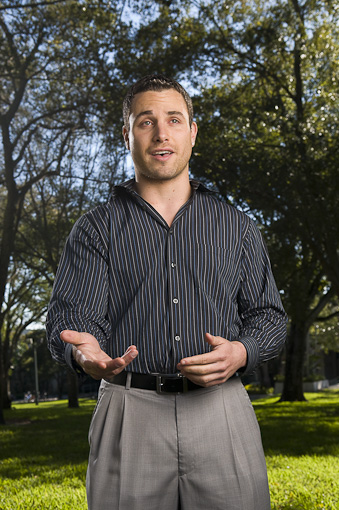
I was to meet three students at three separate times, each about a half an hour apart and in the same general outdoor campus location, creating portraits that would relate to each other and be run as a triptych.
My first light was the overall ambient coming from the late afternoon sun slicing through the heavy tree cover. By placing the students with their backs to the sun, I let God light the overall background and project a nice back light onto their head and shoulders. I underexposed the ambient a stop or so with my shutter speed, just enough to save the sparkly highlights in the leaves, but dark enough to allow my subjects to pop off the background.
The bread and butter formula called for my second light to be a medium soft box at arm’s length off to camera right just a touch and adjusted to give me nice skin tones and details in their clothing. (You need to use at least a moderate wide angle, like 35 mm, or the box will be in your way.) The box had enough angle to give me some definition by cross lighting their faces, but not to much to be unflattering. If I’m using a lower camera angle looking up, I will lower the box to keep a catch light in their eyes. I will never use the soft box from a high angle.

I will place the main light either left or right, depending on how they part their hair, where the sun is or physical limitations on placing light stands in a crowded spot ... or in this case, all on the same side to work in the triptych. This light could be from two thirds to a stop and a half over the ambient, first set with a flash meter, then adjusted to taste by viewing the camera’s histogram. If the soup needs more salt, I adjust to taste.
The third light was a subtle touch but a vital part of making the formula light a great light. I set it up on the side opposite of the main, higher and behind. It skimmed the hair, side of face and shoulder, helping to separate my subject from the background. A bare head with gobo made of tape and cardboard or whatever is handy helps control flair, and as it is usually a lot hotter than the soft box. I pull the stand way back to adjust it to about a stop over, depending on clothing, hair or skin color.

But we didn’t debate those philosophical questions very often ... we just didn’t set up a news photos or ask someone to do something they didn’t normally do.
Firstly, a portrait by definition is having a subject pose for the viewer and is not “truth. Yet viewers accept the fact that people normally don’t freeze with hands on hips or arms crossed in every day life, with just the perfect bit of authority, warmth or attitude on their face. And secondly, most business portraits have to be set up in order to choose an environment that not only helps tell the subject’s story, but also is artistically pleasing.
Oh, and set it up all fast because Mr. or Ms. Executive is Very Important and only has a few minutes to allow you to capture that perfect fleeting moment that distills their essence in a photograph!
Pun warning: over the years I’ve saved my bacon by pulling out the bread and butter when I’m in an environmental portrait jam.
Here's a link to more Miami corporate photography.
Wednesday, March 17, 2010
Multimedia By Saying Hello In Chinese, Mongolian & Tibetan
I've been developing a web site to show case my multimedia work, and in the process of reviewing all my projects, I've decided to premier "Chinese Breezes" here. I produced it last Fall and it's never been posted for public viewing.
Breezes showcases 53 photographs created during my first four trips to China ( 2004 through 2008 ), and reflects my candid street photographic style plus the compromises inherent in traveling while partially on someone else's agenda. I wrote about those compromises and upsides earlier on this blog.
It's 3' 30" long. A larger version can be viewed here.
The photographic technique I use to capture the relaxed and candid side of people from a culture other than my own is pretty basic. I show respect, smile, indicate an interest in them with body language ... the Golden Rule I guess.
My Chinese vocabulary is limited to a handful of badly mispronounced words. I can say "beer", "bottoms up", "spicy", "ice". Oh, and "ni hao" for "hello", the most important.
While in China's Inner Mongolia in 2008, I learned one word in Mongolian, sain baina uu, sorta pronounced "say ba nooh". We went 10 days without seeing a single other Western face, and often when approaching ethnic Mongolians were greeted with blank stares and open mouths. A smile plus "sain baina uu" immediately broke the ice.
And last year in the ethnic Tibetan regions of far Western Sichuan province, "tashi dele" for "hello", pronounced by me as "sa shea daleah" worked just as well.
I really mean it, instant smiles in return.
I like to imagine my self walking down Ocean Drive on South Beach when a tall, green alien approaches me with a camera around it's triple neck ... a friendly "hello" in English would work as a terrific ice breaker. Would I sign a model release with one of those "for any use throughout the universe" clauses, well ....
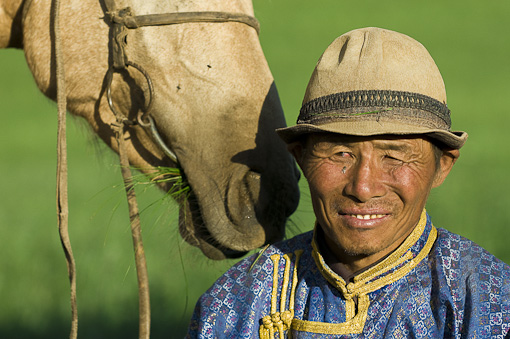
I guess stopping to show the LCD after one or two frames feels to much like the concentration breaking practice of Chimping, looking down at the screen after each and every shot. Nothing brands the scarlet C on an amateur faster.
What is Chimping, those non photographers may be asking ? The story goes that in the early days of digital, like all of 10 years ago, news photographers gathered at large events were amazed by the ability to actually see their photos instantly on the back of their cameras' tiny one-inch screens.
They would point and say, " Look, cool ! Ooh, ooh, ooh ooh ooh !", sounding like chimpanzees.
The sound track on "Chinese Breezes" is the first multimedia program for which I have not recorded the sound bed. The upbeat Chinese themed sound track is called "Scarf Dance", composed by Jonathan Geer of Pot Of Earth Publishing.
Here's a link to more multimedia photography from China.
Thursday, March 11, 2010
Talking Picture Postcard - Sichuan Opera
At the end of my November trip to China's Sichuan Province, we spent several days in Chengdu, a city of about 10 million people who pride them selves not only being modern and relaxed, but also the center of the distinct art form called Sichuan Opera.
"Dear Kathy, in Chengdu tonight very funny henpecked husband character at Sichuan Opera a hoot, and secretive face changers amazing. Traditional musical instruments great, beer even better. Tom "
I was expecting the stiff and formal opera style often associated with Beijing Opera, notably a lot of loud screeching. I was quite surprised with the program at the Shufen Ya Yun Tea House, which in addition to the opera performance featured amazing musicians and shadow puppeteers.
Wikipedia describes it much better than I - "...Overall the art form is well known for its singing, which is less constrained than that of the more popular Beijing opera form. Sichuan opera is more like a play than other forms of Chinese opera, and the acting is highly polished..."
The show wrapped with two secretive face-changing artists, who whipped multiple masks off their faces in a blink of the eye. We were told the skill is a highly guarded secret.
I can't say I did any fancy audio engineering to capture the sound bed for my second Talking Picture Postcard ... I simply left my recorder near the orchestra pit and let it run, leaving both hands free for either a camera or a cold beer.
Here's a link to more multimedia photography Talking Picture Postcards.
Sunday, February 28, 2010
Talking Picture Postcards Personal Challenge
Today I’m launching what I hope will become a challenging personal project, telling short stories from my experiences and travels by assembling just a handful of photographs and a few sound clips to tell short stories.
I’m calling them Talking Picture Postcards, and hope to write them fairly often and mail the multimedia shows on this blog.
“ Dear Mom, went camping in Everglades NP, found great Osprey nest with two chicks ... kayaking on Florida Bay at sunset another family squawked at me. Otherwise very quiet and peaceful weekend. Promise to find real job soon. Tom”
I’m trying to think of each as a couple of lines on the back of a picture postcard, like those I’ve discovered while rummaging through dusty boxes in antique stores over the years. I love those hand colored black and white photos of some some obscure vacation spot from the 1930s or 40s, or even the sepia toned ones from the early teens.
After gleaning what I can from the photos, I turn the cards over to read the hand written lines, often family news, weather reports and plans about the future. I wonder how the parties to the correspondence lived their lives and what happened to them. Those few lines can be the best part, ease dropping on people who’ve long since passed away.
But here I am 50 or 100 years later, reading about how they enjoyed their visit last weekend or how they are sending money to their sister.
With a postcard you only have room for the briefest of reports, so my challenge will be to use 20 to 30 seconds to scribble my couple of lines on the back of these digital postcards.
If you're reading this 50 years from now after discovering a dust covered box of antique blogs, I hope it was a bargain.
Here's a link to more Miami multimedia photography Talking Picture Postcards.
Thursday, February 11, 2010
Wide & Skinny Panoramic Photographs
Even though I’ve been distracted in recent years photographing with digital cameras and their traditional format, I always enjoy returning to view the world in the wide and skinny panoramic format.
I’m forced to see in different terms when my picture telling canvas is three times as wide as it is tall. Sure the rule of thirds aids my composition, but mostly I lead the viewer’s eye from left to right or vice versa, allowing them to roam along and discover the exciting corners of my narrow frame.
In China last Fall I used my Hasselblad XPan II for both street photography and landscapes. Here a morning commuter reads his morning newspaper outside the subway stop at the end of busy Nanjing Road in Shanghai.
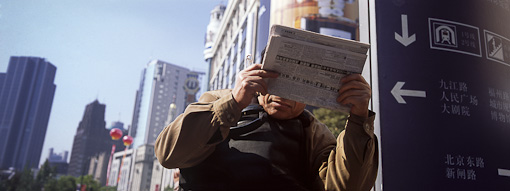
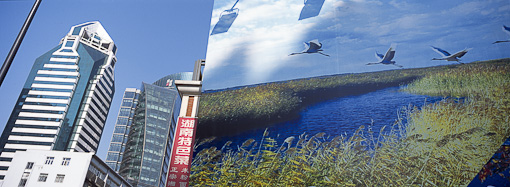
Generations of street photographers have utilized rangefinder cameras in their work. The cameras are quiet and stealthy, and being unencumbered with all the latest auto everything, micro processors and super telephoto lens, your mind is clear to really make photographs. I do utilize the XPan center weighted aperture priority auto exposure, and the motorized film transport frees up my thumb for hanging onto the camera.
This November landscape shot was captured at sunset in Sichuan, China, as we crested a 14 500 foot pass.
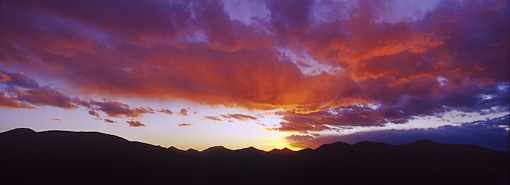
In panoramic the aspect ratio of width to height is at least 2 to 1, with 3 to 1 being my favorite. The XPan is 2.6 to 1. Any wider than three times the height, you have difficulty viewing in traditional display prints or in print publications, however on the web very wide aspect ratios work well in virtual reality applications.
On an earlier China trip several years ago the XPan street credentials help me capture this brick yard worker
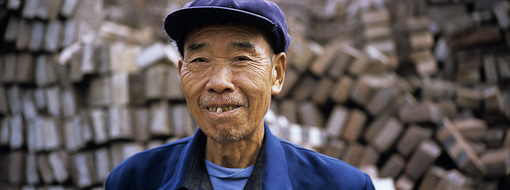
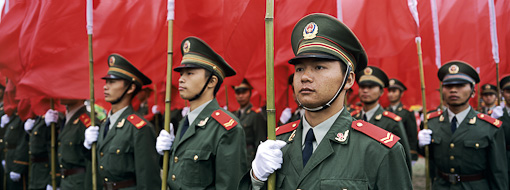
Having E-6 color transparency film processed is a challenge now, with not one single South Florida lab reliably running it. I now express ship film to BWC Photo Imaging in Dallas, much more complicated and expensive than just a few years ago when two hour turn around at more than a dozen Miami labs was routine.
I love the advantages of digital and have never looked back since switching from film for assignments in 2006, yet for quietly capturing those wide and skinny photos of people, I’ll stick with old fashioned film and my Hasselblad XPan.
Monday, January 25, 2010
Sichuan Audio Slide Show Plays To Strengths
When I put together a multimedia presentation my goal is to combine still photographs with audio interviews and natural sound that give the viewer a fuller, more compelling experience than any one of those elements alone could do by themselves.
Story telling photographs can stand on their own quite well, say in a daily newspaper, as can an audio interview of the subject broadcast on the radio, yet the marriage of the two through multimedia on your computer screen or even as a podcast on your tiny iPod screen seems to present more information in a lot more exciting way. (If mentioning newspapers and radios in the same sentence dates me, well, so be it.)
Hearing the story subject speak in their own voice lends more legitimacy to the photographs, and photograph of the speaker places the voice in context ... the viewer can trust as real what they both see and hear.
And in my opinion adding a bed of natural sounds underneath the photos and interview adds a fourth dimension of spice, texture and realism to the presentation. Ambient sounds makes the entire dish sizzle with reality, like smelling the aroma of the chef’s creation as final proof the food is real.
I’m very excited about my latest multimedia project from my November trip to China’s Sichuan Province, 72 photographs with two dozen field recorded sound clips combined into an audio slide show. Relying on only natural sounds and no interviews, here is the three minute 20 second show.
You may ask, why not just shoot video ? The best answer is that I play to my strengths of being an experienced still photographer and a good listener. I know how to capture story telling moments in time as a photojournalist and portrait photographer, and understand how to blend photo selection, point of view and sequencing to linear story telling in multimedia.
And I’m finding recording audio in the field very fulfilling, as I’ve blogged about before here and here.
Both of these skills I can be good at on my own, a one man band in the field. Please note that good photography and good audio are two separate and equally important jobs. To do each one well requires close attention to creative and technical skills, so balancing both in the field is a dance of compromise.
At the Tagong Temple I was recording a monk playing drum and cymbal, and through the window could see more monks outside in the courtyard playing shell horns, a great photo. Grrrrr. But I had to remind myself to be happy with the moment, and I did record some great sound.
But with video, life becomes a lot more complicated. There is a reason they have “video crews”, with producer, director, director of photography, sound tech, camera operator, gaffer, caterer and on and on. And once it’s shot you need narration, music and full scale production services. Should a client need video, I partner with those who specialize in these areas.
On my own in China, I’ll keep it simple and keep listening for photos and looking for sounds.
Here's a link to more multimedia photography from China.
Friday, January 8, 2010
Lighting Cover Photo In Warehouse
A recent conversation with my teen aged daughter got me thinking about the bulk of the photography I do, shooting environmental portraits for magazines and corporations. I guess I’m really a problem solver, creating interesting photographs of people in usually very uninteresting surroundings - making something from nothing - and it’s a lot of fun.
I’ve been working on a multimedia project my daughter’s high school, which I will report about here soon, and some of her friends saw me on campus and asked her at lunch what I did for a living. When she answered that her dad was a photographer, they all said “Cool !”, implying an understanding that in our society photography is glamorous.
But I don’t shoot celebrities, professional athletes or rap stars, nor do big name travel magazines assign me to photograph tropical islands. My work is not glamorous, as a case history of an executive portrait shoot in a dingy warehouse will demonstrate.
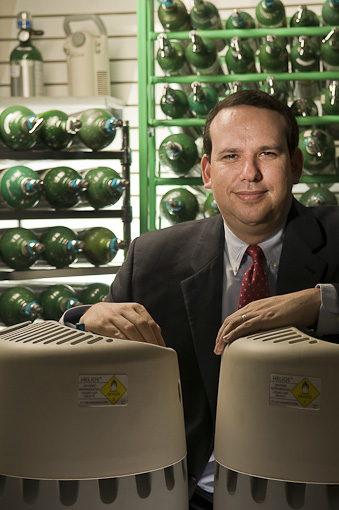
My assignment was to create a compelling cover photograph of Rob Brant, owner of Miami’s City Medical Services, for Ascend Media’s HME Today, a small trade magazine covering the Home Medical Equipment supply industry. Rob had been very active in the trade’s effort to stay above the Medicare national billing fraud scandals plaguing a tiny portion of the industry, with Miami-Dade County being ground zero for hundreds of millions of dollars of government losses.
My photographic challenge began as soon as Rob showed me around his small warehouse situated in an industrial district. At first brush there were nothing interesting visually to work an environmental portrait around, with shelves and tiny passages jammed to the concrete ceiling with jumbles of wheel chairs, medical beds and breathing machines. There were no clean backgrounds, no sexy piece of medical machinery to set my composition around.
Poking around and scratching my head on my own for half an hour, I finally discovered two heavy racks of green oxygen bottles almost hidden in the corner by a garage door. At that point I was grateful for any color, and green caught my eye, as did the repetitive pattern offered by the storage racks. And the oxygen related to Rob’s business.
With warehouse staff help we dug the racks free and filled in the empty spaces with bottles from around the building. Now I had a background with potential visual interest, stuck in a dark corner.

I placed my first flash, a bare tube on a short stand behind the racks and against the cream colored wall, a space of only a few inches. A bare tube is simple flash unit about an inch in diameter and six inches long without modeling light, reflector or cooling fan, with a long cord attached. They are a lot of fun to hide and insert light in difficult spots. The flash bounced off the wall and all around to back light the racks and opened up the dark corner.
Now I needed to place my subject in front of the background, and turned an empty bucket upside down for a short stool. To hide the bucket, give Rob something to place his hands upon ( I think hands are very expressive in portraits ) and add more medical equipment clues to the photo, we rolled over two large tanks that take oxygen from the air. First we had to dig them out of the mess, unwrap them and clean them off.
My second flash was a three degree honey comb grid from camera left, a spot light that at this distance, four feet, lit just a six inch circle, to open Rob’s face with light and not throw extra light all over the set, destroying the mood I was creating.
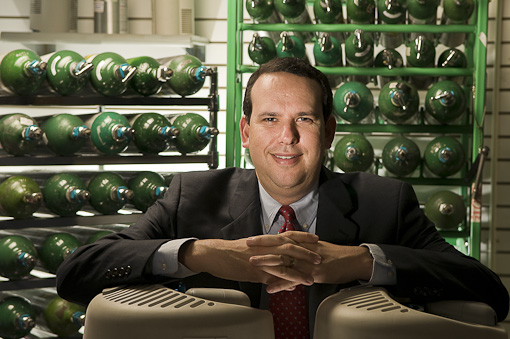
At that point I thought the front of the oxygen generators were to dark, so I added light number four, pointed straight down from six inches above the gray concrete floor. Turned to very low power, it added just enough fill light at a cool upward angle to complete the shot.
With a warehouse worker sitting in, I adjusted the lights with flash meter and camera histogram, and about two hours after arriving I was photographing Rob for his first magazine cover.
I love it when I successfully create an environmental portrait that my client is happy with and was a challenge of logistics, aesthetics and photographic lighting. It’s fun, and to me, even a bit cool. But glamorous, sorry kids, I would have to say no.
Here's a link to more Miami corporate photography.
Thursday, December 31, 2009
Open Mind Discovers Florida Keys Photos
This month I spent a windy, overcast and for us Floridians a chilly week in the Florida Keys enjoying the out of doors and taking a break from pushing pixels around on a computer screen.
No long philosophical essay here on the renewal of creative juices for those in the visual communications business. Nor will I evoke Henry David Thoreau’s Walden Pond to describe the spiritual benefits derived from being out-of-doors.
Just a short note to say I love the outdoors and being alone for a few days with nothing I have to do, and lots of optional creative outlets - photography and sound recording - available should I be moved to leave my campsite reading chair or find ocean kayaking in 30 mile per hour wind no longer relaxing.
You may click on any of these photos to enlarge them.

Without the pressure of having to produce a photograph to a client’s specifications I wandered about Bahia Honda State Park - one of the most beautiful state parks in the country and which has a beach once voted the best in America - struggling to abandon any previous techniques that would box me in to capturing the same old same old photo.
I arrived late in the afternoon and set up my tent in the wind and rain, and it was after “sunset” that I was walking along Sand Spur Beach on a very gray day when I noticed lightening bolts opening up the inside of storm clouds off shore in the Atlantic Ocean. “Thats cool”, I thought, all lit up from inside.
I threw my camera on a tripod, guessed a 30 second time exposure at F 11 might blur the water and if I was lucky I might catch a lightening flash. I was lucky, on the first frame only and created a photo I had not anticipated.

During the day I was looking for a way to make the drab, flat, overcast light interesting and was poking around the dry, sandy scrub land that makes up the interior of the island. I noticed some new bright green Sea Grape leaves, about five inches across, and wondered what they would look like if I lit them with just a light from behind. I placed a flash underneath, blew the light through a white diffusion cloth, and exposed to see the veins and detail thingies inside the leaf. Sorry I’m not a botanist, but I loved finding a new way to discover the complexities of a leaf.

The next evening there was a five minute window at sunset as the sun sliced under the heavy cloud cover and skimmed from the West right along Sand Spur Beach, highlighting the wave ripples as they quietly created patterns that changed several times a second. Here a telephoto lens and fast shutter speed gave me a new insight.
Here's a link to more editorial photography from Florida.
Monday, December 14, 2009
Still Photos Tell Time With Time-Lapse Photography

With some basic experiments in time-lapse photography I’ve been tackling one of the conundrums of multimedia audio slide shows, how do you depict the passage of time with still photographs that do not move.
You may click on photo to see larger.
Below is a 12 second Quick Time movie depicting stars rotating around Polaris - the North Star - in Everglades National Park earlier this year. Or click here for a full size version. A photograph was made every four minutes over 72 minutes, from 12:38 Am to 1: 50 AM, and when assembled to play over 12 seconds, the rotation is really cool.
Slide shows posted to the web have to grab the viewer’s attention and keep it or they will click onto something more interesting, like kittens clapping their paws in time to music on You Tube. Keeping the story’s pace moving and varied is important and can be done in several ways;
- limit the time each still photo is on screen to under six seconds or so
- vary the screen time from image to image
- utilize close up detail photos to balance wide scene setters
- make sequences of the same portrait setup varying subject size & placement in frame
- pan across a photo with a “Ken Burns” effect
- and lastly, utilize time-lapse sequences of still photographs
In the above 22 second Quick Time movie shot on South Beach this Fall at sunrise, 55 photos were captured at five second intervals over just five minutes. A full size version can be seen here. By the way, all three movies attached here are accompanied with natural sound recorded on scene.
Cinematographers have been using time-lapse photography since the early days of movies by capturing each frame of film at a rate much slower than will be played back. A regular feature film is shot at 24 frames a second, and when projected at the same frame rate the motion seems normal to us. Filmed at a much slower rate but played back at 24 fps, the action is sped up. (If shot at a faster frame rate, but played back at 24 fps, we perceive slow motion. ) We’ve all seen time-lapse sequences of flowers blooming, where one frame is shot every hour or so and petals slowly unfold, or a glacier receding from year to year, with one frame per day captured.
Changes across time too subtle for the human eye to detect, such as stars moving in the sky or the sun rising, are slowed down for our study and enjoyment by a slower replay frame rate
From the 47th floor penthouse looking South in August down Miami Beach’s Collins Avenue, the Atlantic Ocean on the left and downtown Miami at upper right, shots were made every 30 seconds or so over 37 minutes for this 21 second Quick Time movie. Full size version available here. I enjoy seeing the clouds slide by, a boat zip up the intra-coastal and post sunset glow settle onto the city.
This sequence with fewer frames included opened the multimedia show I wrote about here.
Time-lapse photography is adding a fun dimension to my multimedia projects by allowing me to show the passage of time. And I'm combining the outdoor and skyline photography I love with my photojournalism and environmental portraiture.
Here's a link to more Miami multimedia photography.
Wednesday, December 9, 2009
Audio Recording Leads To Pelican Rescue
Sunday I decided a peaceful kayak paddle on Biscayne Bay was a terrific way to enjoy the mild Florida weather and a great opportunity to record quiet ambient sounds, so I grabbed my sound recording gear and Nikon digital point n’ shoot camera and launched just five minutes away from my home. As I left I had no idea I was going to rescue a pelican from certain death nor be cursing the noisy skies above.
 You may click on any photo to view larger.
Enjoying the sensation of floating freedom the first few paddle strokes, when my body realized I was not rushing through a metropolis of 2.2 million people, I threaded between a half dozen low mangrove covered islands. In this part of Biscayne Bay, which runs North 35 miles from the Florida Keys and is sandwiched between the Miami Beach barrier island and mainland Miami, I felt as if I was in the wild, yet I was surrounded by urban skyline all around. Sunday I could understood artist Christo’s fascination with these islands which in 1983 he wrapped in miles of hot pink plastic for his Surrounded Islands art project.
One island is a popular rookery for water birds, allowing osprey, brown pelicans, white ibis, cormorants and even magnificent frigatebirds , which have impressive air filled red pouches and long forked tails, an isolated haven for safe nesting sites. Floating off at a reasonable distance as not to disturb them, I powered up my recorder and shotgun mic to record their raucous clamoring.

I’m not a birder, but I could distinguish the throaty clack-clack-clak of the cormorants and the angry screeching of a great blue heron. And with headphones it sounded like I was deep into a far off wilderness. Well, for about 60 seconds ... off in the distance I heard an airplane, a jet coming closer and louder, finally a roar in my ears. I waited for it to go away, and started recording again. Less than a minute later, another jet.
I quickly realized Miami International Airport was sending flights almost exactly every minute off over Biscayne Bay, and on top of me and the rookery, as the wind was coming inland from the Atlantic Ocean. And soon I picked up the mile off go fast boats, roaring up and down the Intracoastal Waterway , and then a propeller plane pulling a sign that read “I luv u Amy, will you marry me? Omar.”
What the heck, I decided to incorporate the jets into a sound clip, plus some peaceful wind blowing through island palm trees and water lapping on shore, recorded in the 30 seconds of relative silence between jets. It's 1:30 long.
By the time I left the rookery, the wind was blowing with light chop and rain squalls were passing over the bay. I headed for a more southern island, and hugging the shore, I turned a bend and was startled by a pelican less than a paddle length away. He was sitting just above the water on a mangrove branch. I said “hello”, and moved off not wanting to disturb it. But about 100 yards down the island, it struck me that something did not seem right. Pelicans always fly away from large orange kayaks.
I turned around and paddled back, approaching the pelican again and looking closely I could see it was thoroughly tied down with fishing line. I could even see a lead sinker half an inch across. Carelessly discarded fishing tackle is a major threat to pelicans in Florida, as they can swallow baited hooks or be caught during a cast. In May I photographed Wendy Fox, the Executive Director of the Pelican Harbor Seabird Station for The Chronicle of Philanthropy, and I had seen dozens of injured and recuperating pelicans at their facility just a couple of miles up the bay from this poor fellow.
I knew from watching Wendy teach an intern how to handle pelicans that I did not have the special skills to catch a wild bird with a 10 foot wing span, and I certainly had no veterinary expertise. But this spot was in water about two feet deep so little small boat traffic passed by, and I had to do something. No telling how long it had been trapped, it could be starving to death for all I knew. I paddled over to the mangrove in the choppy water, and the pelican flapped and spun around on it’s fishing line tether.
I cursed not carrying a knife with me, but I was wearing paddling gloves, so I figured I could at least break the line. With the bird squawking and throwing it’s beak about, I noticed a brass clip holing an 18 inch leader to a large hook caught deep into the center of his back. Bad luck for the bird, good luck for me as it was an easy fix, and the moment the bird felt the tension release, it flapped off into the water under thick mangroves.
I really didn’t want to capture the bird and paddle it to the Seabird Station, but I had to make sure it wasn’t half dead. I beached the kayak, crawled under the mangroves, shooing the bird into open water, where it flew off. I was relieved to see it seemed vigorous, and hopefully the hook could remain in it’s back without harming him for the rest of his life.
I gladly joined the large club of Florida boaters who have rescued sea birds, and paddled off looking for more sounds to record, wondering if Amy took Omar up on his proposal.
Here's a link to more Miami multimedia photography.
Monday, November 23, 2009
Photographing Details and Grasshopper Buzz
Earlier this month I had fun searching for detail photographs, those very selective views extracted with a telephoto lens, while visiting Chengdu in China’s Sichuan province, a bustling and visually chaotic city of 11 million. From past experience I knew that discovering details often reveals small insightful stories about the country I'm traveling in, which I feel is one of the best rewards of travel.
While walking through the park-like Kuanzhai Xiangzi shopping area in the central Chengdu, I heard the melodic sounds of metal tuning forks. Men and women dressed in medical style white coats were sounding them to solicit business from shoppers and tea house customers.
 They were the city’s unique ear-cleaners, who carried pockets full of what looked like miniature chimney sweep tools, long wooden and wire handles with knives, scoops and brushes on the end, some tipped with tiny delicate feathers.
I didn’t really want my ears cleaned, especially not in full view of the public, but there was no shortage of others getting comfortable in chairs under shade trees, closing their eyes and slowing displaying the most relaxed expressions on their faces.
I was told the procedure is less a hygienic exercise and more a massage-like experience, with the tools and feathers stimulating acupuncture points within the ear. When the vibrating tuning fork is placed against a brush, the gentle sound deep within the ear has been described as the soft relaxing buzz of a grasshopper.
 I encountered another visual detail while visiting the Wenshu Buddhist Temple where visitors were touching, patting and caressing two large brass lions guarding the main hall’s entrance. These mythical male and female lions symbolize defense and protection and guard many building and gateway entrances throughout China.
I knew touching the lions is thought to bring good luck, but these worshipers were also touching the corresponding spot on themselves. A pat on the lion’s worn head, a pat on their head. A brush down the lion’s back, a touch to their own.
A visitor explained to me that it is believed their own physical ailments at those locations would be healed or at least improved with the tactile help of these lions.
 Just outside the Wenshu Temple were incense and candle shops and rows of outdoor souvenir stands lining the busy commercial street, a perfect example of the new China. One tiny detail caught my eye, a rack of plastic medallions with bright red braided cord. In the USA they could pass for either Christmas ornaments or decorations to hang from your car’s rear view mirror.
I loved the juxtaposition - and irony - of Mao Zedong’s familiar and reassuring portrait being sold next to Buddhist religious icons. China certainly has come a long way since the chaotic Cultural Revolution of the 1960s where no religion or independent thought was tolerated, nor were entrepreneurs allowed to flourish selling anything.
Such a small detail I might have overlooked in the past
When earlier in my career I was shooting news for daily newspapers and later United Press International, I was always looking for that one moment in time that would tell the reader the journalistic touch points of who, what, where and why. Often the best way to do that was with an all encompassing wide angle lens, placing the action in the foreground while maintaining the context of the surroundings. The optics of a wide angle emphasizes what is closest to it, yet it can fit in a lot of real estate left to right, especially if your in tight quarters. A photographer can also create a wonderful three dimensional feeling with a wide angle with graphic lines leading your eye within the image.
I still have that news photographer point of view, a wide angle is my “normal” lens, 24 mm or so, rather than what text books describe as the preferred angle of view, a 50 mm..
But as my client base and photographic interests have broadened, so has my need to capture detail views to be published in print complementing the scene setter, or utilized in multimedia shows depicting movement and time.
And I’m learning more about the world around me ... maybe when I next visit Chengdu I’ll understand the wisdom of having my ears cleaned.
Here's a link to more editorial photography from Sichuan.
While walking through the park-like Kuanzhai Xiangzi shopping area in the central Chengdu, I heard the melodic sounds of metal tuning forks. Men and women dressed in medical style white coats were sounding them to solicit business from shoppers and tea house customers.

I didn’t really want my ears cleaned, especially not in full view of the public, but there was no shortage of others getting comfortable in chairs under shade trees, closing their eyes and slowing displaying the most relaxed expressions on their faces.
I was told the procedure is less a hygienic exercise and more a massage-like experience, with the tools and feathers stimulating acupuncture points within the ear. When the vibrating tuning fork is placed against a brush, the gentle sound deep within the ear has been described as the soft relaxing buzz of a grasshopper.

I knew touching the lions is thought to bring good luck, but these worshipers were also touching the corresponding spot on themselves. A pat on the lion’s worn head, a pat on their head. A brush down the lion’s back, a touch to their own.
A visitor explained to me that it is believed their own physical ailments at those locations would be healed or at least improved with the tactile help of these lions.

I loved the juxtaposition - and irony - of Mao Zedong’s familiar and reassuring portrait being sold next to Buddhist religious icons. China certainly has come a long way since the chaotic Cultural Revolution of the 1960s where no religion or independent thought was tolerated, nor were entrepreneurs allowed to flourish selling anything.
Such a small detail I might have overlooked in the past
When earlier in my career I was shooting news for daily newspapers and later United Press International, I was always looking for that one moment in time that would tell the reader the journalistic touch points of who, what, where and why. Often the best way to do that was with an all encompassing wide angle lens, placing the action in the foreground while maintaining the context of the surroundings. The optics of a wide angle emphasizes what is closest to it, yet it can fit in a lot of real estate left to right, especially if your in tight quarters. A photographer can also create a wonderful three dimensional feeling with a wide angle with graphic lines leading your eye within the image.
I still have that news photographer point of view, a wide angle is my “normal” lens, 24 mm or so, rather than what text books describe as the preferred angle of view, a 50 mm..
But as my client base and photographic interests have broadened, so has my need to capture detail views to be published in print complementing the scene setter, or utilized in multimedia shows depicting movement and time.
And I’m learning more about the world around me ... maybe when I next visit Chengdu I’ll understand the wisdom of having my ears cleaned.
Here's a link to more editorial photography from Sichuan.
Friday, November 13, 2009
Personalizing A Small Business With Multimedia
When Jana Armstrong came to me in September she had a definite goal for her title insurance company, Miami based Continental Title Services; grow her business and thrive in spite of our current world wide economic slump that has hammered the real estate industry.
She had thought through and articulately put on paper what her small business was all about and why her services were unique, and had distilled the information onto her redesigned web site.
She challenged me to help her differentiate her company's site from the crowd of title insurance company sites competing for attention in South Florida.

I suggested that a multimedia slide show - combining still photographs with recorded interviews - would present her as a real person, warm and approachable, professional and knowledgeable. By utilizing journalistic interview techniques and photographic styles we would place a unique voice and face to all the written material.
We all know from when we were kids with noses buried in the National Geographic that everybody looks at the photos first, then maybe, reads the story. And with the YouTube generation well reasoned sales copy may be skipped over, but two minutes of multimedia may just make the connection.
Here is the finished show, live this week, and link to a larger version.
To create the multimedia slide show we first discussed what handful of key points she wanted to make in a brief 2 minutes 46 seconds, and I interviewed her from a list of questions prepared from those points.
Next was recording ambient sound of their document scanner, keyboards and conversations, and then street traffic and the ocean, to lay a bed of colorful sound under her voice.
I created environmental portraits of her overlooking the financial district’s Brickell Avenue and on Biscayne Bay to place her in the midst of Miami, the vibrant crossroads city.

I shot journalistic photos of her conducting a closing with clients, and then detail shots of hands, papers and CDs to vary the show’s timing and pace.
Capturing a time lapse sequence of Miami Beach skyline from daylight to after dark, and photographing a condominium project described in the interview, added additional visual layers to the narrative, emphasizing her stature in her market area.
And lastly, screen shots grabbed from her web site would mark specific points touched in the audio story.
I loved working with Jana on this project, she being an equal partner in planning the interview, sketching out the story board and shaping the program's pace and tone. And I was able to combine my photographic favorites of environmental portraiture and city skylines with the newfound magic of audio.
Ah, then the really hard part began, post production, editing and mixing the audio, selecting and processing the digital photos, placing the ingredients into more software to set and adjust the time line. For every day in the field, several more are required on the computer to complete a multimedia project.
The results, I feel, humanize the rows of type on a screen in telling Jana Armstrong’s story to the world.
Here's a link to more Miami multimedia photography.
Friday, November 6, 2009
Listening For Photographs and Looking For Sounds
I’ve just returned from more than two weeks traveling in the ethnic Tibetan regions of
Western Sichuan province, the mountainous areas abutting the Tibetan Autonomous Region, as the People’s Republic of China describes what we call the country of Tibet.
This fifth trip to China was my first where I started listening for photographs, and looking for sounds.
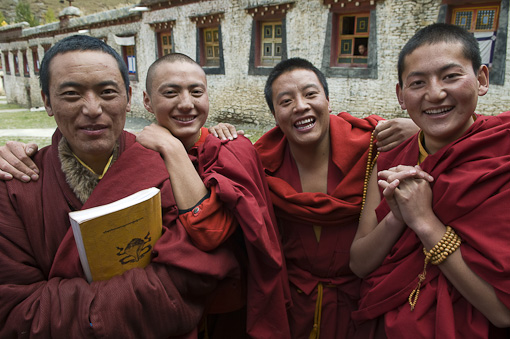
When we first drove up a steep hill to the Huiyuan Temple in Bamei, looking down onto a temple carved from the earth, dozens of spinning prayer wheels and hundreds of Tibetan Buddhist pilgrims marching clockwise, I was overwhelmed and unable to pick up a camera. Just too many sensations to absorb at once. Heck, there were even dozens of young monks swarming all over painting the decorative roof.

I put on my headphones, turned on my tape recorder, attached a microphone and started listening. I heard the shuffling feet, and spin of the wheels. I followed a tinkling bell to the far side, recorded the low chants, creak of the prayer wheel. I noticed the steady thump of walking sticks. I started to see photographs and got to work.
Play the 30 second clip under the photo and experience how the ambient sounds inform the photograph, and how the photo amplifies on the recordings.
After dedicating my entire photographic career to photojournalism and commercial photography by capturing a single image distilling an entire story into a single frame, Henri Cartier-Breasson’s famous “Decisive Moment”, I’ve begun working in multimedia production. I’ve become fascinated with the expanded dimensions of story telling that capturing on scene ambient sounds and interviews with photo subjects add to my still photographs.
Ultimately I will combine the sounds and still photos from Sichuan into a multimedia slide show that will tell a story over time, linear story telling, but that will be a topic of a future post.
 At a Tibetan cultural dance festival in Danba I loved photographing these men wearing hats made from wild cat skins ( and hoping they were not endangered species ), yet when I recorded their call and answer singing with their female partners, and their skin boots stomping, the entire experience came alive.
Back in Chengdu, a very laid back and friendly city of 10 million, I was walking through the quiet gardens attached to the Wenshu Temple, one of the largest Buddhist temples in China. It was overcast, air yellow with pollution. Bad light, my photographer side said. While listening to the monks chanting during their mid-day meal, I heard a bird at a distance, and followed the sound. Then more birds, playing off each other, rising and flowing through the trees. I did not recognize them as wild, they were so melodic.

Under the low hanging bamboo trees were six song birds in cages, enjoying the “fresh air”, with their six elderly male owners sitting on stools and animatedly discussing the affairs of the day and the relative skills of their birds. Another combination of photographs with sound.
It all started last summer. For years I’ve spent a lot of time capturing landscapes and photographing the wildlife in Everglades National Park, using the subtleties of sunrise light or catching the glint in an alligator’s eye to tell my stories. Of course I was aware of the sounds around me, buzz of the insects and calls of the birds. But they were just part of the enjoyment of being out doors, not being in an office cubicle to make a living. But this summer when I ventured into the same familiar wetlands with a tape recorder and shotgun mic, suddenly my visual world really came alive with the sounds that surrounded me. A thunder storm, rain drops and running water said “Everglades” in a way none of my photos ever had.
Be warned, it's three minutes long.
I was unable to post to this blog while in China, as the government has blocked practically all access to social media from within the country, including Blogger, Face Book and Twitter. An internet search from within China yielded complicated articles on how to use proxy servers to read and post to overseas blogs, but I decided that was way too complicated while I was working up to 14 hour days and sleeping poorly at 10, 000 feet.
Heck, the PRC has even blocked access to the iTunes store, making it impossible to catch up on the National Public Radio shows such as “Car Talk” that I missed!
Here's a link to more editorial photography from Sichuan China.
Western Sichuan province, the mountainous areas abutting the Tibetan Autonomous Region, as the People’s Republic of China describes what we call the country of Tibet.
This fifth trip to China was my first where I started listening for photographs, and looking for sounds.
When we first drove up a steep hill to the Huiyuan Temple in Bamei, looking down onto a temple carved from the earth, dozens of spinning prayer wheels and hundreds of Tibetan Buddhist pilgrims marching clockwise, I was overwhelmed and unable to pick up a camera. Just too many sensations to absorb at once. Heck, there were even dozens of young monks swarming all over painting the decorative roof.

I put on my headphones, turned on my tape recorder, attached a microphone and started listening. I heard the shuffling feet, and spin of the wheels. I followed a tinkling bell to the far side, recorded the low chants, creak of the prayer wheel. I noticed the steady thump of walking sticks. I started to see photographs and got to work.
Play the 30 second clip under the photo and experience how the ambient sounds inform the photograph, and how the photo amplifies on the recordings.
After dedicating my entire photographic career to photojournalism and commercial photography by capturing a single image distilling an entire story into a single frame, Henri Cartier-Breasson’s famous “Decisive Moment”, I’ve begun working in multimedia production. I’ve become fascinated with the expanded dimensions of story telling that capturing on scene ambient sounds and interviews with photo subjects add to my still photographs.
Ultimately I will combine the sounds and still photos from Sichuan into a multimedia slide show that will tell a story over time, linear story telling, but that will be a topic of a future post.

Back in Chengdu, a very laid back and friendly city of 10 million, I was walking through the quiet gardens attached to the Wenshu Temple, one of the largest Buddhist temples in China. It was overcast, air yellow with pollution. Bad light, my photographer side said. While listening to the monks chanting during their mid-day meal, I heard a bird at a distance, and followed the sound. Then more birds, playing off each other, rising and flowing through the trees. I did not recognize them as wild, they were so melodic.

Under the low hanging bamboo trees were six song birds in cages, enjoying the “fresh air”, with their six elderly male owners sitting on stools and animatedly discussing the affairs of the day and the relative skills of their birds. Another combination of photographs with sound.
It all started last summer. For years I’ve spent a lot of time capturing landscapes and photographing the wildlife in Everglades National Park, using the subtleties of sunrise light or catching the glint in an alligator’s eye to tell my stories. Of course I was aware of the sounds around me, buzz of the insects and calls of the birds. But they were just part of the enjoyment of being out doors, not being in an office cubicle to make a living. But this summer when I ventured into the same familiar wetlands with a tape recorder and shotgun mic, suddenly my visual world really came alive with the sounds that surrounded me. A thunder storm, rain drops and running water said “Everglades” in a way none of my photos ever had.
Be warned, it's three minutes long.
I was unable to post to this blog while in China, as the government has blocked practically all access to social media from within the country, including Blogger, Face Book and Twitter. An internet search from within China yielded complicated articles on how to use proxy servers to read and post to overseas blogs, but I decided that was way too complicated while I was working up to 14 hour days and sleeping poorly at 10, 000 feet.
Heck, the PRC has even blocked access to the iTunes store, making it impossible to catch up on the National Public Radio shows such as “Car Talk” that I missed!
Here's a link to more editorial photography from Sichuan China.
Friday, October 9, 2009
Lessons From Chinese Breezes
I have two sides to my working personality, and I think most people do too. One side rational, the other side emotional. Organized and disorganized. Hard working and lazy.
Two photographs that I've taken in China illustrate my different sides and have taught me two lessons about capturing great photos while traveling. First, work really hard, do your homework and be persistent. Secondly, don't worry about outside forces and be flexible.

Shanghai is an amazing city to say the least, a perfect example of China's new "Capitalism with Chinese Characteristics", and nothing exemplifies that better than along The Bund, the promenade above the western bank of the Huangpu River facing the towering skyscrapers of the Pudong District.
The Bund is within the former Shanghai International Settlement and is fronted with colonial era buildings that before 1948 housed Western Banks, trading offices and foreign consulates, embracing centuries of Chinese history. Today, thousands every morning keep Chinese traditions alive by performing tai chi, exercising and strolling. The skyscrapers, some the tallest in the world, across the river represent the booming economy of China.
Planning before my trip dictated the obvious photo opportunity, and I returned to The Bund early every morning for four days running. I noticed older men flying elaborate kites each day, their dancing toys way to high to make a picture. Finally, on the last day, just as the sun was rising, I made the image I felt captured both the traditional and booming China.

On the same trip, my friend Nancy Brown and I were invited by the Huaguang Photography Art College in Fujian Province to share our photography and be liaisons with the Art Institute of Ft. Lauderdale.
The college is located in the city of Quanzhou, a city of over seven million, and is not exactly a hot tourism destination. The one place we found in a guide book with picture potential was a puppet making industry, so we asked our hosts to set up a visit. They promised for four days that it would be no problem.
On our last day, we were told we were finally off to the puppets, but first a few stops that the city fathers and school officials, who were financing our trip within China, wanted to show off. First, the electrical cord factory. Second, a rusty ship yard. Third, a mosque that consisted of mounds of rubble. Then, a decorative paper cutting workshop. Don't worry, the reassured us, the puppets are awaiting.
Then, off to see a monument. At that point Nancy and I protested and complained, as politely as we could that we were tired of the dog and pony show. No, the monument we must see !
When we approach the monument, reportedly the largest in China, of Zheng Chenggong, a 17th century Chinese national hero, we were amazed by the scene. And this complainer caught the perfect moment of a woman flying a tiny kite under the giant horseman.
As for the puppets, the factory was closed when we finally arrived, but by then it didn't matter as I had already let go of my agenda and captured the unplanned.
Here's a link to see more editorial photography from China.
Subscribe to:
Posts (Atom)