Wednesday, October 23, 2013

Billions Of Chinese Phones Love Big Nose

On my September trip to China it seemed to me a large percentage of the country's 1.2 billion people were talking on their mobile phones, sending texts or surfing the internet. I saw the phones in the hands of parents commuting through traffic with children hanging off their electric scooters. In the country side I noted farmers chatting. While zooming at 200 Km per hour on a high speed train, fingers flew playing internet games. 
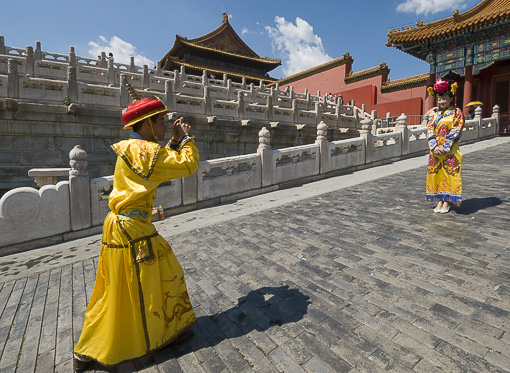

While wearing rented 17th century costumes boyfriend snaps mobile phone photos of girlfriend in Beijing's Forbidden City last month.

And the Chinese were snapping photos with their phones of everybody and everything. In the park with grandma and grandpa, tourists dressed in Qin dynasty costumes, pictures of photographs hanging at photography festivals. Even pictures of photographers standing in front of their photographs at photography festivals.

A recent report claimed that among the 1,200,000 citizens of China, there were 1,104,000 mobile phone users. Gee that seems high, even noting that maybe people have multiple handsets or SIM cards. But come to think about it, though, as a Westerner I must of had a cel phone camera pointed at me nearly a billion times.
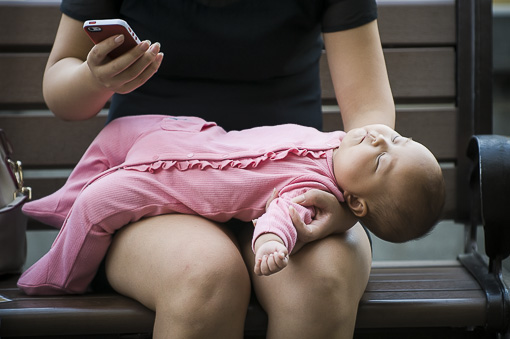

While baby sleeps mother stays connected with smart phone while visiting the Longman Caves in Luoyang, Henan Province, China.

Every day, often multiple times an hour, while walking down the street I would catch several faces smiling at me, with one of their party trotting up to me for a photo. Smile, "ha ha ha ha" and thank you in English and Chinese. Then the shooter and the subject would change places, others would see the activity, waiting their turn to be photographed with the "Dabizi".

I learned to pronounce it "Dah - be - zerrr", "big nose" or "long nose", the Chinese description for foreigners. I figured that described me pretty well, so I embraced the term.
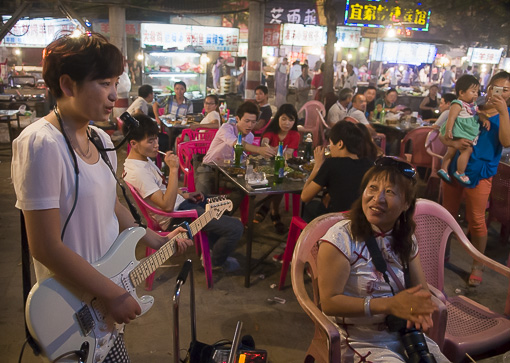

In September street performer sings for tips at night market while baby-toting mom (right) photographs the Big Nose, Kaifang, Henan Province, China.

 One afternoon I was completely pooped from walking in an amusement park for hours in the heat and humidity, so I bought a cold bottle of juice and was leaning on a tree while the multitude surged around me. I felt a gentle nudge on my back, and turning, discovered a teen age girl sneaking close to have her picture taken with the visiting Big Nose. She was to shy to talk to me, so I turned around and gave her camera phone toting boyfriend a big grin.
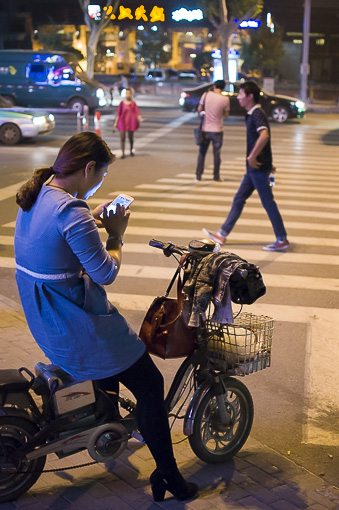

Last month young woman commuting home on electric scooter pauses to text, Anyan, Henan Province, China.

OK the headline at top is a bit of hyperbole, a billion Chinese weren't really shooting my picture, nor a million, and I doubt if no more than a bunch of dozen zoomed in on me. But I had fun meeting so many Chinese who were friendly and genuinely curious about a Big Nose.

Wednesday, July 31, 2013

Surprising Guided Conversation With Foster Child

Every interview is a guided conversation, but in spite of where I think I may be headed with my reporting, my subjects always lead me down paths unanticipated, and frequently they surprise me with their insight.


Foster teen Isaac and his adult mentor Barbara K. have developed a lifelong bond through weekly Saturday visits. iPhone & iPad link. Video by Paul Morris.

My journey down one of those paths began when I answered the phone back in March. Barbara Schechter, Executive Director of the Heart Gallery of Broward County (FL) was on the line wondering if I had any ideas on how to recruit mentors for her children living in foster care. Besides organizing a traveling photography exhibit of children waiting to be permanently adopted, the Heart Gallery provides innovative programs that enrich the county’s foster children.

I suggested we produce a multimedia piece featuring one adult mentor who has developed a successful relationship with a Heart Gallery child so we could tell the story through their eyes and in their own words. I’ve found viewers easily relate to the combination of photojournalism and audio story telling, what I call Public Radio With Pictures.

 Isaac, 13, leaps into mentor Barbara K.'s swimming pool during weekly Saturday visit. Still photographs by Tom Salyer

While Barbara set to work finding the subjects, I began researching mentoring on social service agency web sites and building a list of keywords that would help us filter our story telling decisions. What activities should we photograph, at what locations and the questions we should ask? Why are we making this film?

My keyword list included: guidance, friendship, relationship, trust, sharing, teacher, listen, adult, growth, role model, permanence, family problems, self confidence, support, patience, time, heart, consistency, commitment, approval, the future. Shortening the list to four or five, I was able to state the purpose of the film in one sentence:

Mentors provide children living in foster care with positive adult relationships that encourage trust, self-confidence and friendship.

During a brief telephone pre-interview with our adult mentor, Barbara K. described how for two years she has called 13-year-old Isaac every Friday afternoon to talk about their Saturday plans. Keyword consistency. How they went swimming and made cookies. Keyword friendship. Washing the car, doing homework and attending a baseball game would make great locations. While drawing up a list of questions I tried to anticipate the arch of our story, how to open, our subject’s journey and a final resolution.


Mentor Barbara K. lets her dog lick cookie dough as Isaac, who lives in a foster care group home, looks on.

On interview day in April colleague Paul Morris, running the video cameras, and I were joined by Barbara Schechter and new Heart Gallery Executive Director Ken Crooks. First we interviewed Barbara K., who quickly gave us unanticipated answers.

Among the reasons she wanted to be a mentor:

Selfishly, I have two grown children in their 40s, neither one is married, neither one has any children. I wanted some grand children!

Wrapping up her mentoring experience:
  
I hope that what ever happens to Isaac that he’s in my life ... forever... you’re have  friend for life, you really will.

When we asked Issac our written question about what his life was like before foster care, he firmly stated he didn’t want to talk about that. But later he offered this unanticipated journey:

I really love Miss Barbara because she is always there for me... like when I do bad stuff, and she tells me the right things to do, like when I ran away...she’s like, Isaac, you should of never (done) that, you could of gotten hurt, and...nobody could of found you, and you could of been dead...

One more guided conversation full of surprises.

This video “Miss Barbara Is Always There For Me” will be posted on the Heart Gallery’s web site, on YouTube and shown live at foster family and adoption training and fund raising events.


 Former Heart Gallery of Broward County Executive Director Barbara Schechter, left, and current Executive Director Ken Crooks supervise car washing scene during filming of "Miss Barbara Is Always There For Me."

Technical Notes:

Paul Morris recorded the video with Canon 5D Mark II and Mark III cameras and lenses. During my still photography, I recorded the ambient sound and conversations with concealed Tram TR50 lavalier microphones and Sennheiser G3 wireless units, and the interview with a boomed Sennheiser MKH 8050 hyper cardioid. I edited stills in Adobe Light Room and Photo Shop, and assembled the video in Adobe Premier Pro and Audition CS 6.

Friday, May 31, 2013

Sounds Overheard: Florida Bay Deserted Island

 One of the tiny Oyster Keys floats in Florida Bay earlier this month a short paddle from Everglades National Park's Flamingo Visitor Center. 


I was paddling my kayak on the mirror smooth waters of Florida Bay when two tiny dots off on the horizon caught my eye. Out there where the blue sky meets the even bluer water I had no idea how many miles into the distance I could see. But it was far enough for my mind to imagine the curving of the earth causing some distant islands to slip below the waterline just far enough for me to barely detect the tippy tops of the three-story tall mangrove trees.

I knew I was just an hour of paddling from the mainland, about four miles out, but with my back to the shore and my face into the sun facing South West, I pretended I was lost in a vast wilderness and needed to reach those distant fuzzy dots in order to survive. 

At low tide the the mangroves revealed a tiny opening on the lee side just big enough for me to beach my kayak on dry land, climb out and begin soaking in the amazing sounds emanating from this island about the size of a city home lot. A chatty king fisher scolded me and great blue heron squawked, seemingly to complain about my presence. But a cricket hidden under a rotten log didn't seem to mind, nor the thousands of bees seeking nectar from the mangrove flowers high up in the forest canopy. I popped on my headphones and set up my recorder and began to preserving the sound of my wilderness island.

iPhone & iPad friendly link to audio recording.

During my assignments and travels I've been recording the sounds I overhear, and many don't have supporting photographs or stories. This occasional series will be my excuse to share my audio orphans, these Sounds Overheard

Tuesday, April 30, 2013

Best (Kayak) Camera Is The One That's With You


Fish Eating Creek overflows live oak and palm tree forest last October near Lake Okeechobee. Shot with Canon PowerShot S100 point 'n shoot digicam.

Today I'm attempting to connect the dots between a weekend conversation, a trending style of internet photography and, lastly, staying creative while paddling a kayak. Let me know If I've succeeded ...

Sunday I had my photojournalist hat on while on assignment at the Miami’s Marlins Stadium, shooting two foster children and their adult mentor for an upcoming multimedia program. I had my two Nikon D300 DSLRs with three zoom lenses while I worked in and around the fans seated near my subjects, when a young woman asked what I was doing. I explained the story, and she said “wow those are pretty nice cameras, you must be getting great photos”.

Most professional photographers have heard such remarks many times, and I admit, even my 2008 era digital cameras, now a generation out of date, do allow me to make images in difficult situations. In the stadium, I needed wide angle to telephoto focal lengths, a fast motor drive and good low light capabilities.


Rainbow at sunset this January while paddling in Atlantic Ocean off Bahia Honda Key. Shot with Canon S100.

But it’s not the camera that makes the photograph, I thought to myself, it’s your story telling eye, your vision of the world and your people skills that capture the images.

In a rush, I not very eloquently told her that such cameras "help, but you still need a brain!”

Just because I go out and buy a set of law books doesn’t make me a lawyer, nor having the cash to buy a Ferrari won’t make me a race car driver. Heck, even buying the latest and most expensive Nikon won’t make me a better photographer. (Note to Santa, a Nikon D4 and a D800 would be sweet!)


While paddling the back country in Everglades National Park's 10,000 Islands area, I photographed wave details with Nikon P6000.

Several years ago photographer Chase Jarvis’ The Best Camera Is The One That’s With You became a sensation,  in which he urged everybody to just use that camera phone in you pocket. Shoot what you see and experience every day. It’s your creativity that matters, not fancy equipment nor exotic locals. Keep it simple, and practice practice practice.

Sorry this post is not another iPhoneography convert having fun with cool camera apps. I’ve used my iPhone camera a little, but somehow that internet phenomenon of post processing camera phone photos with colors, effects and borders hasn’t clicked for me. I’ll leave that to others, including friend Steven Boxall’s I Shoot You Long Time blog.


Clouds are icing atop Miami city skyline during paddle around Elliot Key in Biscayne Bay. Nikon P6000.

But my creativity and insatiable curiosity about nature and the outdoors gets going the moment I sit in my kayak, launch onto open water, and I pull out my digital point ’n shoot camera to document what I experience and discover. I used to paddle with my DSLRs and long lenses, but once I began to  record audio from my kayak, I was carrying to much gear to have any fun. My current Canon PowerShot S100 is about the same heft and volume as my iPhone yet packs a lot of capability. 

It goes without saying that only having my point 'n shoot with me in my kayak makes that camera the best at hand. And as long as I “... still need a brain”, I'll make out just fine.


Dry season on Nine Mile Pond in Everglades National Park forces me to share shallow water with several alligators. Note, as your review mirror warns, wide angle lens makes six-foot gator seem further away than reality. Nikon P6000.

Friday, March 8, 2013

Single Woman Adopts Brothers With Rare Syndrome

I've had a lot of fun photographing portraits of orphan children living in foster care for the Heart Gallery of Broward County (FL), and like the more than two dozen other professional photographer volunteers, have felt the thrill of seeing our subjects find adoptive homes.

Upon viewing the portraits for the first time, prospective parents often report an instant connection to the child. Putting the faces of a real children onto dry case files is why over 100 Heart Galleries in the USA exist.


Brothers Royce and Noah paused for a rare quiet moment in the group home bed room they shared when I photographed them in 2009. Now ages 18 and 14, they've been adopted out of foster care. Born with 5 p minus, they are developmentally at 4 and 5 year-old levels.

This week I realized the handful of hours we photographers contribute are really nothing compared to the commitment and devotion required of  the adoptive parents and their children in creating new families. Heart Gallery Executive Director Barbara Schechter has written this week a newsletter story about a 28-year-old single woman who adopted two teenage brothers who have the same rare genetic disorder two of her siblings were born with. Tabitha found the boys from a photograph after ChildNet, the private agency contracted with the State of Florida to facilitate adoptions, used innovative recruitment techniques to find her.

Young Mom Adopts Brothers With Rare Genetic Syndrome

By Barbara Schechter

Royce and Noah have been in foster care most of their lives. They have been photographed for the Heart Gallery and featured in Forever Family news segments several times over many years. They are gentle, sweet boys, now ages 18 and 14, but their rare medical condition, known as 5 p minus, scares most adoptive families away. People assume that their needs are more than they can handle - times two.

"Too much to handle" never even occurred to Tabitha, a single, 28-year-old woman who adopted the boys last fall. As soon as she saw their photo, she knew that she wanted to adopt them. 5 p minus, also known as Cri du Chat Syndrome, has touched Tabitha's family deeply. She is one of ten children, two of whom were born with this disorder.

5 P Minus occurs in only 50 to 60 births a year. It requires lifelong therapy, but the children are usually friendly and happy. Most can have a normal life  expectancy and lead full lives. Royce and Noah are developmentally at 4 and 5 year-old levels.

The connection between Tabitha and ChildNet was the result of some creative family finding on the part of Jessica Samuels, Wendy’s Wonderful Kid Recruiter at ChildNet. “No one ever called about these boys. I knew I had to try something different”. So she Googled and found the Five P Minus Society, a support organization for families of children with the syndrome. Jessica contacted the Society and they permitted her to submit a short article for their newsletter along with their Heart Gallery photo. The rest is the beginning of an amazing journey…

As soon as Tabitha saw the photo of Royce and Noah in the newsletter, she got on the phone to Jessica. Jessica then sent her a Forever Family video and she knew that they were supposed to be her boys. She came to Fort Lauderdale from out of state three times to get to know them and every time found it difficult to leave. Royce and Noah are much higher-functioning than Tabitha’s siblings, one of whom died right before Tabitha decided to adopt. In fact, their ability to speak and interact has brought her family close to them and created a wonderful support system for this single parent.

The boys lead busy lives that include special needs scouting and Special Olympics (three sports!). Tabitha left her job as a special education teacher to care for the boys. Her training has helped her to anticipate their emotional and social needs. They have adapted beautifully to their new life.

Gia Tutalo-Mote, of Forever Family, sums up our sentiments. “It thrills my heart to know that Royce and Noah have finally found that loving forever family we’ve been searching for. This proves once again that there is a family out there for every waiting child.

Heart Gallery Updates: Celene, the Heart Gallery teen who declared "Adopt Me, I'm Unforgettable" in an audio slide show featured on this blog in 2010, was adopted in 2011. Her friend in the video, Sheaundra, now 18, was just adopted this month, along with her now adult brother, by the same family. Laterence's adoption, featured here last September, should be finalized this month. Teenager Corey, who admitted struggling in foster care after the death of his mother, has turned 18 and "aged out" of the foster system and is out on his own.

Wednesday, February 27, 2013

Sounds Overheard: Parking Lot Wild Life


Once the sun sets nature can often be heard from parking lots of such places as Bahia Honda State Park, in the Florida Keys, photographed in December 2012.

Last month after a long day kayaking in the Florida Keys, I left my camp site close to midnight and drove to the end of the road at Bahia Honda State Park. All the day visitors were long gone, I had the crashing waves on beautiful Sand Spur Beach all to myself, and I stumbled along with my tape recorder by starlight. Just steps from the car I picked up a lone cricket in my head phones, fiddling away underneath the concrete parking bumper, giving me a pretty cool recording right in the parking lot. I realized that I've often captured the sounds of wild life from parking lots, often in very urban settings.


Examples of wild life recorded from parking lots and urban settings: 0:00 frogs in motel parking lot, 0:25 cricket under concrete bumper, 0:46 vultures have kerfuffle, 1:12 mocking bird in city. iPhone & iPad friendly link to 1 min 48 sec MP3. 

I was attending a workshop in Chapel Hill, North Carolina, last year, and after a long evening of slaving over a hot video editing workstation, I returned to my hotel wedged between a busy ring road and a strip mall. A wonderful sound caught my attention, what seemed like a million croaking frogs were jamming in a living room sized water retention pond alongside the parking lot. I just had to make a recording.

In the clip above I also have the sound of turkey vultures flapping and fussing over a bit of road kill in a parking lot in Everglades National Park, and a male mockingbird over stoked on testosterone in the middle of the night alongside my drive way in Miami. Listen for the passing car with boom box.

During my assignments and travels I've been recording the sounds I overhear, and many don't have supporting photographs or stories. This occasional series will be my excuse to share my audio orphans, these Sounds Overheard. Please also visit my Miami commercial photography portfolio.

Saturday, December 29, 2012

Sounds Overheard: Alcatraz Listens To Freedom


After rowing around Alcatraz Island for sport, two athletes return to the freedom of downtown San Francisco.  

The long concrete cell blocks rose three stories high above the prison floor, their steel doors permanently open and silent. Even though hundreds of visitors passed where nearly 1,500 of the country's most dangerous prisoners spent years of their lives, including Al Capone and Robert "The Birdman" Stroud, only a quiet murmur floated about the concrete and steel.


Listen to the sound of footsteps recorded in The Hole contrast with birds, waves and far off bell, sounds of freedom wafting into Alcatraz. iPhone & iPad friendly version.

Last November I was visiting Alcatraz Island, one of the Golden Gate National Parks, a rocky outcrop in San Francisco and a scant 1.5 miles from the downtown skyline. 

Inside the notorious D-block, also known as The Hole, where the worst of the worst were housed for bad behavior, I entered an eight by eight foot all steel cell. My steps thumped from the floor, off the  walls and bounced from the ceiling. I paced back and forth between the to close walls. Was this what a prisoner heard while isolated in near darkness?

Now a National Park, the federal prison on Alcatraz Island housed the USAs toughest convicts, from 1934 through 1963.

Outside the cell house and along a cliff side trail, my attention was drawn to the sound of waves lapping the shoreline, and the sound of birds nesting along the rocky cliffs. The low drone of an unseen airplane passed overhead. I wondered if these sounds of the outside world ever reached the confined convicts ... maybe on a very still day.

As I explored the walled recreation yard where prisoners could see the blue sky and breathe fresh air, work out or play a game of baseball, I could not see San Francisco Bay, but I could hear it as a navigational buoy bell clanged every few seconds.


Wild flowers grow through concrete of the high walled recreation yard, one of the few places prisoners could enjoy the out doors. It is within earshot of crashing waves and a buoy bell along the island's rocky shore.

What was it like for prisoners, confined in the toughest federal prison in the country, to hear these sounds from the outside world, the sounds of freedom drifting into their grim world?

During my assignments and travels I've been recording the sounds I overhear, and many don't have supporting photographs or stories. This occasional series will be my excuse to share my audio orphans, these Sounds Overheard. Please also visit my Miami commercial photography portfolio.

Saturday, November 17, 2012

Photographing Revolver That Killed JFK Assassin

Holding the snub nosed .38 caliber Colt Cobra revolver in my hand, I expected to feel the weight of history slam down hard. This weapon was used to murder the assassin that shot JFK. Gripping it’s handle firmly, resting my finger on the trigger, sighting down it’s short barrel,  the gun didn’t seem all that special. At first I felt nothing exceptional.


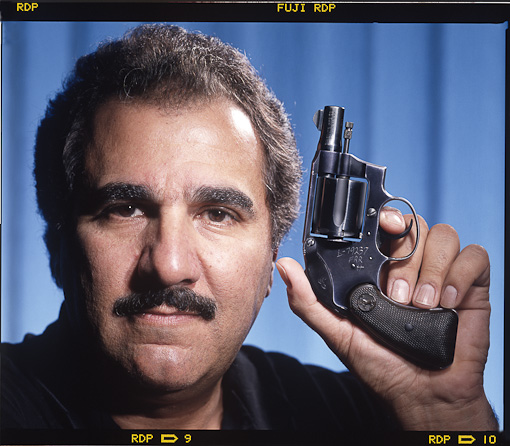
Real estate developer and memorabilia collector Anthony Pugliese holds the snub nosed .38 revolver that Jack Ruby used to kill JFK assassin Lee Harvey Oswald. Photographed in 1993 for Newsweek. Notations scratched onto weapon by Dallas police detective.

It’s flat black finish was worn away on the edges. Crude numbers and letters scratched onto the flat metal near the chamber scared the handgun.

The letters were initials, I began to remember, the initials of the Dallas police detective investigating a shooting. The detective placed his notation on this revolver himself,  days after the nation reeled from the killing of President John F Kennedy. This very weapon I now held was connected to one of the greatest chapters of United States history.

Finally the weight of history caught up with me ... cringing, I set the infamous item down gently onto the conference table.

November 22, 1963, the President is shot while riding in his open top limousine, dying in his wife’s arms. Hours later a suspect is arrested, Lee Harvey Oswald, and booked into the Dallas police headquarters. Two days later, a local night club owner, Jack Ruby, freely walks up to Oswald, pulls this .38 caliber Colt Cobra revolver from his pocket and shoots Oswald in the abdomen, killing him.

Like most Americans alive at the time, I remember where I was when I heard of JFK's death. Seventh grade class, Mountain Home, Idaho, the announcement crackled across the loud speakers. As school closed early, my classmates and I were stunned, not really understanding what the news meant. I remember flickering black and white television images of the Oswald shooting and from JFK's funeral. Holding Jack Ruby's revolver I shivered as it physically connected me to this awful history.


Wearing this hat, holding this revolver loaded with these bullets, Jack Ruby was photographed the split second he shot Lee Harvey Oswald on November 24, 1963. 

History and childhood memories were on my mind in the conference room of South Florida real estate developer and memorabilia collector Anthony Pugliese in the Fall of 1993. I was on assignment for Newsweek to photograph Jack Ruby’s gun, the hat and shoes he was wearing during the shooting, bullets from the revolver and telegrams sent to Dallas police supporting Ruby.

Mr. Pugliese simply handed my assistant and me a box with the items, told us to take our time, and left us alone in the room. As alone as one could be with the full weight of this terrible history bearing down. The photos ran on the 30th anniversary of the assassination.

When I realized another anniversary would be arriving next Thursday, the 49th since President Kennedy’s death, I recalled the Newsweek assignment and found the original color transparencies. Shot on my beloved Mamiya RZ67 medium format camera, the 6X7 format transparencies were in an envelop unceremoniously labeled “Ruby Gun”.  As I laid the ‘chromes down on my light table, I realized I had forgotten the tactile feel of film. The images were three inches wide and sharp as a tack, their colors glowing back up at me. We shot the portrait with a 180 mm tele, wide open, and the still life with my favorite lens, a 50 mm wide angle, lighting with several tight grid spots.

History Update - Jack Ruby, whose conviction for murdering Oswald was overturned,  died of cancer in prison awaiting a new trial in 1967. So technically, he is innocent. The Warren Commission concluded both Oswald and Ruby acted alone, but conspiracy theories persist to this day. The snub nosed .38 caliber Colt Cobra revolver was put up for auction in 2008, but prices did not reach expectations and it did not sell.  The sale was to help finance memorabilia collector Anthony Pugliese’s plan to turn Florida scrub land into an Eco-sustainable city. The Destiny project vaporized with the real estate crash. This October Pugliese was charged with money laundering and fraud in that development plan.

Tuesday, October 23, 2012

Sounds Overheard: Chants At Rebuilt Monastery


Incense wafts on late afternoon sunlight at Reting Monastery North of Lhasa, Tibet. 

The Reting Monastery’s 11th century walls were freshly painted bright white, deep orange and dusty red. Gilded deities kept an eye on me from their perches atop cracked timbers supporting the roof. I felt I could reach up to touch the brilliant blue sky, as I was standing extra close at over 13, 000 feet. It was completely quiet. No breeze rustled the fall leaves, no birds chirped, no footsteps distracted me.


Listen to 1:22 recording of two Tibetan Buddhist monks chanting and playing drum and cymbals. Try headphones to hear stereo effect. iPhone & iPad link.

Suddenly two young monks rushed across the temple courtyard and disappeared through a narrow stone doorway, their red robes a quick flash of color. Soon a loud drum shattered the silence, boom, boom, boom. Then brass cymbals crashed. I followed the rhythm through the doorway and into a narrow room, a sliver of stony space with candle soot blackened walls rising two stories to an open window high above. 

The two monks began chanting in Tibetan, rapid fire fast, their voices drawn up and out the window and over the hillside temple complex, calling their brother Buddhist monks to evening prayers.

During China’s chaotic Cultural Revolution, this magnificent monastery North of Tibet’s capital Lhasa was nearly destroyed, stones and timbers torn down and salvaged for building projects, it’s monks harassed and disbanded. Since Reform and Opening of the late 1970’s, China has slowly become an economic power house tolerant of religion and money making, as long as the Communist Party is not threatened. Government and private funds are rebuilding many cultural sites, and Reting’s former splendor is slowly rising from the large piles of rubble awaiting rebirth.

During my assignments and travels I've been recording the sounds I overhear, and many don't have supporting photographs or stories. This occasional series will be my excuse to share my audio orphans, these Sounds Overheard. Please also visit my Miami commercial photography portfolio.

Tuesday, September 18, 2012

These Wheels Are Walking Wheels: Disabled Teen

When Laterence was just three days old, his mother realized that because of his disability she could not care for him, and straight from the hospital placed him in state custody. Now a teenager, he has been living in Florida's foster care system all his life, with families and in group homes, all the while hoping he would be permanently adopted by a loving family.


This multimedia piece incorporates video, still photos, interview and field-recorded natural sound. iPhone & iPad friendly link.

Four years running his photograph has been in the Heart Gallery of Broward County (FL), a traveling photo exhibit of foster children available for adoption. Hoping to spark frank discussions around adopting children with disabilities, the Heart Gallery commissioned this multimedia audio slide show. The show will be utilized by social service agencies charged with recruiting and training adoptive parents.

Laterence - he prefers LT - is now a very articulate 15-year-old, and in this three minute story he narrates his emotional journey and has advise for prospective adoptive parents.

Does LT ever find his "forever family"?


 From left, LT gets to know Jennifer and Brad during visit to South Florida in July.

This multimedia piece could not of been created without collaboration with colleagues, as there are just to many moving parts for one photographer to keep track of when video is incorporated into narrative story telling.

My hands were more than full with recording the audio while conducting the interview, so Paul Morris helped me by recording the A roll on two video cameras, then picking up B roll afterward. Heart Gallery Executive Director Barbara Schechter helped me plan the coverage, conduct the interview and shape the editing of the piece. Miami video journalist Chuck Fadely gave me invaluable feedback. And of course we would be unable to tell this story without LT, Brad and Jennifer.

Notes for still photographers beginning to work with motion capture ... it’s not rocket science nor do you need a ton of expensive gear. First, you need a great story, and then you must shape a compelling narrative arch that captivates your audience.

- Video cameras, Canon 5DMarkII & Canon 7D (no rigs, EVFs, focus assist)
- Video camera rolling wheels in mall, Canon s100 point ‘n shoot
- Still cameras, Nikon D300
- Interview Mics, Tram 50 lavalier & Sennheiser ME 64 cardioid; wild sound, Giant Squid
- Sound Devices MixPre D field mixer & Tascam DR 100 recorder
- Adobe CS 5.5 Premier Pro, Audition & touch of After Effects

 Please visit my Miami commercial photography portfolio.

Monday, August 27, 2012

Roaring Chinese Children Sweep Photo Cobwebs

I had just flown and sat around in airports for nearly 30 hours to reach Chengdu from Miami, and by my first morning I needed to stretch my legs, get some fresh air and make some photographs. As I entered Wenhua Park, just a few steps from my hotel, I could feel the cobwebs tugging at the corners of my tired brain.

I love wandering Chinese urban parks, especially early in the morning while millions head off to work through honking traffic and yellow smog. I find open spaces, greenery, even chirping birds. And parks provide lots of people enjoying themselves outdoors, easy to approach and photograph.


Kindergarten-age children roar like lions during school outing in Wenhua Park, Chengdu.

I’ve been invited to China several times to attend photographic festivals, and once to lecture at a trade school, and my eager hosts booked my days with activities they thought a photographer would enjoy. Visiting the ethnic village and puppet factory made photos. The trip to the electrical cord factory and municipal museum, not really. But by getting up early and skipping breakfast, I could fast walk to the closest park and find people I would shoot on my own terms.

And skipping a breakfast of cold noodles with super spicy meat sauce, watery oatmeal or pickled shredded vegetables would keep my mind on the pancake house back home give me time to shoot.

 Children race to picnic area in Wenhua Park last October.

On this weekday in Wenhua Park I found children flowing past the usual seniors tango dancing and performing tai chi with swords. The young, brightly dressed elementary aged students were on school sponsored outings with teachers and parent volunteers.

As about three dozen kids sat in tiny plastic chairs, their teacher read them an adventure story while encouraging them to vocalize the animal’s roars and growls.

As I plopped down nearby on the pavement and began making photos, the children cheered, laughed and howled at the top of their lungs. I shot wide, then closer, then super tight, picture after picture, the children’s expressions were terrific. Before I knew it, their roaring and blown away my cobwebs and I was ready for the coming three weeks traveling in China.


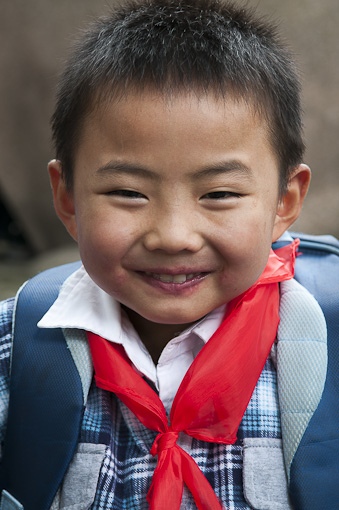
Wearing the red scarf uniform, a member of the Young Pioneers is curious about my 
cameras in Wenhua Park, Chengdu, China.

To see more photography from China, please visit my Miami editorial photography portfolio site.

Thursday, August 9, 2012

Sounds Overheard: Seeing Tibet With Closed Eyes

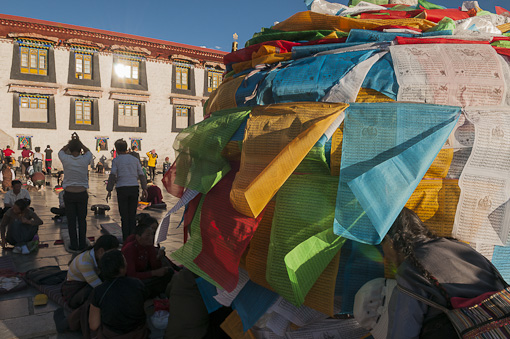
Pilgrims worship at the Jokhang Temple, Tibetan Buddhism's holiest site.

Exploring Lhasa on my first day in Tibet was so overwhelming that I was having trouble seeing photographs. Crowds of Buddhist pilgrims dressed in regional costumes streamed down every street, Han Chinese merchants in Barkhor Square sold everything from prayer wheels to yak butter and the occupying Chinese army marched with assault rifles at the ready.

I was gasping in the thin air at 12,000 feet altitude. My stomach was deciding if it liked my yak stew lunch. Colors were way to saturated, the blue sky, the monk’s saffron robes and the rooftop golden lambs.

So I closed my eyes and started listening for pictures.


Close your eyes, listen to the sounds around the Jokhang Temple in Lhasa, and tell me what you see. iPhone & iPad link to 1:48 long MP3.

The first sound I heard was a far off rhythmic slapping and chanting.  I discovered over a dozen workers, men and women, building a traditional aga earthen roof atop the Jokhang Temple. They were on their hands and knees with hand held wooden paddles compacting the mix of gravel, dirt and water infused with willow tree bark.

I recorded the sound of wooden and leather hand protectors scraping on the cobble stone temple square as the pilgrims prostrated them selves in repetitive prayer. They stood with their hands together above their heads, then down on their knees, then on their stomachs with arms out stretched.

My ears discovered a man singing prayers from a well worn book of Tibetan script, his voice competing with the thousands of pilgrims circumambulating the mile-long circuit around the temple.

Slowly the sounds awakened the visual corners of my brain, I opened my eyes  and began making photographs.

Editors note: If you visit the "aga earthen roof" link above, poke around the site a little and see how the Chinese government views the Tibetan people.

During my assignments and travels I've been recording the sounds I overhear, and many don't have supporting photographs or stories. This occasional series will be my excuse to share my audio orphans, these Sounds Overheard. Please also visit my Miami editorial photographer portfolio.

Thursday, June 7, 2012

Seat Of Your Pants Location Lighting

Lighting environmental portraits on location is always challenging for me. I have to find and light a great composition, coax compelling expressions from my subjects and tell my magazine’s story, all as quickly as possible.  For a while I just plain go nuts with all the moving parts of the photograph tugging for my attention. But once I start flying by the seat of my pants, I’m able to relax and my image comes to life.

Lighting formulas usually don’t work for me. The physical layout of locations vary, every portrait subject is different, and, well, I never learned many formulas while earning my BS in Electrical Engineering. I meet the subject, recall the art director’s brief and adapt the basic lighting gear I own to tell my story.
 
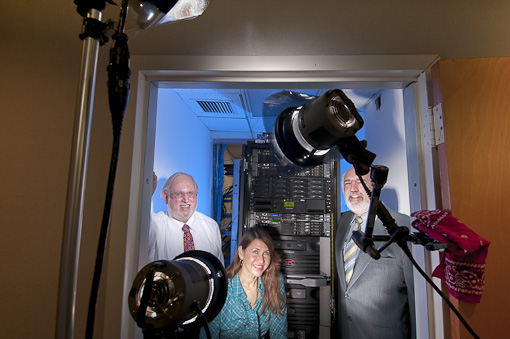
Posed in a closet with computer are Goldstein Schechter Kock's, from left, Zvi Gold, Amelia Regalado and Alan Kirzner. Three grid spots for faces, forth spot on floor lights computer, a bare tube with blue jell behind rack is light number five. 

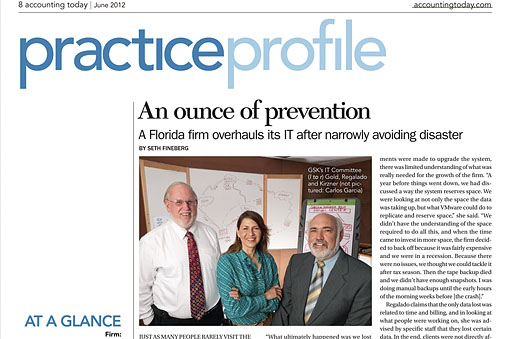
In May I flew by the seat of my pants on an assignment for Source Media's Accounting Today. I was tasked with creating two environmental portraits of three accounting firm principals, one with a tech theme for the tabloid style cover, one for the inside profile. The partners were only available at 10 AM, and the very earliest I could get into their offices was 830 AM. An hour and a half for two portraits, for me, is tight, especially without scouting ahead of time.

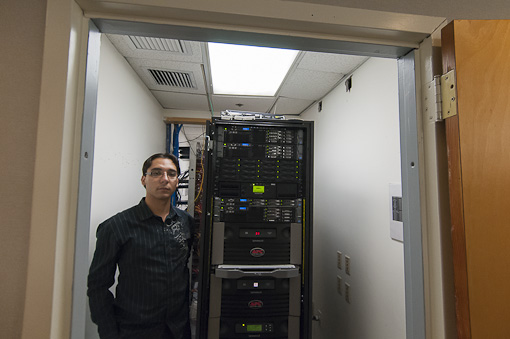
Assistant Jonathan Rios with computer and closet before we began setting lights.

I began my going nuts phase when I decided the best idea available would be to cram three adults into the former coat closet that now housed their computer server. Arghhh, what have I got myself into, I wondered. We quickly set up,  jammed, really, three grid spots into the doorway, one clamped onto the door with a magic arm and super clamp, with a small spot open for me to insert my 18mm wide angle lens. A forth grid was mounted on the floor facing up to catch the equipment, and flash number five, a bare pencil light with blue jell, went into the back of the closet.
I barely had room to insert my camera between two light stands and super clamp plus magic arm attached to open closet door.

With two power packs and five flash heads spoken for, I only had one pack and two heads left to light the secondary portrait. I popped open a  60 inch soft box over my shoulder to light the thee subjects, dragged the shutter to bring in the window light. But how was I going to light the the background white boards and wall with my one remaining light?  Arghhh. 
Paper sheets torn from presentation easel become my background light. 
I grabbed several sheets of the presentation paper off it’s easel, laid them on the carpet, and pointed my last flash head directly down at them, bouncing a broad and soft light onto my background. A quick chimp at the histogram, and I was good to go.

Were my solutions contest winners or fine art? No. But flying by the seat of my pants allowed me to adapt to difficult locations and pull of another successful assignment.


To see more environmental portraits visit my Miami commercial photography portfolio site.

Friday, May 18, 2012

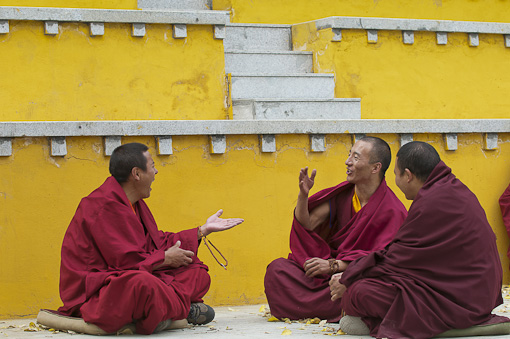
Sounds Overheard: Tibetan Monks' Spirited Debate

Spirited debate between Tibetan Buddhist monks at the Drigung Thel Monastery, Lhasa.

While traveling in Tibet last October, Tibetan Buddhist monasteries were not only locations to create some great photographs, but were also sources of terrific natural sound.

Today's post is short and sweet, three photos of debating monks from three monasteries, and a short recording of natural sound from one of them.

Listen to this 1:13 field-recorded natural sound of Tibetan Buddhist monks debating at the Sera Monastery.  iPhone & iPad friendly version.


Monk debates at the Sera Monastery, Lhasa.

From an earlier post on this blog, a little background on the debates:
Debate is an important part of a Tibetan monk's training, and is said to help expand the mind, increase mental sharpness, develop analytical skills and help gain mental clarity. The debates follow a strict form, with the standing questioner challenging the thesis of the humbly sitting defender. As the questioner raises doubts, the exchange becomes increasingly animated, with exaggerated body language, lunging, hand slapping and loud shouting. The defender mostly sits quietly and looks away, occasionally making a counter point by waving his arm.
As one monk, left, encourages the defender, right, the challenger, center, claps and lunges to make his point at the Reting Monastery.

During my assignments and travels I've been recording the sounds I overhear, and many don't have supporting photographs or stories. This occasional series will be my excuse to share my audio orphans, these Sounds Overheard. Please also visit my Miami commercial photography portfolio.

Monday, April 30, 2012

Magic Dust Not Just For Professional Photographers

This week I'm giving two presentations about photography and multimedia production to advancement and marketing professionals representing educational institutions from around the USA. As most of them will be executives with basic hand's on experience shooting or working with multimedia, I hope to help them improve their own skills, and learn when to call in a pro.

The idea for the Multimedia For Small Shops workshop in Naples, FL, April 30 and May 1, is that with today's digital cameras and recorders, and with the development of user friendly video and audio editing software, successfully multimedia can be created by non-specialists. Not every piece for social media outlets needs to have top production values as long a a good story is told.

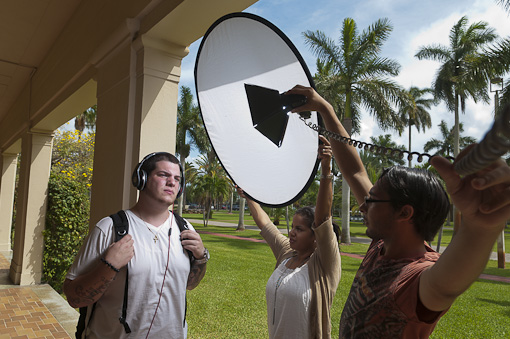
Photography 101 will contain samples shot for the presentation at Miami's Barry University. Thanks to subject and assistant Silvia Arbelaez

My audience will be members of CASE, an international association of educational institutions:
The Council for Advancement and Support of Education is a professional association serving educational institutions and the advancement professionals who work on their behalf in alumni relations, communications, development, marketing and allied areas. CASE helps its members build stronger relationships with their alumni and donors, raise funds for campus projects, produce recruitment materials, market their institutions to prospective students, diversify the profession, and foster public support of education.

My first talk will be Photography 101 where I will be presenting tips on how non- professional photographers can improve their photography and how to recognize good photography they may be commissioning by others. I'll cover the basics, such as treat your viewfinder as you canvas, the rule of thirds, change your perspective, be aware of light and show a sense of place.

I also want attendees to not worry about being laymen taking photographs:

The most important tip I can give you is, use your eyes to carefully observe your world. Then apply your unique life experiences - who you are, what you’re curious about - to how you want to capture your photographs.  You get to choose the story you want to tell. Use the skills you possess to capture the scene in front of you.

It’s all about how you use the building blocks of good photography - composition, moment, light - not the latest giga megapixel camera, carbon fiber tripod nor trendy software technique. It’s your “eye” or “vision” that makes you a great story telling photographer.
 Successful photography also relies on your people skills, patience, insight and resourcefulness, all skills you already have.
Yes, the professional photographer has mastered a lot of craft, the nuts and bolts of f-stops and lighting ratios, and this mumbo jumbo can help them pull off very demanding shots. But what makes a professional photographer unique you can have too, your own magic dust: your ability to see and tell a story. Pick up a camera and get out and create come photographs!


Basic off camera flash demo shot for Photography 101 presentation. Thank you assistant Jonathan Rios, far right.

I will segue to when you should call in a professional photographer, how to find one and evaluate if their skills matches your project, and what a commissioning party should think about before they call. I'll cover how a photographer will describe the shoot's treatment, and how creative fees and expenses can be discussed. I'll also discuss how photographs are licensed and how licensing protects the client and accommodates value.

I recommend down loading the PDF file for Photography 101 (link at bottom), as it contains extensive resources of how to work with a professional photographer, and has web links to several colleagues who have graciously allowed me to refer to their work, and to the American Society of Media Photographers.

Specifically:
  • 10 reasons to hirer a professional photographer P 19
  • How to find a  photographer P 21
  • How to evaluate a photographer P 22
  • Stuff to think about when you want a quote P 24, 25
  • How a photographer will present an assignment estimate p 26
  • Why license photography P 29
I will write about the second CASE presentation, Audio Photography,  in another post.

CASE attendees PDF downloads:

Friday, March 30, 2012

Video Stories With Vision & Collaboration

As a group still photographers are creative, independent and stubborn as we’ve relied primarily on ourselves in pulling successful photos from challenging assignments while at the same time embracing the digital information age.  But as we’re being asked to add video to our story telling tool set, we’re being forced to - gasp - learn new skills and - double gasp - collaborate with others.


Four still photographers collaborated in producing a web video promoting Nancy Brown’s photography book “Simply China”. Paul Morris with video, lighting and studio space. Tom Salyer recorded sound and edited. Jonathan Rios as production assistant. Nancy Brown, on camera talent and stills. http://vimeo.com/39290394

On my section of the long tail of photography the four-year economic crisis has reduced my assignment budgets to hiring an assistant to very rare. I’m producing my shoots, setting up my lights and processing my own files. That’s were stubbornness comes in for us, we can do it ourselves doggone it.

I’ve heard wondrous stories of colleagues working on high budget advertising shoots with a producer, hair and makeup, assistants and digital tech. And a lunch budget, oh my! 

OK, I agree, the idea of every photographer being a lone wolf working completely on their own is not completely accurate, at least in the commercial photography field. We all have colleagues we can call for advise and insight with projects, our art directors give us direction, and most still shoots are not overly complicated.

Working either on our own or with a small crew, our independence drives our ability to visualize our images in advance and make them happen. Our “eye” is our strongest asset, and can be transferred to another medium.

By comparison, with motion projects the nuts and bolts of producing technically successful video is very complex and has a steep learning curve. You thought learning about color spaces and layer masks were hard? Try mastering Final Cut Pro, motion graphics and compression codices.

Video requires many jobs: director, producer, director of photography, camera operator, lighting grip, sound recordist, and editor. On simpler shoots a person can handle multiple jobs, but there are to many moving parts for one transitioning still photographer to handle them all. The story line will be jumbled, the picture overexposed, the sound levels low.


NFL St. Louis Rams head coach Jeff Fisher is interviewed last weekend by Paul Morris, far left, and Orlando Noah, left center, at The Breakers, Palm Beach, FL. Photo by Tom Salyer.

Photographers need to collaborate with the people who already have these skills, and our unique vision is the key to success. We already approach image making with our life time of experience as visual story tellers. We already know how to compose a great image, capture a decisive moment, and creative lighting is a piece of cake.

Clients are beginning to come to still photographers asking to add on motion for web sites and social media because they trust their eye and ability to successfully complete jobs. Don't worry big video production companies, most of us aren't competing with you. Yet.

Examples:

- Minneapolis based Ryan Siemers has been expanding his architectural photography business by adding motion, interviews and animations.

- Jeffery Salter, a Miami portrait and fine art photographer, collaborated with videographers on stories for Readers Digest: Richard Patterson on former football player Keith Fitzhugh, and with Chuck Fadely on long distance swimmer Diane Nyad.

- Miami commercial photographer Paul Morris has added video to two still photography assignments in the past months: executive interviews for farm equipment trade association American Equipment Manufacturers, and National Football League head coaches for New Era head wear suppler. I was sound recordist on both, and Orlando Noah and Meine Smith of Digital Decaf provided video and digital services on the latter.

Please see example of my Miami multimedia photography portfolio.